Haplogroup J2a1a1a2a2b2d1

– 5 min read


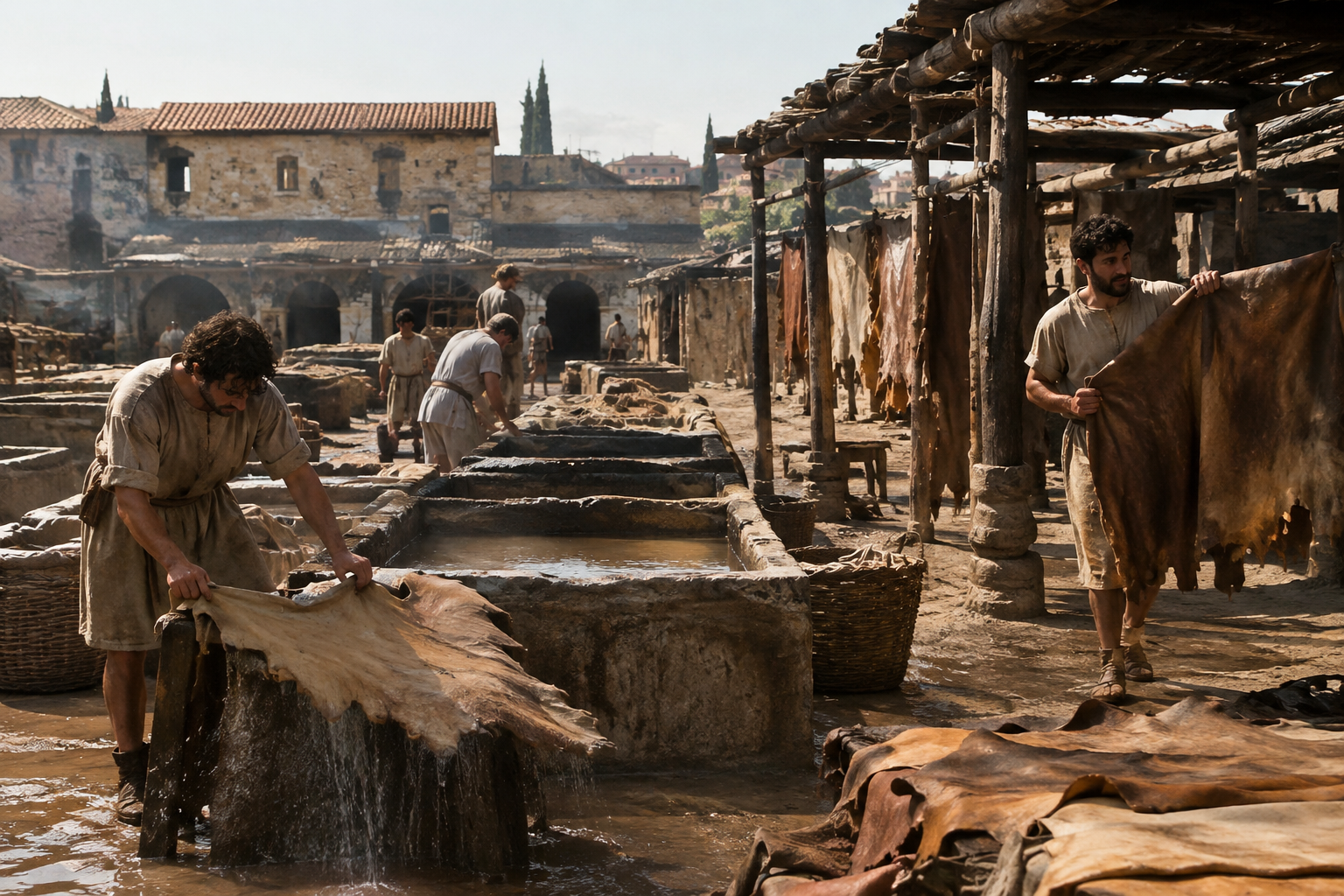
At Casal Bertone in imperial Rome, archaeologists were not excavating a senator's villa or a marble monument. They were working in a gritty industrial quarter on the eastern side of the city, an area associated with production and labor, including the tannery complex that gave one part of the site its name. From this setting comes ancient individual T21, dated to around AD 100, a man linked in MyTrueAncestry's reporting to the Y-DNA haplogroup J2a1a1a2a2b2d1.
That combination of place, period, and paternal lineage is what makes T21 so interesting. J2 is a broad Y-chromosome family with deep roots in the eastern Mediterranean and western Asia, but J2a1a1a2a2b2d1 is a far narrower branch. Y-DNA traces one direct male line only, not a person's whole ancestry, yet even that single line can be historically revealing when it turns up in the middle of Rome's working landscape. It reminds us that the imperial capital was not merely a city of emperors and temples. It was also a city of migrants, craftsmen, laborers, and families whose paternal histories had traveled long before they reached the banks of the Tiber.
Casal Bertone has become important because it offers a view of Rome from below rather than from above. Instead of asking only who ruled the empire, the site asks who made urban life possible: the people working amid furnaces, workshops, processing areas, and the less glamorous infrastructure of a vast metropolis. T21 belongs to that world.
In historical terms, around AD 100 is the age of Trajan, when Rome stood at the center of a huge imperial system stretching from Britain to the Near East and North Africa. By then, movement into the city had been going on for centuries. Some arrivals came as soldiers, merchants, enslaved people, freed families, artisans, administrators, and dockside workers. Others were children or grandchildren of migrants already absorbed into the city's neighborhoods. A paternal lineage such as J2a1a1a2a2b2d1 fits comfortably within that wider Roman reality: not as proof of one specific homeland, but as evidence that the male lines present in imperial Rome could be strikingly diverse.
An ancient DNA study examining burials from imperial Roman contexts has helped sharpen this broader picture of urban diversity, including the complicated mixture of local continuity and long-distance ancestry that characterized the city and its hinterland. One research point of entry is this published study of ancient genomes from Roman-period contexts, which sits behind the growing realization that the empire's capital was a demographic magnet as well as a political one.
Roman Italy and Ancient Amiternum
The temptation with a very specific haplogroup is to treat it like a complete biography. It is not. J2a1a1a2a2b2d1 is a fine-grained branch inside the larger J2a family, and J2a as a whole has long been associated in genetic studies with populations around the eastern Mediterranean, Anatolia, the Caucasus, and parts of the Near East. But that broad background should not be collapsed into a neat story for one Roman man.
What we can say more safely is that a branch of this wider paternal family was present in imperial Rome by the early second century AD, and specifically present not in an abstract "Roman population" but in a documented burial from Casal Bertone's industrial zone. That matters. Archaeology is always better when it sticks to the ground it is standing on, and here the ground is a working district of a cosmopolitan capital.
This is also why a lineage like J2a1a1a2a2b2d1 feels so Roman in the historical sense. Rome did not simply conquer other peoples and leave them where they were. It pulled them into military service, trade circuits, urban economies, marriage networks, slavery, manumission, and neighborhood life. A paternal line with eastern Mediterranean associations turning up in an imperial cemetery is not an anomaly needing melodrama. It is exactly the sort of thing one might expect in a city that was forever importing people along with grain, oil, marble, ideas, and gods.
There is another reason T21 deserves attention. Sites like Casal Bertone stop us from imagining ancient DNA only in palaces, elite mausolea, or battlefield burials. Ordinary urban cemeteries may look less glamorous, but they tell us more about how empires actually worked. A tannery district was not a footnote to Rome; it was part of the machinery that clothed, equipped, and sustained a city of enormous scale.
So when a paternal lineage such as J2a1a1a2a2b2d1 appears there, the real historical question is not "Which famous dynasty did he belong to?" but "How did such lineages become woven into everyday Roman society?" The answer is almost certainly through the routine movements of empire: relocation, labor, commerce, military supply, freed communities, and urban settlement over generations.
That pattern also helps explain why Roman-period genetics so often refuses simple ethnic labels. The people buried in and around imperial cities were not tidy representatives of single tribes or homelands. They were city-dwellers whose ancestors may have come from several directions before them. The paternal line is just one thread, but it is still a thread worth following.
If we step back from T21 without wandering into fantasy, a broader setting comes into focus. Haplogroup J2 and especially its J2a branches are often discussed in connection with the long history of the Mediterranean and Near Eastern world: farming dispersals, Bronze Age exchange, Greek and Phoenician seafaring, Hellenistic mobility, and later the connective tissue of the Roman Empire. None of those processes can be assigned wholesale to J2a1a1a2a2b2d1 itself, but they help explain why related paternal lines are unsurprising in Roman contexts.
Rome sat at the receiving end of many of these older currents. By the imperial period, it had become a place where lineages from Italy, the Balkans, North Africa, the Levant, Anatolia, and farther afield could coexist within the same city. The remarkable thing is not that this happened, but that ancient DNA now lets us see it at the level of individual burials rather than just imagining it from texts.
For readers interested in how Roman rule could leave lasting biological traces well beyond Italy, the Iberian evidence makes an illuminating comparison. The spread of imperial institutions often went hand in hand with the movement of people, though never in a simple one-way fashion.
Roman Hispania's Genetic Legacy
T21 does not give us a grand family tree, and he does not need to. His importance lies in scale. Ancient history is often narrated through emperors and generals, but populations are built from individuals like this man at Casal Bertone: someone buried in the orbit of labor, industry, and the dense human traffic of imperial Rome.
For a modern tester whose paternal line falls under J2a1a1a2a2b2d1, that is the valuable connection. Not a promise of direct descent from one excavated Roman, and not a shortcut to ethnicity, but a concrete sign that this branch was already present in the lived social world of the early empire. It places your direct male line, at least at one point in its long history, within the same Mediterranean web of movement and settlement that made Rome the most connected city of its age.
That is, in its own sober way, rather thrilling: not a legend about origins, but a documented glimpse of your haplogroup in the middle of an ancient working city.






Comments