Haplogroup J2a1a1a2a2b2a

– 5 min read


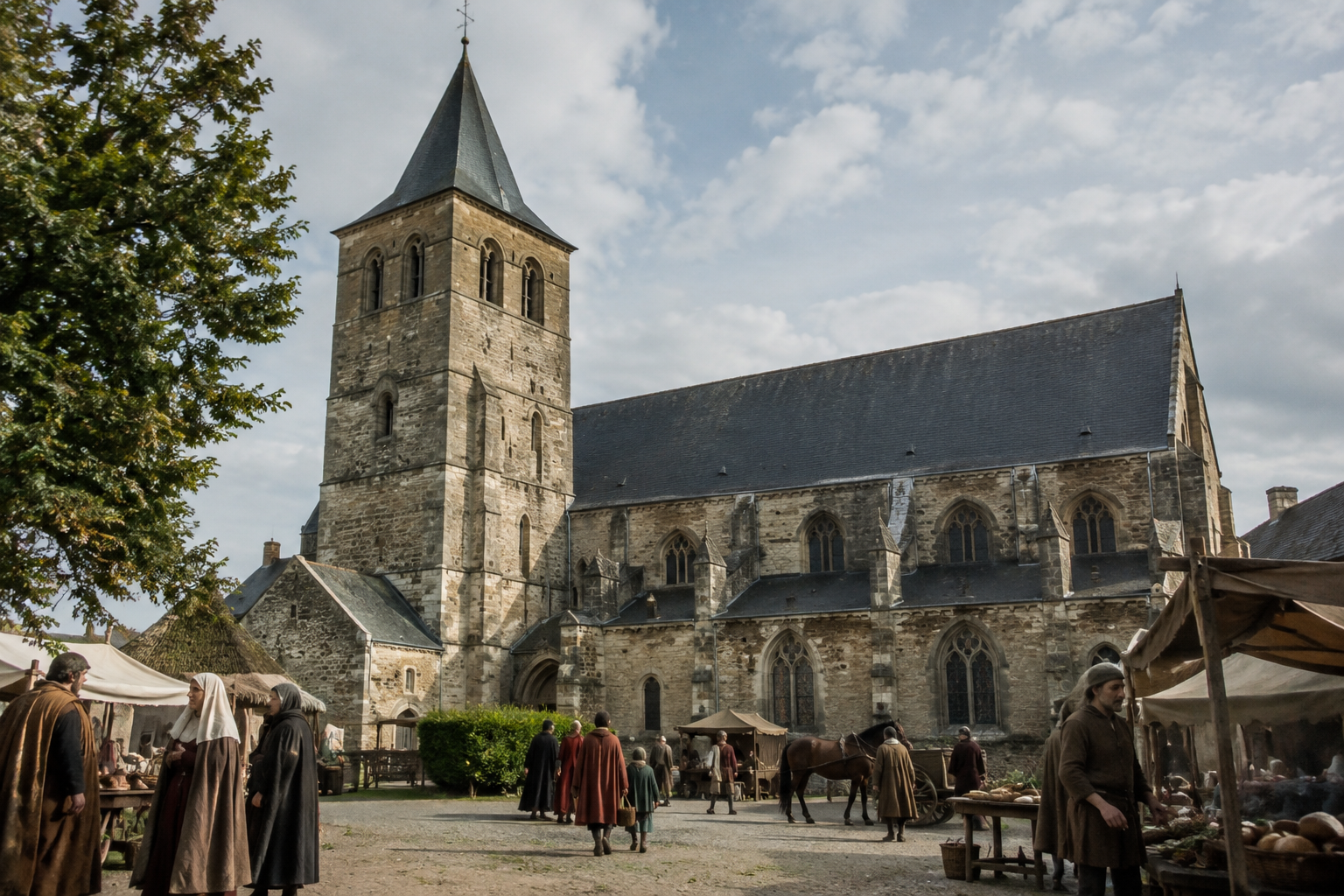
In about AD 900, a man identified as ST3041 was buried at Sint-Truiden's Onze-Lieve-Vrouwekerk in what is now Belgium. On paper, that sounds modest enough: one medieval individual, one church site, one date. But ancient DNA has a way of making even a single grave unexpectedly illuminating, and in this case the paternal line associated with him is the very specific Y-DNA branch J2a1a1a2a2b2a.
That matters because Sint-Truiden sat in a part of medieval northwestern Europe that was anything but isolated. It was a religious center, a settlement shaped by the post-Roman world, and part of a landscape tied into trade, pilgrimage, lordship, and movement across the Meuse and Rhine zones. A narrow paternal lineage like J2a1a1a2a2b2a does not tell us everything about ST3041's ancestry, social identity, or language, but it does offer one sharply focused line of descent within a much larger human story.
Sint-Truiden is not famous in the popular imagination in the way of Rome or Sutton Hoo, yet that is precisely why it is useful. Places like this show how medieval Europe was built in practice: not only by kings and battles, but by church communities, market towns, burial grounds, and ordinary generations living through the long centuries after the Roman Empire's western political collapse.
The site of Onze-Lieve-Vrouwekerk belongs to that world. By around AD 900, this was a Christian community in a region where older Roman structures, Frankish power, and local mobility had all left their mark. Ancient DNA from such burials helps us test an old habit in history writing: the tendency to imagine neat, bounded populations where the evidence increasingly suggests mixture, continuity, and movement.
A recent genetic study focused on medieval Sint-Truiden explores exactly that broader setting of urbanization and population structure in the town's past, and it is the key research context for ST3041's appearance in this lineage discussion: aDNA research on medieval Sint-Truiden. Even without pretending that one paper or one grave can solve the whole history of the region, this kind of work is invaluable because it places named individuals back into their archaeological landscape.
The first thing to say is that J2a1a1a2a2b2a is a highly specific branch nested inside the broader Y-haplogroup J2a. In archaeogenetics, that distinction is crucial. The wider J2a family has a long and complicated history in western Eurasia, often turning up in discussions of the eastern Mediterranean, Anatolia, the Caucasus, and later movements across Europe. But it would be careless to paste the full grand history of J2a directly onto this one narrow subclade without direct evidence.
What Y-DNA does trace is a direct paternal line: father to son to son over many generations. That is powerful, but it is also narrow. ST3041 may have carried a paternal branch ultimately linked to deeper networks extending far beyond medieval Belgium, while his overall ancestry, upbringing, community ties, and daily life were overwhelmingly local to the early medieval Low Countries.
That is one of the most useful correctives produced by ancient DNA. Medieval people were not reducible to a single line on a phylogenetic tree, yet those lines can reveal how older population histories remained present in places where later historians once expected cleaner ethnic categories.
If readers are surprised to see a J2-derived paternal line in medieval Belgium, the surprise says as much about modern assumptions as about the past. Northwestern Europe by AD 900 was already the product of many centuries of contact. Roman military recruitment, trade, clerical travel, marriage patterns, and post-Roman population reshuffling all contributed to the human landscape of the region.
The Low Countries were especially well placed for this. They lay near the old Roman frontier, linked river systems, and routes joining the North Sea world to inland Europe. By the Carolingian and post-Carolingian periods, communities here were not sealed ethnic capsules. A lineage with deeper roots further southeast in Eurasia could easily have entered the region generations earlier and then simply become part of the local medieval population.
That broader pattern fits what many ancient-DNA studies are finding across Europe: local continuity often exists alongside smaller but real signals of long-distance ancestry and male-line diversity. It is one reason sweeping labels such as "Frankish," "Germanic," or "Roman" need handling with care. They may describe political or cultural worlds, but they do not map neatly onto a single Y chromosome.
A church burial like the one at Onze-Lieve-Vrouwekerk also reminds us that by the 9th and 10th centuries, Christianity had reorganized much of the social geography of burial in this part of Europe. People were increasingly buried in places tied to ecclesiastical institutions, and those institutions themselves stood at the center of economic and social life. Monasteries, churches, and associated settlements drew in people from surrounding countryside and beyond.
So ST3041 is best understood not as an isolated genetic curiosity, but as part of a town-forming world. Sint-Truiden grew within the dense historical mesh of abbey influence, agricultural hinterlands, and regional exchange. When a paternal branch like J2a1a1a2a2b2a appears there, the interesting question is not whether it "belongs" in Belgium, but how many such lineages were already woven into medieval communities long before modern nationalism taught us to expect sharper boundaries.
This is where archaeology and genetics work best together. The archaeology gives us the burial ground, the settlement context, the institutional setting of the church, and the chronology. The genetics adds another layer: a reminder that the making of medieval towns involved not only local reproduction but also the accumulation of older, sometimes far-travelled family histories.
One tempting mistake with a lineage like this is to invent a dramatic migration story for one man. There is no need. The real history is already interesting enough. Over the centuries before ST3041 was buried, northwestern Europe had absorbed soldiers, merchants, craftspeople, clerics, settlers, and spouses from many directions. Some arrived in the Roman period, some in late antiquity, some in the early Middle Ages, and some likely moved only short distances within already mixed regions.
Ancient genomics has been steadily dismantling the old cartoon version of Europe's past in which one "people" cleanly replaced another and each region had a single ancestral signature. For readers interested in how language spread and populations mixed in early medieval northern Europe, this broader interpretive frame is useful background rather than proof of ST3041's exact biography.
Germanic Languages and Genomics
The same caution applies in reverse. A man carrying J2a1a1a2a2b2a in medieval Belgium does not mean a recent arrival from the Mediterranean or Near East. His paternal line may have been in northwestern Europe for many centuries by the time he was buried. Genetic lineages often outlast the historical labels we put around them.
The value of ST3041 is not that he founds a dynasty or solves a famous pedigree. It is that he anchors the branch J2a1a1a2a2b2a in a real early medieval burial from Sint-Truiden around AD 900, inside a documented churchyard and a rapidly changing European society. That gives the lineage a concrete archaeological foothold in the medieval Low Countries.
For someone researching this paternal branch today, the responsible takeaway is simple and rather exciting: your direct male line belongs to a family of lineages with a long western Eurasian history, and at least one associated ancient example places that line within a Christian community in medieval Belgium. Not a mythic tribe, not a romantic saga, but a man in a town, in a church burial ground, in the complicated world that became Europe.






Comments