Haplogroup J2a1a1a2a2b

– 5 min read


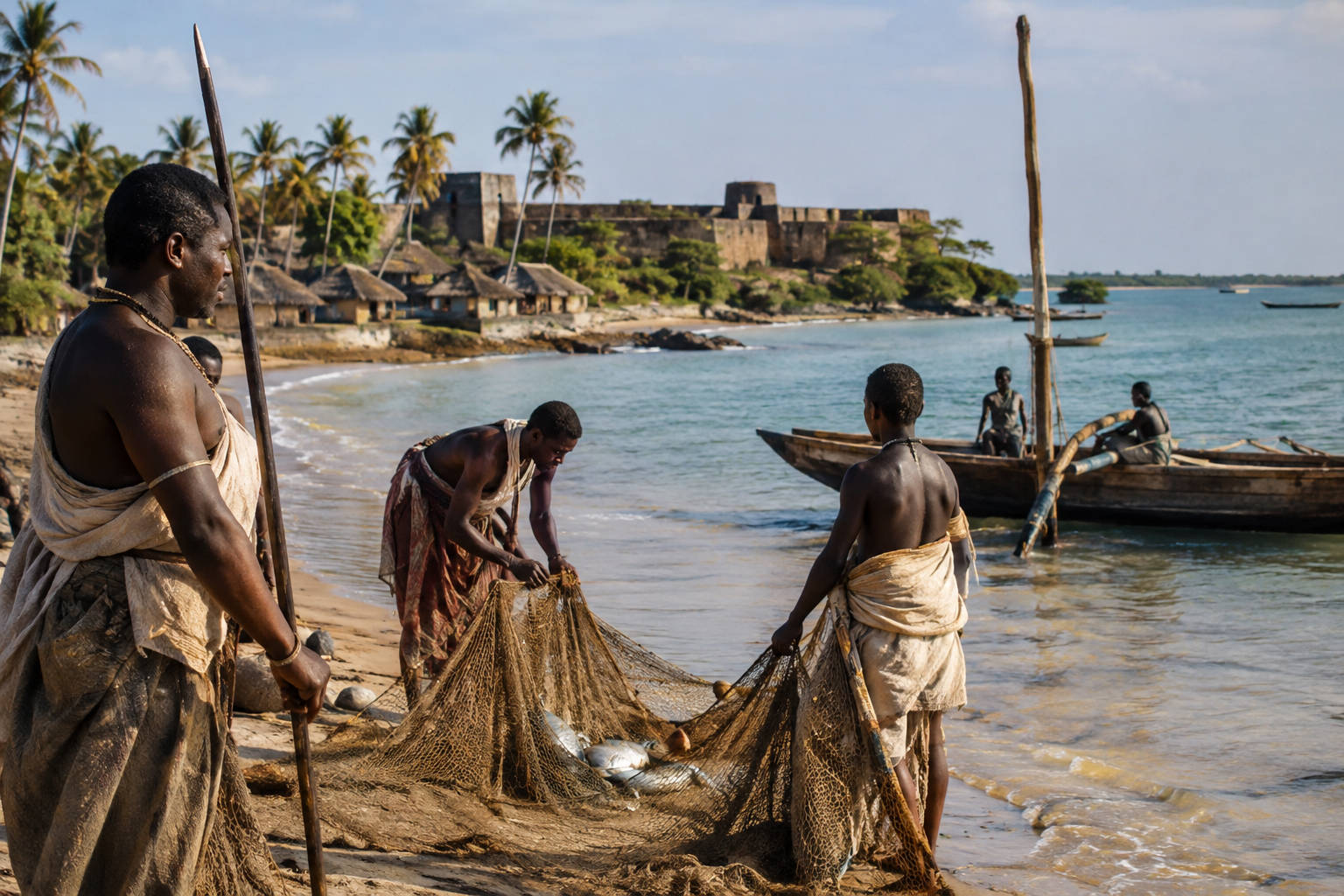
At Mtwapa on the Kenyan coast, one medieval man has quietly become a striking witness to Indian Ocean history. Identified as I23662 and dated to around AD 1600, he comes from a Swahili town that stood inside one of the busiest maritime worlds on earth. His reported Y-DNA association with J2a1a1a2a2b matters not because a single burial can explain a whole people, but because it places a very specific paternal line inside a port society built on trade, religion, language, and movement.
This is also a useful reminder of what Y-DNA can and cannot do. It traces one direct paternal line only, not a person's total ancestry. Yet in a place like Mtwapa, where merchants, sailors, craftsmen, religious scholars, and local families met across generations, even one paternal lineage can open a window onto the larger historical machinery of the Swahili coast.
Mtwapa flourished on the East African coast in the late medieval and early modern period, in a region tied into the wider Swahili world from southern Somalia to Mozambique. These towns were never sealed-off settlements. They were urban communities linked by Islam, commerce, coral-built architecture, and seaborne contact with Arabia, Persia, India, and, increasingly by the 16th century, the Portuguese presence in the western Indian Ocean.
That setting is the key to understanding why a lineage like J2a1a1a2a2b is historically interesting here. The broader parent haplogroup J2 is often associated in ancient DNA and modern populations with parts of the Near East, eastern Mediterranean, and adjoining regions, but one must be careful: that broad pattern does not automatically tell us the exact route by which this narrower branch reached coastal Kenya. What the Mtwapa burial shows, securely enough, is that such a paternal line was present in a Swahili coastal community by about AD 1600.
An ancient DNA study examining medieval and early modern individuals from coastal eastern Africa has helped bring precisely this sort of evidence into view, turning long-discussed questions about Swahili origins and overseas contact into something more concrete at the level of excavated human remains. The relevant research can be found here: https://www.biorxiv.org/content/10.1101/2022.07.10.499442v1.
J2a1a1a2a2b is a very narrow branch inside a much larger Y-chromosome family tree. That distinction is more than technical. Broad haplogroups can spread over huge regions and many centuries, while a fine-grained subclade may reflect a much more specific male-line history that is still poorly mapped in ancient remains.
With this article's evidence, caution is essential. We have one ancient individual from Mtwapa linked to this branch, but not a chain of earlier samples tracing it step by step down the East African coast. So the responsible historical reading is modest and interesting at the same time: by the early modern period, this paternal line was part of the human landscape of a Swahili town whose population had been shaped by both local continuity and long-distance exchange.
That point fits well with what archaeology has been telling us for years. Swahili society was neither a simple transplant from overseas nor an untouched local isolate. It was a coastal civilization of African towns deeply engaged with the Indian Ocean, and lineages like this one are exactly the sort of evidence that help us see those entanglements at the level of families and male descent.
There is a temptation, when faced with a single Y-DNA result, to rush off in search of a dramatic origin story. Better to stay with the archaeology. Mtwapa itself is the story: a town on the coast of Kenya at a moment when the Indian Ocean connected East Africa to southern Arabia, the Persian Gulf, western India, and beyond. A paternal line associated with J2a1a1a2a2b in this context is not an isolated curiosity. It is exactly the kind of finding one might expect in a port society where men, marriages, and mercantile networks moved across the sea.
But expectation is not proof of any one route. This man may represent recent ancestry from across the ocean, older admixture already absorbed into local coastal society, or a lineage that had circulated around the western Indian Ocean for generations before his lifetime. The burial does not let us choose neatly among those possibilities. What it does allow us to say is that by about AD 1600, this branch belonged to the lived population of coastal Kenya.
That matters because older written arguments about the Swahili sometimes tried to force a choice between "African" and "foreign" origins, as if coastal history had to be one or the other. Ancient DNA, used carefully, makes that opposition look rather clumsy. The Swahili coast was African and cosmopolitan at the same time.
By AD 1600, Mtwapa stood in a world already centuries old. Seasonal monsoon navigation had long tied East Africa into commercial circuits carrying cloth, beads, ceramics, metals, timber, ivory, and enslaved people. Islam had taken root in many coastal towns, and identities on the coast were shaped in conversation with inland African communities as well as overseas partners.
In that setting, Y-chromosome diversity is historically unsurprising. Male-biased movement is a common feature of maritime exchange systems, whether through trade, settlement, religious learning, soldiering, or marriage alliances. A lineage such as J2a1a1a2a2b appearing in Mtwapa therefore sits comfortably within a broader pattern of contact across the western Indian Ocean, even if this one burial cannot specify whether its more immediate paternal ancestors came from Arabia, Persia, South Asia, or another already-mixed coastal population.
This is where genetics is most useful when it behaves itself. It does not replace archaeology or history; it sharpens them. Instead of repeating old myths about pure origins, it lets us see how urban coastal societies accumulated people and lineages over time, often in ways that written traditions only partly preserve.
Mtwapa is not historically unique in showing how burial populations can carry evidence of varied ancestry and far-reaching contact. Other ancient DNA studies from later urban and post-Roman settings have likewise revealed that ports, frontier towns, and politically connected settlements often gathered people of diverse backgrounds into the same cemeteries. The exact histories differ, of course, but the method has transformed the question: instead of guessing from pottery styles or architecture alone, we can sometimes see mobility written into the genomes of excavated individuals.
For that reason, the Mtwapa man with haplogroup J2a1a1a2a2b is best understood not as an exotic exception but as part of a recognisable historical phenomenon. Connected places attract connected pedigrees. Coastal East Africa, like Roman border communities or medieval island entrepots, was made by movement as much as by locality.
Medieval Sicily's Mixed Populations
If your paternal line falls under J2a1a1a2a2b, the clearest lesson from the ancient evidence so far is not a grand claim about one kingdom or one ethnicity. It is something more historically believable: this lineage appears in a man from medieval coastal Kenya, in a Swahili setting shaped by African roots and Indian Ocean connections. That places the branch, at least in one documented case, within a vividly cosmopolitan world.
For family historians, that is a good sort of clue. It suggests that the deeper history of this paternal line may be bound up with the eastern Mediterranean, Near Eastern, Arabian, Persian Gulf, or Indian Ocean spheres of movement that fed into the Swahili coast over many centuries. As more ancient DNA is published, the path of this narrow branch will almost certainly become clearer. For now, Mtwapa gives it a real historical address: not an abstract map pin, but a coastal town where the sea brought worlds together.






Comments