Haplogroup J1a2a1b1a1
– 5 min read


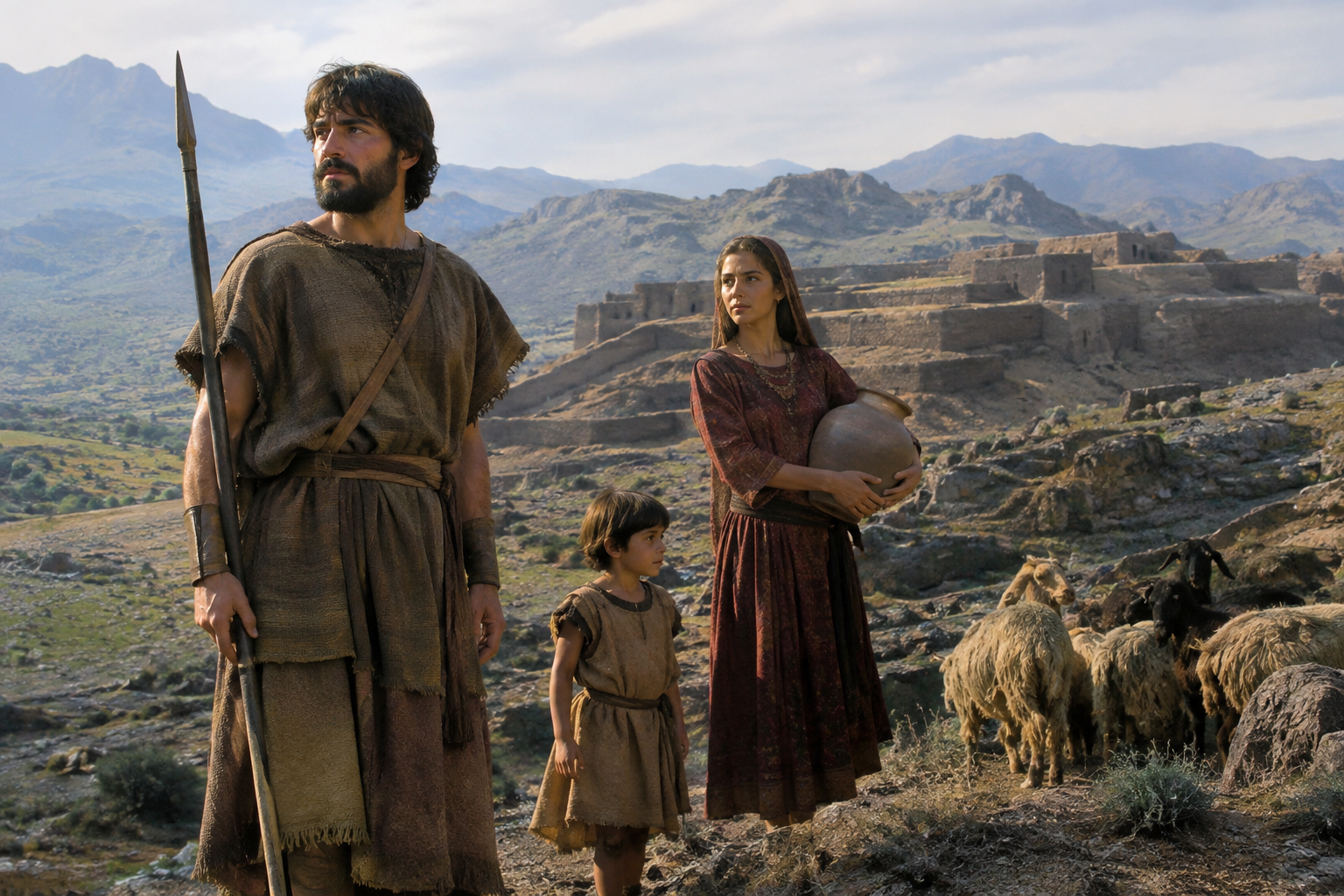
At Hasanlu in northwestern Iran, archaeologists uncovered the remains of a violently destroyed Iron Age town, sealed by catastrophe and preserved with unusual clarity. Among the ancient individuals recovered there is sample I4097, dated here to around 1350 BC, and associated with the Y-DNA haplogroup J1a2a1b1a1. That makes him a particularly interesting anchor for this lineage: not a vague modern distribution map, but a man from a real place, in a real settlement, at the edge of the ancient Near Eastern world where highland Iran, Mesopotamia, Anatolia, and the Caucasus all met.
For anyone exploring this paternal branch, that is the important starting point. Y-DNA follows one direct male line only, not a person's whole ancestry, but it can still illuminate historical settings in which that line appears. In the case of J1a2a1b1a1, the clearest evidence here points not to legend or later pedigree, but to an Iron Age community in the Iranian plateau's northwestern zone.
Hasanlu is one of those archaeological sites that repeatedly forces historians to slow down and be precise. It sits in the Solduz Valley near Lake Urmia, a region that was never culturally isolated. In the Late Bronze and Iron Age it belonged to a corridor of movement and exchange linking the Zagros, the South Caucasus, eastern Anatolia, and Mesopotamia. That matters because a Y-chromosome lineage found here belongs first to this local and regional history, not to some simplified story about a single people spreading in a single direction.
Sample I4097 is therefore most useful when placed inside that frontier landscape. Northwestern Iran in the second millennium BC was shaped by shifting local polities, long-distance trade, and contact with larger states beyond the highlands. A paternal lineage found at Hasanlu may reflect continuity from earlier regional populations, movement across neighboring mountain and lowland zones, or the ordinary social mixing one expects in a settlement tied into wider networks.
A genetic study of ancient populations from the broader region, published in Science, helped place ancient Iranian and neighboring communities into a much larger map of West Eurasian population history. Even without forcing the evidence too far, Hasanlu stands out as exactly the kind of site where paternal lineages such as J1a2a1b1a1 could be embedded in a complex local society rather than in a neat ethnic label.
The haplogroup name here is extremely specific: J1a2a1b1a1 is a narrow branch within the broader J1 family. That distinction is crucial. The wider haplogroup J1 has a long and complicated history across parts of West Asia and beyond, but a specific subclade cannot automatically be given the entire parent branch's origin story, migration history, or historical identity.
So the careful reading is this: at least one ancient male from Iron Age Hasanlu is reported in association with this branch, or with a classification close enough to connect him to the article's focal lineage. What that gives us is a secure archaeological setting for discussion. What it does not give us is license to claim that every carrier of J1a2a1b1a1 descends from Hasanlu, belonged to one named tribe, or took part in one famous migration.
Still, there is genuine value in this level of detail. Broad haplogroups can remain frustratingly abstract, but a subclade attached to an excavated individual lets us speak historically. We are no longer dealing only with modern frequency charts. We are dealing with one paternal line present in an inhabited, fortified, and connected settlement of ancient Iran.
The Hasanlu find becomes more interesting when we remember where the site lies. The Lake Urmia basin was not merely peripheral to the great kingdoms of the ancient Near East; it was one of the places where imperial pressure, local autonomy, and regional exchange all met. Peoples moved through it, goods moved through it, and almost certainly marriage alliances, military service, and household mobility did too.
That wider context makes a lineage like J1a2a1b1a1 historically plausible in several overlapping ways. It may represent paternal continuity within highland communities of northwestern Iran. It may also reflect older or ongoing links with adjacent regions to the west and south. Ancient DNA often shows that these possibilities are not mutually exclusive: local populations can remain recognizably rooted in place while also absorbing newcomers over many generations.
In that sense, Hasanlu fits a larger pattern now visible across archaeogenetics. Sites in contact zones rarely produce a single, tidy identity. They produce evidence of persistence and interaction at once. That is why a lineage from Hasanlu is so useful for members of the MyTrueAncestry community: it anchors a paternal branch in a historically busy landscape rather than a mythic homeland.
Bronze and Iron Age Mesopotamia
The date attached to I4097, around 1350 BC, places him in a world already shaped by centuries of earlier population history. By then, northwestern Iran had long been connected to the Bronze Age civilizations of the wider Near East. That does not mean we can simply project one cultural identity backward or forward, but it does mean the paternal line behind J1a2a1b1a1 was part of a deeply layered human landscape.
This is one of the most important correctives offered by ancient DNA. Lineages do not belong to tidy textbook periods. A branch seen in an Iron Age individual may preserve much older regional roots, while the person himself lived in a society transformed by new political pressures and local realignments. The Y chromosome marks descent through one male line; archaeology reminds us that the man carrying it lived in a full social world of mixed ancestors, neighbors, languages, and loyalties.
That broader Iranian context is worth keeping in view, especially as new studies continue to fill in continuity and change across the plateau. Hasanlu is not the whole story of J1a2a1b1a1, but it is a valuable fixed point within it.
It is easy to underestimate a lineage article built around a single ancient sample. In fact, one securely placed individual can matter enormously if the site is strong and the chronology clear. Hasanlu gives us both. Sample I4097 is not floating free in a database; he belongs to one of the best known archaeological settings in Iron Age Iran.
That means the value of this evidence is qualitative as much as quantitative. It tells us that J1a2a1b1a1 was present in northwestern Iran in the late second millennium BC, in a settlement embedded in major regional networks. For descendants or testers today, that is a historically meaningful clue: this paternal branch has at least one documented foothold in the ancient Iranian highland world.
The most distinctive thing we can responsibly say about J1a2a1b1a1 from the evidence here is that it appears in an ancient male from Hasanlu, sample I4097, in Iron Age northwestern Iran around 1350 BC. That places this paternal line in a crossroads society shaped by local continuity and long-range contact. If this is your haplogroup, the historical picture is not one of a solitary wandering ancestor, but of a lineage present in one of the Near East's most interconnected frontier regions.






Comments