Haplogroup J1a2a1a2d2b2b2c4d2a2a5a1e2b

– 4 min read


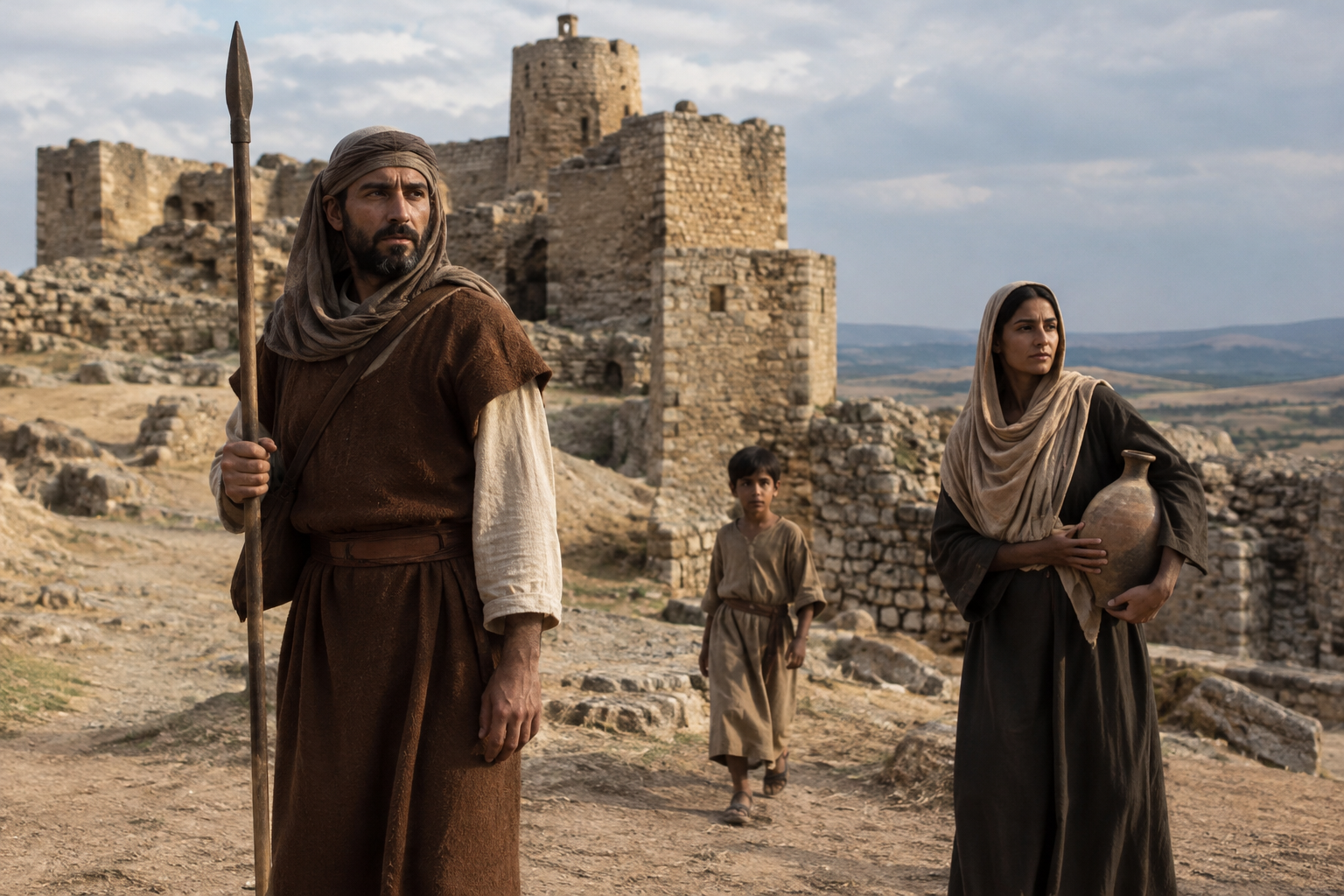
At Tell Masaikh on the Euphrates in eastern Syria, one early medieval man has become unexpectedly important for the history of a very specific paternal line. He is sample R3359, dated to about AD 750. That date places him in a world shaped by the late Umayyad and early Abbasid transition, when northern Mesopotamia and Syria were still dense with old settlements, river traffic, military movement, and communities carrying long local histories beneath changing imperial rule.
The Y-DNA branch linked here is J1a2a1a2d2b2b2c4d2a2a5a1e2b, an extremely fine-grained subclade within the broader haplogroup J1 family. That matters because broad J1 and this much narrower branch are not the same thing historically. A Y-chromosome traces one direct paternal line only, but when an ancient male from a documented site like Tell Masaikh falls on or near such a branch, he gives that lineage a real archaeological setting instead of a purely modern genetic label.
Tell Masaikh was not some romantic ruin standing outside history. It sat in a corridor that had been important for millennia: the middle Euphrates, a zone linking Syria, upper Mesopotamia, and the routes running toward Iraq. By around AD 750, this was a landscape where older Late Antique populations, Arab-era administrations, local farming communities, and regional mobility all overlapped.
That is why R3359 is so useful. Even a single ancient Y-DNA data point can anchor a lineage to a time and place where written history often talks in sweeping political terms while saying much less about ordinary local men. Here, the paternal branch associated with J1a2a1a2d2b2b2c4d2a2a5a1e2b appears not in abstract maps, but in an excavated Syrian settlement context from the early Islamic period.
Research on ancient populations of the broader region has increasingly shown that political change did not simply wipe the demographic slate clean. Communities in Syria and Mesopotamia often combined continuity with movement, local ancestry with incoming strands, and older settlement histories with new imperial frameworks. An ancient DNA study connected to this material is available here: https://www.biorxiv.org/content/10.1101/2022.05.15.491973v1.full.
There is a temptation, with long haplogroup names, to treat them as if they come with a ready-made ethnic badge. They do not. The long label J1a2a1a2d2b2b2c4d2a2a5a1e2b is best understood as a precise twig on a much larger paternal tree. The broader J1 lineage has a deep and complex history across parts of West Asia and surrounding regions, but that larger story should not be carelessly projected onto every tiny downstream branch.
What the Tell Masaikh evidence gives us is something narrower and better. It shows that a man associated with this paternal line, or with a very close ancestral branch to it, was living in early medieval Syria. That does not prove where the branch first formed, nor does it make every modern carrier "Syrian" in any simple sense. But it does provide a firm historical point: by the mid-eighth century AD, this lineage was present in the Euphrates zone.
That is especially valuable for descendants researching paternal ancestry today. Many modern Y-DNA discussions jump straight from present-day matches to grand migration narratives. Ancient evidence slows us down in a useful way. It asks a more careful question: where do we actually see this line, or its close relatives, in dated human remains?
The date attached to R3359 is historically striking. Around AD 750, the old Umayyad political order was collapsing and the Abbasid revolution was reshaping the Islamic world. Syria's political centrality was changing, while Iraq and Mesopotamia were becoming even more prominent. Yet river valleys like the Euphrates were not passive spectators. They were inhabited landscapes in which administrations, merchants, soldiers, farmers, and religious communities all interacted.
In that setting, a paternal lineage preserved in ancient DNA is part of a broader human picture: not a dynasty in waiting, but a resident of a connected frontier between worlds often separated in modern historical writing. Too often we divide "Syria" from "Mesopotamia" as though the Euphrates were a border rather than a corridor. Tell Masaikh reminds us that it was very much a lived route.
That wider Near Eastern context also helps explain why single ancient samples can be so informative. In regions with repeated conquest, administrative reorganization, and long urban histories, continuity may hide beneath changes in language, court culture, or state ideology. A man's Y-line can survive several political eras without needing to map neatly onto one famous ruling power.
For a branch as specific as J1a2a1a2d2b2b2c4d2a2a5a1e2b, the ancient record will almost always feel fragmentary at first. That is normal. Ancient DNA does not arrive as a complete census. It comes as individual recoveries from burials, settlements, cemeteries, and rescue excavations, each one preserving only a slice of past population structure.
So the importance of R3359 is not that he "explains" the entire branch. It is that he securely places one paternal line in an excavated early medieval Syrian context. As more genomes are published from the Levant, upper Mesopotamia, and neighboring regions, branches like this can often be situated more clearly: not by mythic origin stories, but by a growing chain of dated observations.
That approach is increasingly reshaping historical genetics across the eastern Mediterranean and Near East. We are learning that continuity and diversity often coexist, and that local populations could absorb new influences without losing all connection to earlier inhabitants. If you are interested in how eastern Mediterranean and Near Eastern movements affected later populations elsewhere in the Roman world, this piece offers a useful parallel case study:
Eastern Mediterranean Influence
It is worth being precise. The evidence here supports an early medieval Syrian association for the paternal branch discussed in this article through sample R3359 from Tell Masaikh, dated around AD 750. That is a real archaeological foothold. What it does not do, by itself, is establish a named tribe, a famous family, or a single migration event.
Still, that foothold is valuable. For modern testers whose direct paternal line falls under J1a2a1a2d2b2b2c4d2a2a5a1e2b, the most responsible historical takeaway is that this branch was present in the middle Euphrates world during a major turning point in Near Eastern history. In other words, your paternal line belongs to a landscape of deep settlement, imperial transition, and regional continuity rather than to a vague and placeless genetic category.
And that, in truth, is one of the most useful things ancient DNA can do. It takes an intimidating string of letters and numbers and returns it to human ground: a man, a site, a date, and a real stretch of Syrian history.





Comments