Haplogroup I2a2a1a1a2

– 4 min read


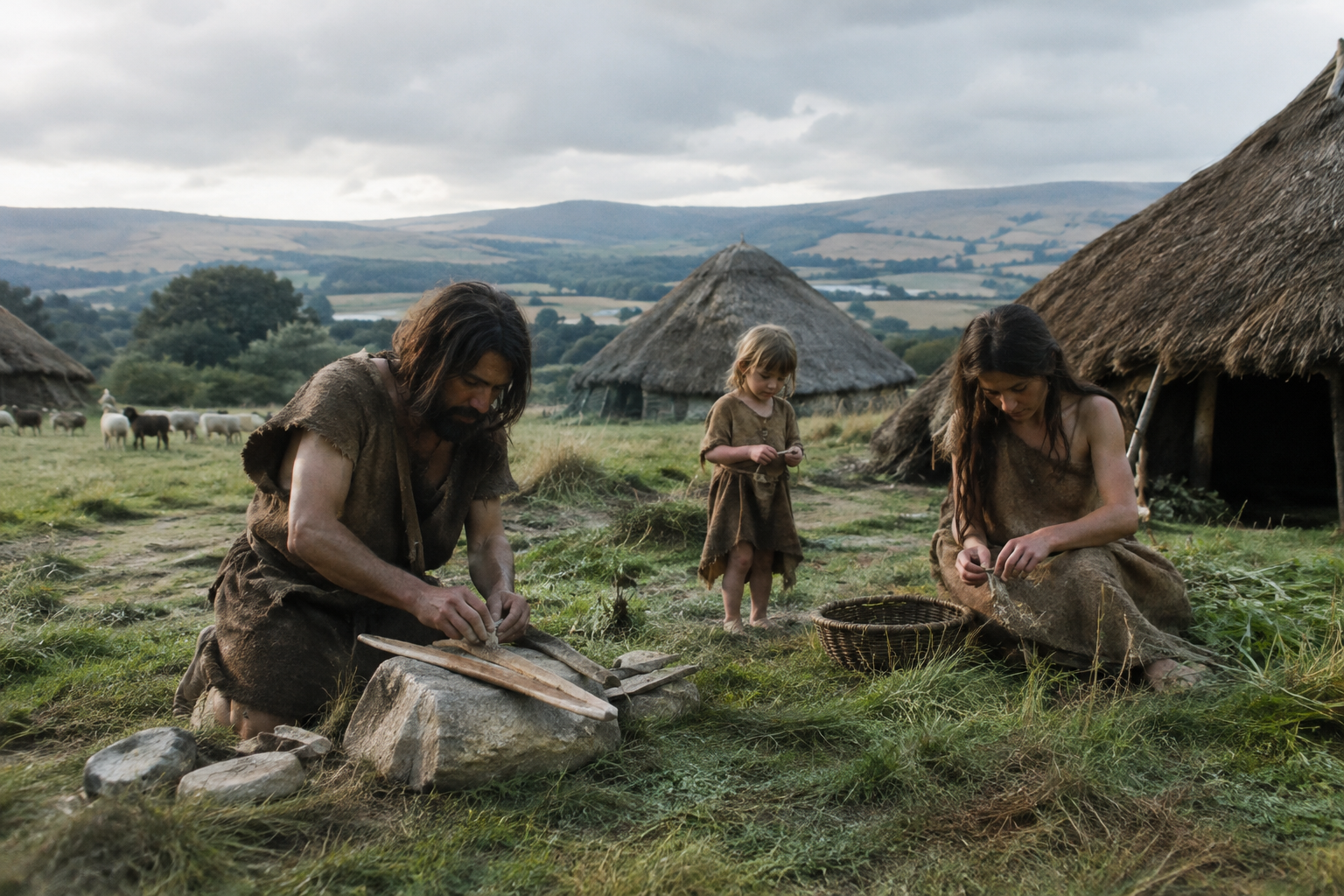
At Uley, on the limestone high ground of Gloucestershire, one Neolithic man has become an unexpectedly useful guide to a very old paternal line. Sample I6762, dated to around 3700 BC and associated with the long barrow landscape of Uppser Swell, Gloucestershire, England, has been linked to the Y-DNA haplogroup I2a2a1a1a2. That is a small and specific branch, but its real historical force comes from where it appears: not in a later warrior grave or a medieval pedigree, but in the world of Britain's first farmers and tomb-builders.
This matters because Y-DNA traces one direct paternal line only, not a person's whole ancestry. Even so, a lineage like I2a2a1a1a2 can still illuminate something important. In early Neolithic Britain, paternal lines reveal how communities were structured, how people were related across burial monuments, and how older European male lineages persisted within populations whose wider ancestry had already been transformed by the spread of farming.
The Gloucestershire uplands are famous for their chambered tombs and long barrows, monuments built in the centuries after farming reached Britain. Sample I6762 belongs to that world. Around 3700 BC, this was a landscape being reshaped by new economies, new monuments, and new ways of commemorating the dead. The importance of I6762 is therefore not simply that he carried a branch of haplogroup I, but that this branch appears in a man living at the very start of Britain's monument-building Neolithic.
Research on Neolithic Britain, including the ancient DNA work published in this major genetic study, showed that the arrival of farming in Britain was associated with substantial ancestry ultimately derived from continental Neolithic populations. Yet those incoming farming societies did not erase every older paternal thread in the same way or at the same speed. Haplogroups within the wider I family, long associated with earlier European hunter-gatherer populations, continued to appear in Neolithic contexts. That makes I6762 a reminder that population change is rarely a clean replacement.
The haplogroup in this article, I2a2a1a1a2, sits deep within the broader Y-DNA haplogroup I, one of Europe's ancient paternal families. That broader lineage has deep roots in prehistoric Europe, but one must be careful here: the history of the parent branch is not automatically the history of every downstream twig. For I6762, the secure point is the archaeological context in Neolithic western Britain and the reported association with this specific branch.
So what can responsibly be said? First, the presence of this lineage in Neolithic Gloucestershire shows that the branch, or a close ancestral line leading into it, was part of the male population of early farming Britain. Second, its appearance in this context fits a wider pattern in which Neolithic communities in Atlantic Europe sometimes carried paternal lines that connect, at broad level, to deeper European prehistory. That does not make I6762 a "hunter-gatherer survivor" in any simple ethnic sense. People are not haplogroups, and Neolithic communities were already mixed biological and cultural worlds.
One reason Neolithic British Y-DNA has attracted so much attention is that burial monuments often seem to preserve patterns of kinship. Across Britain and nearby regions, ancient DNA has increasingly shown that tombs were not random accumulations of unrelated dead. Some monuments were used by people who were biologically connected across generations, and paternal descent could matter in how communities organized memory, burial, and inheritance.
I6762 is especially interesting in that wider conversation because Gloucestershire sits within one of the densest early Neolithic monumental landscapes in Britain. Long barrows were not just graves in the narrow sense. They were statements in earth and stone about belonging, land, and ancestry. A paternal lineage such as I2a2a1a1a2 cannot by itself explain that social world, but it gives us one thin, valuable thread running through it: a single male line embedded in the making of early British farming society.
Reuse of Neolithic tombs in Britain
It is tempting to treat Neolithic Britain as isolated once the Channel crossing had been made, but that would miss the larger setting. Gloucestershire belonged to an Atlantic-facing zone of exchange and shared monument traditions that linked western Britain to Wales, Ireland, and the continental seaways beyond. The people who built and used long barrows were participating in a far wider cultural conversation, even if each valley and ridge had its own local history.
That is another reason the lineage of I6762 matters. A haplogroup found in Gloucestershire around 3700 BC is not simply "English" in any later national sense. It belongs to a time before England, before Celts or Anglo-Saxons in the usual historical meaning, and before any medieval family could claim those landscapes through charter or conquest. The paternal line existed in a much older human geography: kin groups, farming settlements, ritual monuments, and regional networks stretching across Neolithic northwestern Europe.
For modern readers, this often comes as a useful shock. We are used to history beginning with texts, tribes, and kingdoms. Ancient DNA pushes us earlier, into periods where the main evidence is archaeological: bones, tombs, landscapes, and the statistical traces preserved in genomes.
There are haplogroup stories built around grand surnames, castles, or royal houses. This is not one of them, and that is rather refreshing. With I2a2a1a1a2, the strongest evidence here lies not in heraldry but in a prehistoric individual from Gloucestershire. Sample I6762 gives the branch something better than a romantic tale: a real archaeological anchor in the fourth millennium BC.
That anchor also helps correct a common misunderstanding about British paternal ancestry. Later history in Britain was full of migrations, from Beaker-associated population change to Roman mobility, Anglo-Saxon settlement, Scandinavian movement, and Norman conquest. But none of those later episodes wipes away the significance of the earlier layers. Some paternal lines found in Britain today may connect, however indirectly and with many twists, to men who lived in the age of long barrows rather than the age of written chronicles.
Mesolithic-Neolithic transition
For haplogroup I2a2a1a1a2, the most distinctive evidence here is beautifully simple: an ancient paternal line appears in I6762, a man from Neolithic Gloucestershire around 3700 BC, in the era when Britain's first farmers were building enduring monuments for the dead. That does not turn every modern bearer of the haplogroup into a direct representative of one Neolithic community. But it does place this lineage within the deep prehistory of Britain, in a landscape of long barrows, early farming, and ancestral memory that is far older than any later dynasty.






Comments