Haplogroup I2a1b2a2b1

– 5 min read


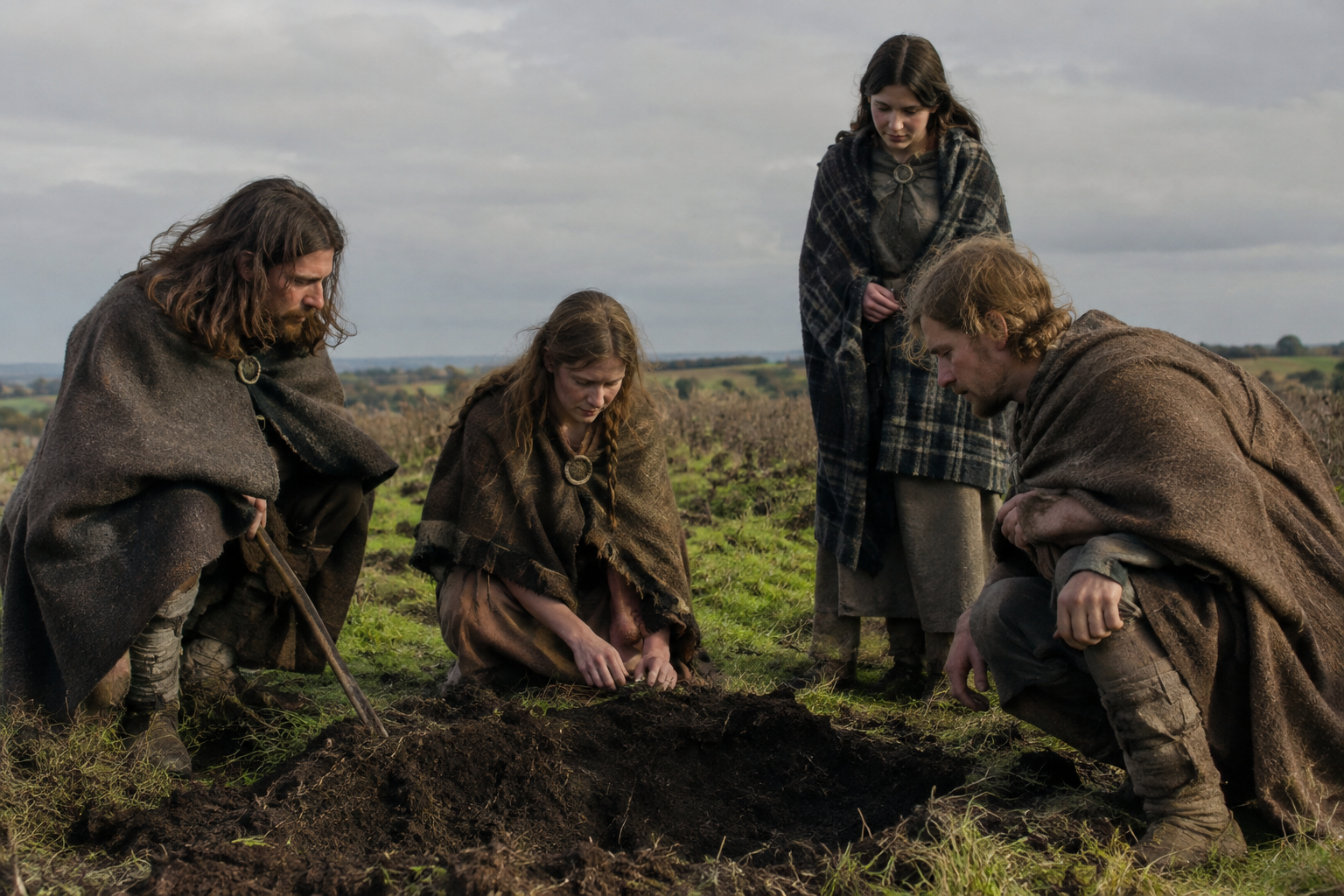
At Wetwang Slack in East Yorkshire, four Iron Age men dated to around 225 BC carry the same reported Y-DNA branch: I2a1b2a2b1. Their sample IDs - I36987, I36864, I36812, and I37142 - come from burials associated with the Celtic Parisi of eastern Yorkshire, a group long known to archaeologists from their cemeteries, chariot burials, and distinctive regional material culture. That is already enough to make the site important, because repeated paternal-line findings at one cemetery can tell us something precise about local male ancestry without pretending to explain an entire people.
That precision matters. Y-DNA follows one direct paternal line only: father to son across generations. So the presence of I2a1b2a2b1 at Wetwang Slack does not define the whole ancestry, language, or identity of the Parisi. But it does give us a rare glimpse of one male lineage present among Iron Age communities in northern Britain at a site that has become central to debates about continuity, kinship, and mobility.
Wetwang Slack sits in one of the most archaeologically distinctive Iron Age landscapes in Britain. East Yorkshire has produced cemeteries unlike most of southern Britain, with formal burial traditions that helped set the region apart. The Parisi, named in later classical geography, are usually associated with this area, though archaeologists are rightly cautious about turning a label from historical texts into a simple ethnic fact.
That is what makes these four men so useful. Instead of starting with broad claims about "Celts" in general, the evidence begins with a real burial ground, a tight date around the third century BC, and multiple males carrying the same reported paternal branch. I36987 and I36864 are specifically listed as coming from Wetwang Slack burials, while I36812 and I37142 are associated with Wetwang Slack in the same Iron Age horizon. Even with sparse sample notes, the pattern suggests that this lineage was not an isolated arrival represented by a single man in the cemetery.
An ancient DNA study focused on Britain and nearby regions has increasingly encouraged this sort of site-based reading: look first at who was buried where, when, and alongside whom, then ask what the genetics can support. That approach is especially important for Iron Age Britain, where archaeology often tells us more securely than later tribal names do.
The haplogroup in this article, I2a1b2a2b1, is a narrow paternal subclade within the wider I2 family of Y-chromosome lineages found in Europe across long stretches of prehistory and history. That broader background is important, but it must not be mistaken for a full biography of this exact branch. A parent haplogroup can have many different regional histories, and a specific subclade may have a much more local or later story than the headline lineage above it.
For Wetwang Slack, the safest observation is modest and valuable: several men in the same Iron Age cemetery are reported under this branch, which points to a recurring paternal line in that community or in closely connected communities using the same burial ground. It does not prove that all Parisi men belonged to I2a1b2a2b1, nor that every modern carrier descends from East Yorkshire Iron Age elites. Archaeogenetics is strongest when it narrows the question rather than inflating it.
That said, repetition matters. A one-off Y-DNA result can reflect chance. Four closely dated men from one notable cemetery begin to look like a local pattern, even if we cannot yet define their exact relationships from the information at hand.
Iron Age cemeteries are not automatic snapshots of entire populations. They are curated social spaces. People buried there may represent particular families, status groups, or community segments rather than everybody living in the surrounding countryside. So when the same paternal branch appears several times at Wetwang Slack, the real question is not "Was this the Parisi haplogroup?" but "What sort of male-line continuity does this cemetery preserve?"
That is a better, more historical question. East Yorkshire's burial tradition has long made the region stand out within Britain, and recurring Y-DNA at one cemetery can fit several plausible interpretations: a cluster of related paternal kin, a lineage established locally over generations, or a burial ground drawing men from allied households sharing a deeper male-line ancestry. Without explicit kinship results, we should not choose among those possibilities too confidently. But the recurrence still tells us that I2a1b2a2b1 was embedded enough in this community to appear again and again.
There is also a wider British context. Recent archaeogenetic work on Britain has shown that continuity and change often coexist: local lineages can persist even while ancestry profiles shift through migration, marriage, and broader social change. A repeated Y-line in Iron Age Yorkshire fits that larger lesson rather well. Research circulated in an ancient DNA preprint on Iron Age and later British populations points to exactly this sort of caution, where paternal signals are informative but only when read alongside archaeology.
Placing these men in time matters as much as naming their haplogroup. Around 225 BC, East Yorkshire was not some isolated prehistoric backwater. It was part of a lively Iron Age world linked by exchange, shared practices, and regional distinctions across Britain and the near Continent. The Parisi landscape is especially famous because it preserves burial customs that have often invited comparison with communities across the Channel, though those comparisons remain debated and need not imply simple migration stories.
That is why the Wetwang Slack evidence is so useful for public history. It shifts attention from old-fashioned tribal stereotypes to something firmer: named individuals from a real cemetery, in a defined region, at a defined period, carrying the same reported paternal branch. In other words, instead of asking whether the Parisi were "really" this or that people, we can ask how lineages were structured inside an Iron Age society that buried its dead in unusually visible ways.
It is also worth noticing what we do not have. No grave goods are listed here for these four men, no explicit kinship matrix, no isotopic mobility study in the sample notes, and no claim that the exact downstream resolution was independently confirmed from a full publication accessible here. That absence is not a weakness in the story. It simply means the archaeological interest lies in the cluster itself.
The four Wetwang Slack men - I36987, I36864, I36812, and I37142 - are best read together, not as isolated curiosities. A cemetery cluster like this invites future comparison with other Iron Age burials in Yorkshire, with later Roman and early medieval male lines in Britain, and with evidence for how burial grounds organized kin and status. If more males from nearby sites also fall under related I2 branches, that would strengthen the picture of regional continuity. If they do not, Wetwang Slack may prove to be preserving a more specific local lineage.
That kind of question has become one of the most exciting things about ancient DNA. It does not just label the dead. It helps us ask whether a burial ground was organized by household, by ancestry, by custom, or by something more complicated than any single category can capture.
If your paternal line belongs to I2a1b2a2b1, the strongest historical point from the present evidence is not a grand claim about all of Europe, but a concrete link to an Iron Age setting where this branch is reported multiple times: Wetwang Slack in East Yorkshire, among men associated with the Celtic Parisi around 225 BC. That does not make every present-day carrier a direct continuation of that cemetery community. It does, however, place your lineage in a real archaeological landscape where the male line was clearly established enough to appear more than once.
For family historians, that is often the most valuable kind of ancient DNA result: not a fantasy pedigree, but a sharply focused glimpse of one paternal branch living within a distinctive Iron Age society in Britain.
Comments