Haplogroup I2a1b1a2b1a2b2

– 5 min read


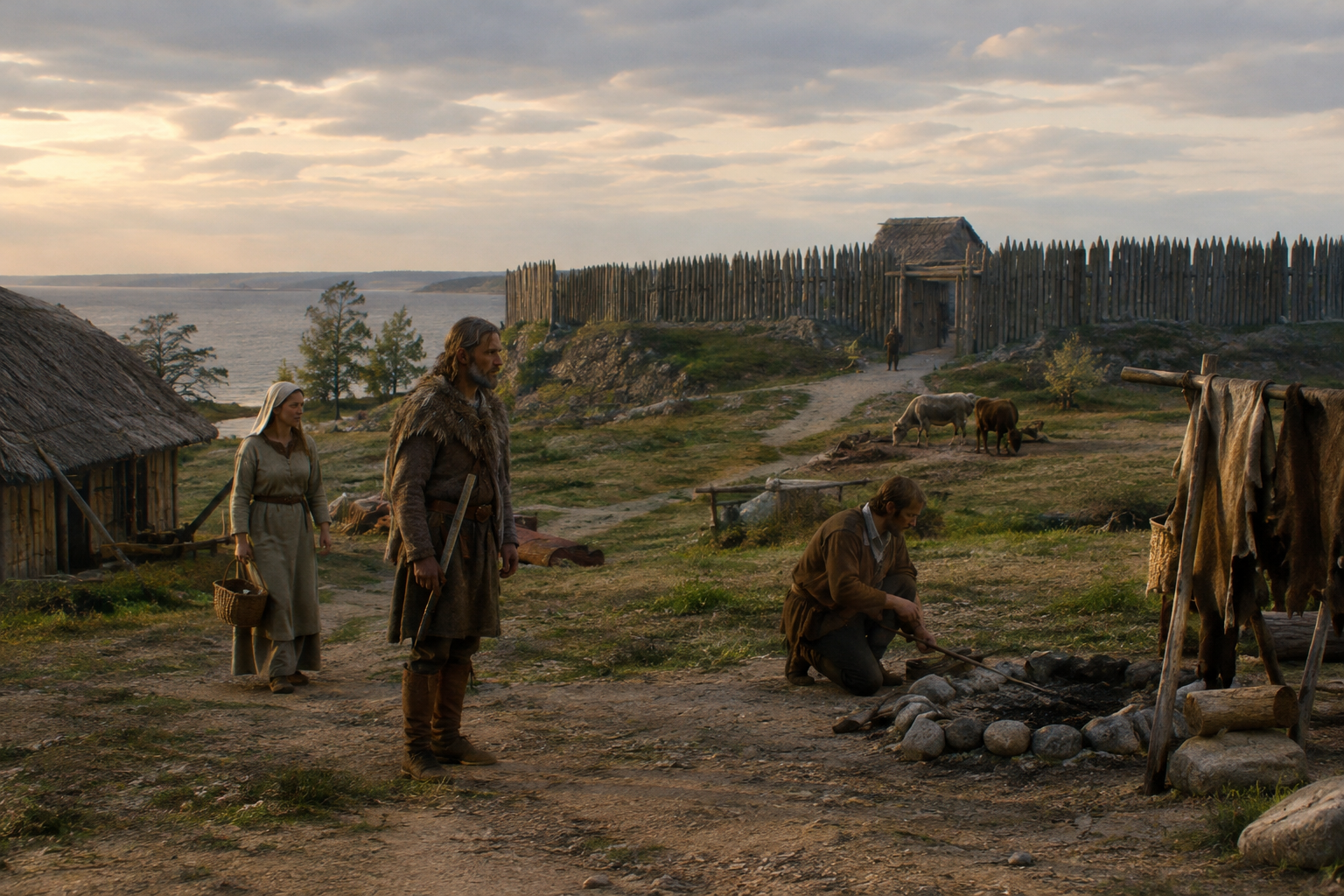
At Sandby borg on the island of Oland, archaeologists uncovered one of the grimmest snapshots in Scandinavian archaeology: a fortified settlement where people appear to have been killed and left where they fell during the late 5th century AD. Among the individuals recovered there is sample snb010, dated here to around AD 475 and associated with the Y-DNA haplogroup I2a1b1a2b1a2b2. It is a very precise paternal label, but the setting matters just as much as the code. This was not an abstract lineage drifting through prehistory; it belonged to a man caught up in a violent episode on a Baltic island at the threshold of the Vendel Age.
That makes this haplogroup especially interesting. Y-DNA follows one direct paternal line only, not a person's whole ancestry, language, or social identity. Yet when a branch like I2a1b1a2b1a2b2 turns up in a site as historically charged as Sandby borg, it anchors that paternal line in a real community, in a real landscape, and in one of the most unsettled centuries in northern Europe.
Sandby borg is one of Oland's ringforts, circular fortified enclosures built into the island's landscape. But unlike a fort simply abandoned over time, this one became famous because of the evidence for sudden violence and an eerie lack of later disturbance. The dead were not formally cleared away in the usual way, which is precisely why the site has such force: it preserves a social catastrophe rather than a neatly managed cemetery.
Sample snb010 belongs to that world. The date of around AD 475 places him in the later Migration Period, when the Roman West had collapsed and power was being reorganized across Europe. Scandinavia was not isolated from that upheaval. Prestige goods, shifting alliances, and regional competition linked the Baltic to wider currents of change, even if the people at Sandby borg were living in a distinctly local Swedish setting.
A broader ancient DNA study of prehistoric Europe, published in Cell, helped place Scandinavian populations into long-term genetic context. For a site like Sandby borg, that wider frame matters: it reminds us that a 5th-century man on Oland carried both immediate local history and a paternal line shaped by much deeper population processes.
The haplogroup name is formidable, but the essential point is simpler. I2a1b1a2b1a2b2 is a narrow twig on the much larger Y-chromosome tree of haplogroup I, one of the old paternal lineages of Europe. The broad family of I lineages reaches far back into European prehistory, but it would be wrong to pour that entire deep history straight into this one late branch as though nothing changed along the way.
What we can say responsibly is that snb010 shows this paternal line present in eastern Scandinavia in the late 5th century AD. That alone is useful. It tells us that this branch was part of the male-line diversity of Migration Period Sweden, and not merely something reconstructed from much later medieval or modern populations.
It also shows the value of precision. A very specific subclade like this is not the same thing as saying only "I2" or even "I2a." Those broader labels cover enormous stretches of time and geography. The importance of Sandby borg is that it gives one sharply dated, archaeologically grounded point for a much narrower paternal signature.
Oland sits in a strategic position in the Baltic, close enough to mainland Sweden to remain tied into its politics, yet distinct enough to develop its own clustered ringfort landscapes and local power structures. In late antiquity, that position mattered. The Baltic was not a quiet backwater but a zone of exchange, competition, and maritime movement.
So when a lineage like I2a1b1a2b1a2b2 appears at Sandby borg, it should be read against this island setting. The man represented by snb010 was not simply "from Sweden" in a bland modern sense. He belonged to a community on an island with strong defensive architecture, seaborne connections, and exposure to the political turbulence of the later 400s.
That does not allow us to assign him a named tribe from later texts, still less to turn one Y-chromosome into an ethnic badge. But it does let us place his paternal line in a society that was both local and connected: rooted in Oland, yet part of the larger north European world emerging after Rome.
Ancient DNA often tempts people into thinking in dynasties: one Y-line, one clan, one ruling house. Sandby borg is a good corrective. A single identified paternal lineage from a violent event does not prove that all the men at the site shared the same ancestry, nor that this branch marked an elite family. What it does provide is a documented male line within a specific community at a specific historical moment.
And that is already significant. Archaeology gives us the broken social world of the ringfort; genetics adds one thread of biological descent within it. Together they show that the victims of Sandby borg were not just anonymous "Migration Period people." At least in the case of snb010, we can say that one direct paternal line now known as I2a1b1a2b1a2b2 was present among them.
This matters particularly for descendants and surname researchers. Modern testers sometimes encounter a rare or tightly defined haplogroup and wonder whether it can be located in time before the medieval period. Sandby borg offers exactly that kind of anchor: not an origin myth, but a secure late antique appearance in a real Baltic context.
The date around AD 475 is not incidental. It falls in one of those awkward but fascinating periods that used to be dismissed as a "dark age," largely because written sources grow thinner. Archaeology has long shown that Scandinavia was anything but dark in the sense of static or simple. Fortified places, prestige exchange, and regional hierarchies all point to active, competitive societies.
Ancient genomics is now sharpening that picture. Instead of treating post-Roman Scandinavia as an indistinct prelude to the Viking Age, we can begin to see its communities in finer resolution. Sandby borg belongs to that sharpening. The presence of I2a1b1a2b1a2b2 there is modest evidence in one sense, but powerful in another: it ties a narrow paternal line to the human reality of political stress, violence, and island life in the Baltic centuries before the famous Viking expansions.
Baltic links in early medieval north
Some haplogroup articles have the luxury of many ancient samples spread across centuries. This one does not, and that is precisely why snb010 matters so much. With sparse evidence, the quality of context becomes decisive, and Sandby borg is exceptional context: a well-known Swedish site, a narrow historical window, and a memorable archaeological event.
For anyone exploring I2a1b1a2b1a2b2, the most careful takeaway is this: your direct paternal line is at least one of the lines present in late Migration Period Scandinavia, specifically on Oland during the violent 5th-century history of Sandby borg. That is not a claim to a tribe, a kingdom, or a noble pedigree. It is something better grounded than that - a direct link to a documented man from a dramatic and deeply human archaeological site.






Comments