Haplogroup I2a1b1a2b1a2
– 6 min read


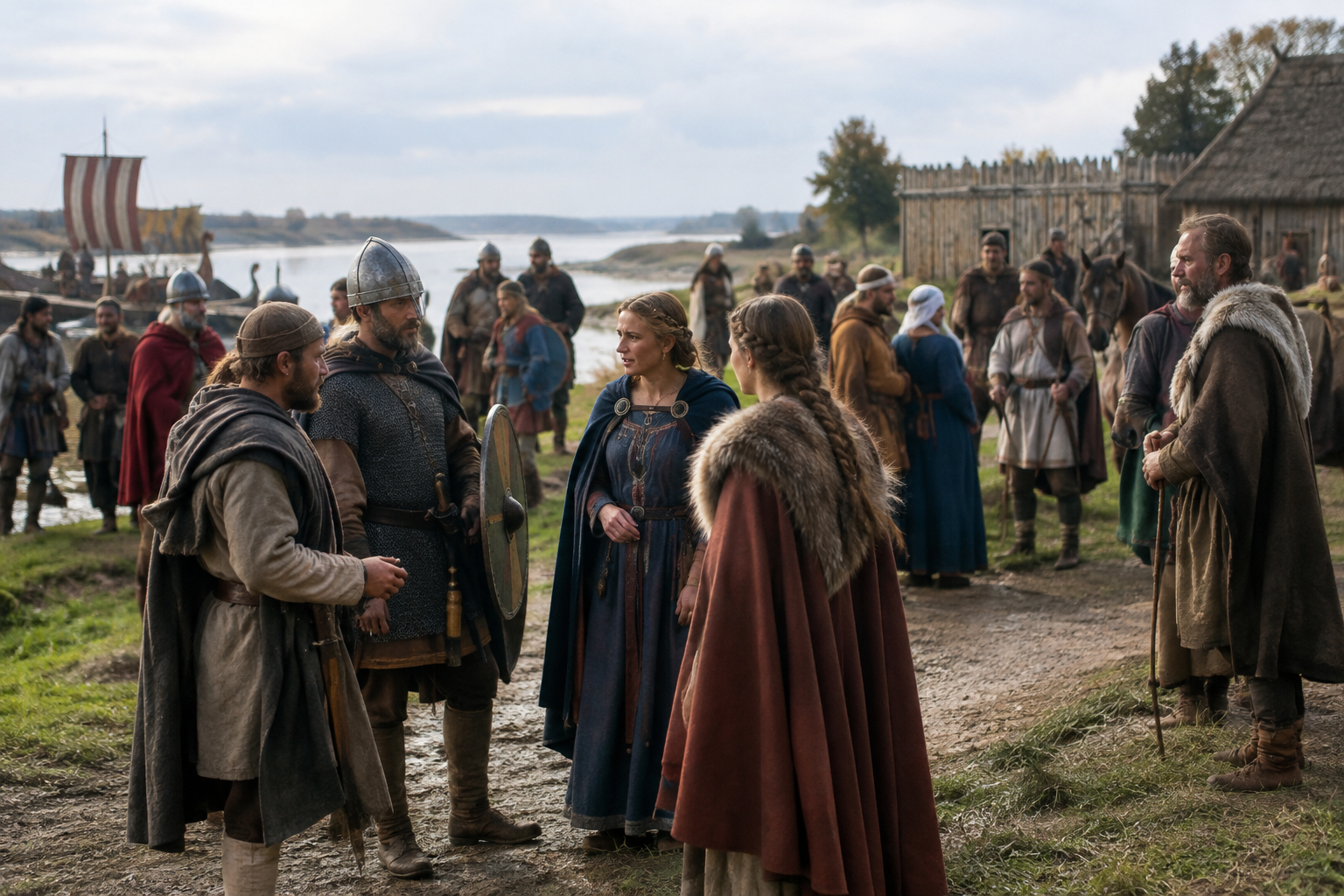
Some Y-DNA branches announce themselves with grand fame. Others are more interesting for a different reason: they turn up, stubbornly and repeatedly, in the graves of men who lived through the making of early medieval Europe. Haplogroup I2a1b1a2b1a2 belongs to that second category. It is a very specific paternal branch, and that specificity matters. A narrow subclade is not the whole history of haplogroup I, nor even of I2, but one twig on a much older tree of European male-line ancestry.
What makes this branch historically compelling is the pattern suggested by the ancient samples supplied here. They cluster not in one neat kingdom or one tidy ethnic box, but across Denmark, southern Sweden, Germany, England, Belgium, Hungary, and even early medieval Spain. That is exactly the sort of evidence that reminds us how the past really worked: not as modern national histories would prefer, but as a world of movement, raiding, settlement, military service, intermarriage, and local continuity all at once.
Y-DNA traces one direct paternal line only: father to father to father. It does not describe a person's total ancestry, culture, language, or identity. Still, when ancient DNA repeatedly finds related paternal branches in particular regions and periods, it gives us an unusually sharp tool for following male-line history through time.
The broader haplogroup I is one of the long-established Y-chromosome lineages of Europe, with very deep roots on the continent. But we must be careful. The history of broad haplogroup I cannot simply be pasted onto the much narrower branch I2a1b1a2b1a2. What we can responsibly say from the evidence here is that this lineage appears strongly in Iron Age and early medieval contexts around the Danish world and its connected regions.
That matters because the first millennium AD saw the North Sea and Baltic become one of the great corridors of mobility in Europe. Men moved as warriors, traders, settlers, and followers of ambitious rulers. Communities in Jutland, Sjaelland, southern Scandinavia, northern Germany, and eastern Britain were tied together by sea routes every bit as important as roads. A paternal lineage found repeatedly in that zone is not telling us a fairy tale about a single tribe marching in lockstep. It is showing us a network.
Readers interested in the longer background to Scandinavian population history may enjoy this broader look at Denmark before these later Iron Age and medieval developments:
The Danish evidence is especially striking. At Alken Enge in Jutland, an extraordinary wetland battlefield deposit from the early Roman era, several men carried this paternal branch: CGG019202 dated to 81 AD, CGG019212 dated to 115 AD, and VK582 dated to 100 AD. These are not abstract data points. They were men caught up in organized violence, their remains later deposited in a landscape that has preserved an unsettling picture of Iron Age conflict. If one wants to see how a paternal lineage is embedded in lived history, this is it.
The same broad pattern continues across Iron Age Denmark. We find CGG107412 at Varpelev in eastern Sjaelland, dated to 115 AD; CGG106726 at Kalundborg Simonsborg, dated to 175 AD; CGG107441 from Asnaes in northwest Sjaelland, dated to 175 AD; CGG107532 from Forevejlegard, also dated to 175 AD; and CGG107480 from Bulbjerg in Jutland, dated to 175 AD. Whatever precise downstream relationships may eventually prove to exist among them, the historical impression is clear enough: this paternal line was present across multiple Danish regions in the Roman Iron Age.
Then comes the next chapter. snb010 from Sandby Borg on Oland, dated to 475 AD, places the lineage in the violent world of the pre-Vendel period in Sweden. CGG017609 from Borre Enge in Denmark, dated to 793 AD, takes us into the Viking Age. And SWG010 from Hedeby Schleswig Rathausmarkt in Southern Jutland, dated to 1100 AD, puts the lineage in one of the great trading hubs of the north, a place where Scandinavia met the wider European world.
For a wider look at the era in which such northern lineages appear across maritime networks, this community article is an excellent companion:
Now, this is where things become properly interesting. The branch is not confined to Scandinavia. In England it appears in BUK037 from Buckland Dover, dated to 400 AD, in an early Anglo-Saxon context; LAK004 from Lakenheath in Suffolk, dated to 650 AD and described as Angle Early Medieval; SED017 from Sedgeford in Norfolk, dated to 760 AD; and VK150 from the Viking St. Brice Massacre at Oxford, dated to 1002 AD. Those are not all the same historical moment. They span early settlement, mature Anglo-Saxon society, and the later Viking age in England.
On the Continent, we see related evidence in BRC029x from Bruecken in Saxony-Anhalt, dated to 500 AD; Alh_80 from Altheim in Bavaria, dated to 600 AD; IND006 from Alt-Inden in North Rhine-Westphalia, dated to 600 AD; and ST0552 from Sint-Truiden Onze-Lieve-Vrouwekerk in Belgium, dated to 900 AD. These finds suggest persistence and spread through regions central to post-Roman population change.
There are also two Gothic-period samples from Hungary, A181014 and A181019, both dated to 450 AD at Kecskemet-Mindszenti Transtisza, along with SZ3 from the Germanic Lombard site of Szolad, dated to 590 AD. This does not prove that the haplogroup was uniquely "Gothic" or "Lombard" - ancient populations were not genetically uniform - but it does show that this paternal line moved within the migration-era worlds associated with Germanic-speaking groups.
And then there is I19904, from Early Medieval Spain, Toledo Illescas Boadilla, dated to 600 AD. That is precisely the sort of sample that stops us becoming lazy. A lineage seen so often in the north turns up in Iberia too, reminding us that Visigothic, post-Roman, and local Iberian histories overlapped in complicated ways.
If that Iberian appearance catches your eye, these articles help place it in context:
What, then, has any of this to do with later noble families? Not direct proof, certainly. Shared haplogroups do not magically bridge a thousand years of missing genealogy. But they do place medieval lineages into deeper regional history.
The supplied noble association here is Clan Galloway, tied to Threave Castle in southwest Scotland. Threave stands on an island in the River Dee near Castle Douglas in Galloway and was built in the 1360s by Archibald the Grim. He made it a stronghold of the Black Douglas family in a period of prolonged warfare and shifting political loyalties. After the Black Douglases challenged King James II, the castle was besieged in 1455 by royal forces using one of Scotland's earliest great siege guns, and it fell to the Crown. It later passed through royal keepers and local magnates, saw action again in the sixteenth century during the politics of Mary Queen of Scots, and by the seventeenth century had declined into ruin, though its great tower still dominates the marshy landscape.
Threave is useful not because a castle can prove a haplogroup - it cannot - but because it anchors later paternal history in a real place. Southwest Scotland stood within the same wider North Sea world that linked Scandinavia, England, the Low Countries, and northern Germany. If a paternal lineage such as I2a1b1a2b1a2 circulated through those regions in antiquity and the early Middle Ages, it is not difficult to see how related branches could later appear among families rooted in medieval Britain. The historical point is geographical continuity and mobility, not a simplistic claim of direct descent.
Readers interested in the regional tradition behind that later Scottish setting can continue with:
The story told by I2a1b1a2b1a2 is not the story of one people. It is the story of male-line continuity across a connected northern European zone, with appearances in battlefields, cemeteries, ports, and migration-period burials. It shows up in Roman Iron Age Denmark, in Swedish and Danish sites of the later first millennium, in Anglo-Saxon and Viking Age England, in post-Roman Germany and Belgium, in Gothic and Lombard-associated settings in central Europe, and in early medieval Spain.
That distribution should make us wary of tidy labels. A Y-DNA lineage can persist through major cultural change. Men carrying related paternal lines might live as Jutes, Danii, Angles, Saxons, Goths, Lombards, townsmen, traders, or medieval lords depending on time and place. Genetics does not erase history; it makes it more complicated, and therefore more interesting.
For a broader introduction to how ancient DNA helps reconstruct such long, uneven histories, this is well worth reading:
Learn How Archaeogenetics Works
If you carry this haplogroup, or a nearby branch, MyTrueAncestry can help place your paternal line against the backdrop of real archaeological discoveries like CGG019202, BUK037, ST0552, or I19904. Those matches do not prove you descend from a particular ancient individual or medieval noble house. But they can offer a vivid, evidence-based view into the worlds where your deeper paternal ancestry once moved.
Upload your DNA to MyTrueAncestry and explore how your results connect with ancient samples, historic populations, and the landscapes where their stories unfolded.






Comments