Haplogroup I2a1b1a2b1a1a2
– 5 min read


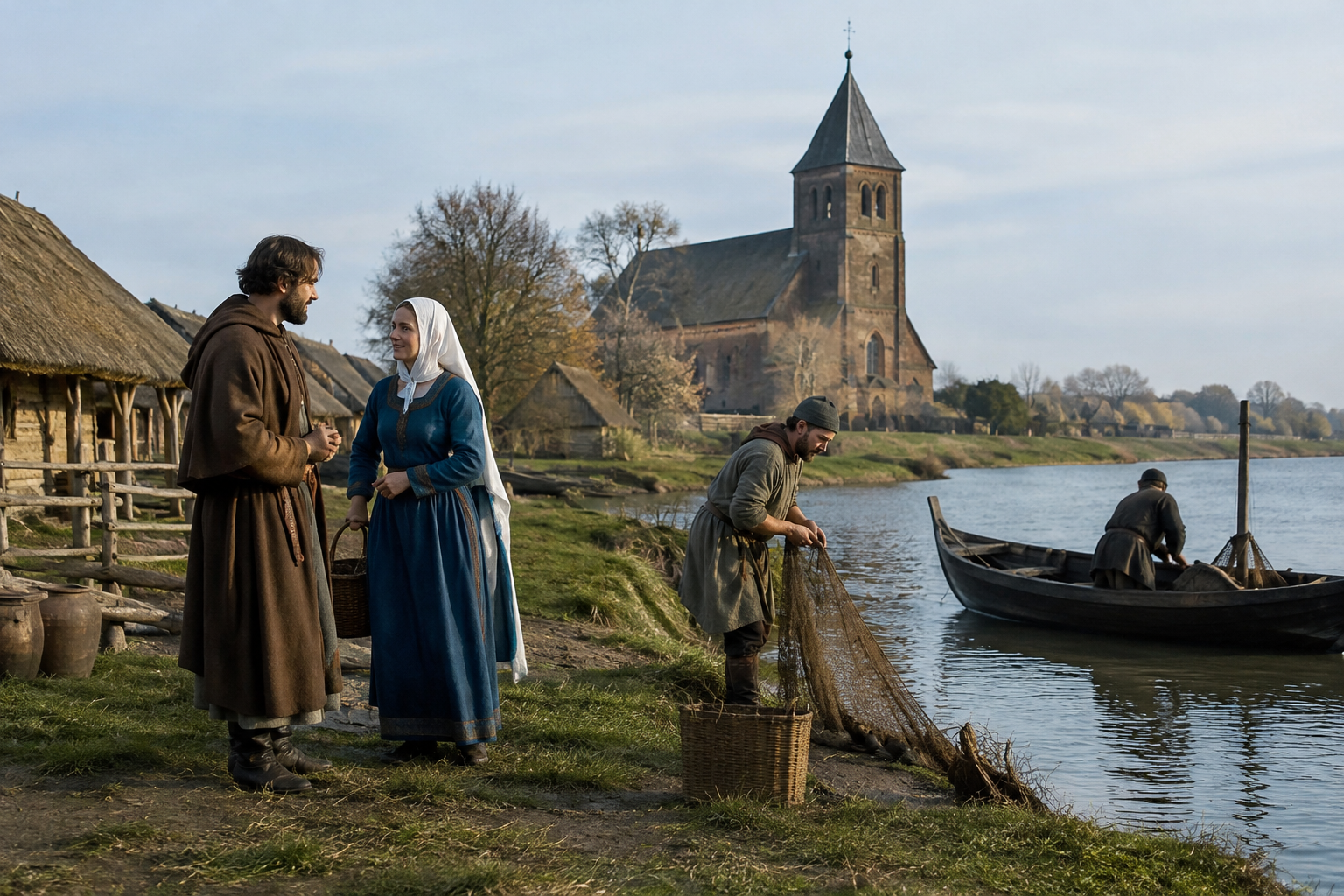
In around AD 1090, a man now identified as GRO019 was buried in Groningen in the northern Netherlands. On paper, that may sound modest beside princely tombs and famous ship burials. But for the history of Y-DNA haplogroup I2a1b1a2b1a1a2, it is exactly the sort of find that matters: a datable medieval individual from a real community in the North Sea world, living at a moment when the old Carolingian order had long fractured and regional societies were becoming more sharply defined.
The interest here lies not in grandeur but in placement. Groningen sat in a zone shaped by marshland farming, seaborne contact, Frisian and Saxon cultural currents, and the long afterlife of the early medieval transformations that followed Rome's collapse. If GRO019 is associated with the branch I2a1b1a2b1a1a2, then this lineage was present in that coastal world by the late 11th century. That does not make the man a representative of all Groningen, nor does Y-DNA tell us his full ancestry. But it does place one paternal line, very specifically, into a historical landscape we can actually describe.
The label "Carolingian Era" can be a little misleading when attached to a burial as late as AD 1090. Charlemagne himself belonged to a much earlier century, and by the late 11th century the political map of northwestern Europe had changed dramatically. Still, the term points to a world shaped by institutions, settlement patterns, Christianization, and regional power structures that had grown out of the Carolingian centuries.
For Groningen, that meant life at the edge of great kingdoms but not outside history. Northern coastal communities were tied into exchange networks across the North Sea and along the river systems leading inland. This was a place where local continuity mattered as much as migration. A Y-chromosome lineage found here may reflect long-settled male lines, more recent arrivals from neighboring regions, or some mixture of both across generations.
I2a1b1a2b1a1a2 is a very narrow branch in a much larger Y-DNA family tree. The broader haplogroup I is one of Europe's long-established paternal lineages, with deep prehistoric roots on the continent. But that broad statement should not be carelessly transferred to this exact subclade. A fine-grained label like I2a1b1a2b1a1a2 represents only one small twig on that tree, and its own documented history depends on where and when ancient or modern carriers are actually found.
That is why GRO019 is useful. Rather than telling a sweeping story about "ancient Europeans," the sample anchors this specific paternal branch in one medieval population of the northern Low Countries. Y-DNA tracks a direct paternal line only: father to son to son across time. Historically, that can be revealing, especially in studies of mobility, kinship, and local continuity, but it is only one line among many in any person's ancestry.
When people see a lineage in the Netherlands around AD 1090, there is a temptation to jump straight to Frisians, Saxons, Vikings, or Franks, as if one label must explain everything. The archaeology of the North Sea world is rarely so tidy. Coastal northern Europe was full of overlap: languages spread without perfect genetic replacement, political loyalties shifted, and families moved in ways that leave only partial traces in burial grounds and DNA.
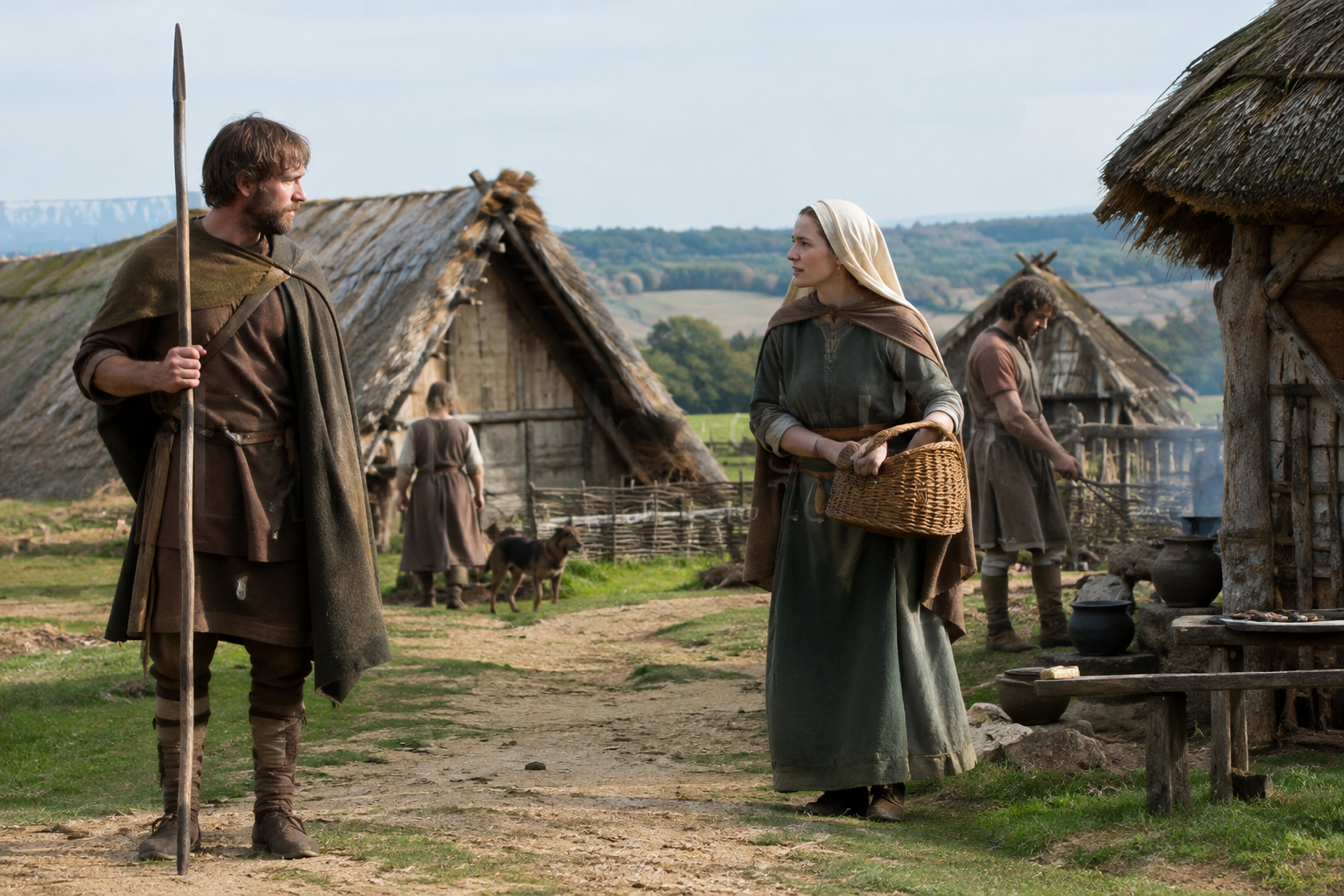
That wider setting is exactly what gives GRO019 his value. He belongs to a period in which the coastal Netherlands was already part of a densely connected medieval world. The region had seen centuries of interaction with neighboring Germanic-speaking populations, with trading routes and ecclesiastical links tying it to both the North Sea and the Carolingian heartlands farther south and east.
A genetic study of early medieval populations in northwestern Europe, including those relevant to Anglo-Saxon migration and related North Sea connections, can be found here. It is useful context for this broader world, even though a single Groningen burial must still be interpreted on its own terms rather than turned into proof of one ethnic label.
Germanic Languages and Genomics
Ancient DNA articles often gravitate toward spectacular discoveries: royal burials, mass migrations, dramatic conquests. Yet much of European population history is built from quieter evidence. A single identified man from Groningen, dated to around AD 1090, gives us something solid: this paternal branch was present in a lived medieval community on the northeastern Dutch coast.
That matters because the Low Countries are one of Europe's great contact zones. River deltas, reclaimed marshes, trading settlements, and ecclesiastical centers drew in people from surrounding regions for centuries. A lineage found there may preserve continuity from earlier local populations, or it may reflect movement across neighboring zones such as Frisia, Saxony, or the lower Rhine basin. Without a larger cluster of closely dated samples, it would be rash to choose one explanation. But the find does show that I2a1b1a2b1a1a2 belongs within the documented human geography of medieval northwestern Europe.
The Groningen find also sits naturally beside a growing body of work on the wider lower Rhine and North Sea frontier. Roman military communities, post-Roman settlements, early medieval villages, and later market towns all contributed to a region where ancestry was neither frozen nor endlessly replaced. Instead, the evidence often points to continuity mixed with periodic movement.
That is one reason northern Dutch medieval DNA is so interesting. It lies between several historical narratives that are often kept too separate: the Roman frontier, the formation of early medieval Germanic-speaking populations, the maritime world of Frisians and Scandinavians, and the rise of later medieval regional identities. A lineage like I2a1b1a2b1a1a2 need not belong to just one of these stories. It may have passed through several of them, carried by ordinary fathers and sons rather than famous names.
The hardest discipline in archaeogenetics is restraint. A precise haplogroup can create the illusion of precision about history itself. But the sample we have here is still one man, one burial, one place, one date. We should not inflate GRO019 into the founder of a people, or claim that everyone with I2a1b1a2b1a1a2 descends from medieval Groningen, or imagine a straight-line ethnic identity that the evidence does not provide.
What we can say is more useful than that kind of fantasy. This branch appears in a documented medieval context in the northern Netherlands, in a region central to the making of the North Sea world. For anyone researching this paternal line today, that is a meaningful clue. It suggests that at least one attested carrier of I2a1b1a2b1a1a2 belonged to the densely interconnected societies of coastal northwestern Europe, where local roots and regional mobility sat side by side.
Lower Rhine-Meuse Deep History
The real strength of haplogroup I2a1b1a2b1a1a2 is not that it can be wrapped in legend, but that it can be placed, however briefly, in a genuine medieval landscape. GRO019 from Groningen gives this paternal branch a defensible foothold in the late 11th-century northern Netherlands. For descendants tracing the line today, that is the valuable part: not a grand invented pedigree, but a historically grounded connection to the working, trading, coastal communities of the North Sea world.


Comments