Haplogroup I2a1b1a2a2a2

– 5 min read


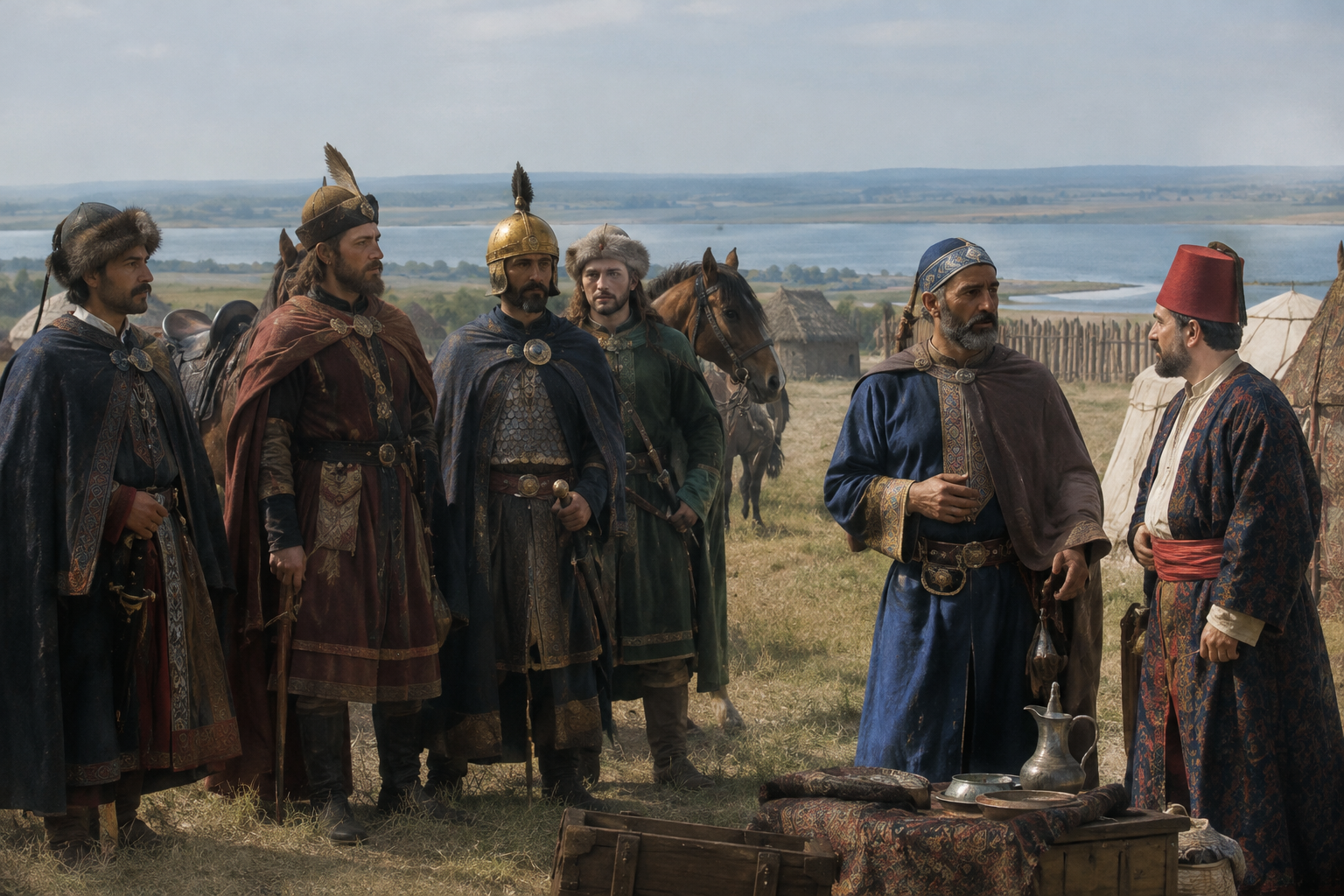
At Kunpeszer in Hungary, four men buried in elite Avar graves around AD 609 - KUP009, KUP010, KUP011, and KUP012 - are linked in this dataset with the Y-DNA haplogroup I2a1b1a2a2a2. That is immediately striking, because the Avar world is so often imagined in purely steppe terms: horsemen from the east, an imperial elite on the move, and a political order that arrived dramatically in the Carpathian Basin in the late sixth century. Yet a paternal lineage associated with these graves points us toward a more complicated reality.
The complication matters. Y-DNA traces one direct paternal line only, not a person's whole ancestry, language, or identity. Even so, when the same branch appears more than once in a tightly defined archaeological setting, it becomes historically interesting. In this case, I2a1b1a2a2a2 turns up not in a single isolated burial, but across several early seventh-century graves in Avar-period Hungary, and then appears again in later contexts stretching toward Anatolia and the Aegean.
The strongest cluster here is clearly Kunpeszer. Four individuals from elite graves - KUP009, KUP010, KUP011, and KUP012 - are all dated to around AD 609 and described as belonging to the early Avar or Gallic Avar elite in Hungary. Even without embroidering the cemetery beyond what is securely given, that concentration is important in itself. It suggests that this paternal line was present among men granted high-status burial within an Avar-period setting.
That does not mean the haplogroup was "Avar" in any simple ethnic sense. The Avar Khaganate ruled over a mixed population, and one of the big lessons of recent archaeogenetics is that early medieval power structures often pulled together men and families of quite different biological backgrounds. An ancient DNA study of Avar-period elites helped show just how varied these communities could be, especially when political identity and biological ancestry are compared.
So what does the Kunpeszer cluster tell us? Most cautiously, that one paternal line associated here with I2a1b1a2a2a2 could be carried by multiple men buried at the top end of Avar society in the Carpathian Basin. That may reflect kinship, patronage, or the incorporation of local or regional male lines into an Avar ruling framework. It is a useful reminder that early medieval elites were not biologically uniform blocs.
A second important appearance comes from Rakoczifalva in Hungary, where sample RKF224 is dated to about AD 650 and classified as Germanic Migration Period. This is a rather different label from the Kunpeszer graves, and that difference is precisely why the sample is useful. It places the same reported haplogroup association into another social and archaeological frame within the same broad region.
Now, one must be careful here. "Germanic Migration Period" is an archaeological-historical label, not a biological essence, and it does not tell us that a man with this lineage belonged to a single fixed people. But RKF224 does show that the branch was not confined to one burial ground or one political identity. In the Carpathian Basin of the sixth and seventh centuries - a zone shaped by the end of Roman rule, shifting military networks, and layered local communities - that is exactly the sort of pattern we should expect.
This is where a narrow Y-line can illuminate the texture of the age. Not by providing a grand ethnic answer, but by revealing continuity and overlap inside a world usually described only in terms of invasions and replacements. The same paternal branch could move through, or remain within, communities labelled Avar, Germanic, Roman provincial, or something more local and less visible in the written record.
The geographical range widens with I10546, a Byzantine Roman individual from Ilipimar in the Marmara region of Anatolia, dated to around AD 700. By this point we are in the eastern Roman world, not Avar Hungary, and that changes the historical backdrop entirely. Yet the reported presence of the same haplogroup association matters because it shows this was not a line confined to one frontier society north of the Danube.
Here the setting is especially evocative. The Marmara region sat at the hinge between Europe and Asia, close to imperial routes, military corridors, and long-lived provincial populations. A genetic study of ancient populations in this broader zone, published in research on southeastern Europe's genomic history, has underlined how interconnected these landscapes were across late antiquity and the early Middle Ages. That larger context makes it entirely plausible that a paternal branch seen in Hungary could also appear in Byzantine Anatolia without requiring any single dramatic migration story.
In other words, the significance of I10546 is not that it "proves" an Avar moved to Byzantium, or vice versa. It is that the branch attached here to I2a1b1a2a2a2 belonged to the human traffic of the middle Danube and the eastern Mediterranean alike. Soldiers, settlers, provincials, captives, traders, and descendants of much older Balkan and Anatolian populations all inhabited this connected world.
The latest sample in this small sequence is I14844, from Iznik in the Marmara region, dated to AD 1564 and described as Medieval Aegean Anatolia. Iznik, ancient Nicaea, had by then passed through Roman, Byzantine, Seljuk, and Ottoman worlds. A lineage found there in the sixteenth century is therefore not evidence of one uninterrupted family story, but it is evidence of durability.
That durability is one of the most interesting features of this haplogroup's sample trail. Between the early seventh century and the sixteenth, the political map changed repeatedly, empires rose and fell, and religious life was transformed. Yet a paternal branch associated in this dataset with I2a1b1a2a2a2 still appears in the same broad Marmara zone. For family historians, that is a sober but valuable lesson: paternal lines can outlast almost every historical label pinned to them.
It also helps explain why Y-DNA can feel both precise and slippery. Precise, because a branch name such as I2a1b1a2a2a2 describes a particular paternal position in the Y-tree. Slippery, because the men who carried it could live as Avar elites, post-Roman Hungarians, Byzantine provincials, or Ottoman-era Anatolians. The lineage stays; the historical costume changes.
Eastern Mediterranean continuity
On present evidence, I2a1b1a2a2a2 appears here as a paternal line moving through the middle Danube and the Marmara-Aegean world across nearly a millennium. The standout evidence is the Kunpeszer cluster, where several elite Avar-period graves share the same reported association, placing this branch inside a high-status early medieval setting. The wider pattern, though, is even more revealing: this was not a lineage tied to one empire or one identity, but one that persisted across changing frontiers and political orders.
If this is your haplogroup, the safest historical takeaway is not a romantic claim about a single people, but a strong connection to the mixed and mobile worlds of southeastern Europe and nearby Anatolia. It is the sort of lineage that fits the real early medieval past rather well: layered, local in some places, mobile in others, and never reducible to one neat label.






Comments