Haplogroup I2a1b1a2a1a1a
– 4 min read


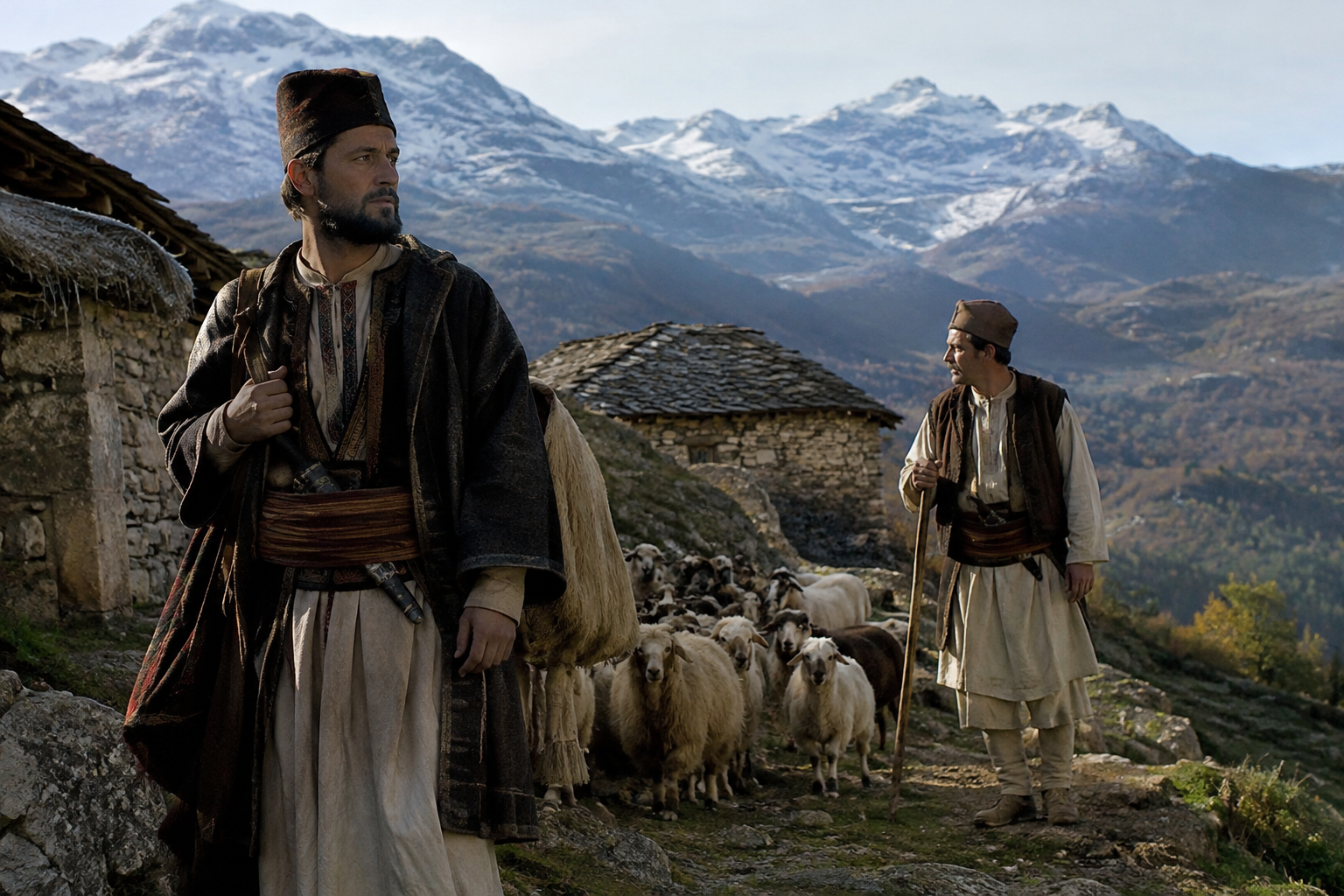
In the late medieval cemetery at Bardhoc in the Kukes district of northern Albania, one excavated man, sample I14686, dated to about AD 1550, carries the very specific Y-DNA lineage I2a1b1a2a1a1a. That may sound forbiddingly technical, but the setting is wonderfully concrete: not a legendary founder, not a royal tomb, but a real person buried in a real Balkan community at the edge of the medieval and early Ottoman worlds.
That matters because haplogroups are often discussed as if they floated above history. Bardhoc brings this one back to earth. Here, the branch appears in a documented Albanian context, in a period when the western Balkans were shaped by long local continuity, political upheaval, shifting frontiers, and communities that were anything but isolated.
Bardhoc lies in a region where valleys, uplands, and routes through the mountains tied northern Albania to Kosovo and the wider central Balkans. By the mid-16th century, when I14686 lived, this was a landscape with deep pre-medieval roots but also centuries of Roman, Byzantine, Slavic, and Ottoman-era change layered upon it. A Y-chromosome result from such a burial is not a label for the whole person, still less for an entire people, but it does preserve one direct paternal line moving through that historical world.
The immediate significance of I14686 is therefore precise rather than grandiose. It shows that the lineage I2a1b1a2a1a1a was present in late medieval northern Albania, and present not as an abstract modern statistic but as an attested paternal line in an excavated individual. For anyone exploring paternal ancestry in the Balkans, that is exactly the sort of evidence one wants: local, dated, and archaeologically grounded.
Deep Balkan roots of Albanians
The long string I2a1b1a2a1a1a identifies a narrow twig on the much larger Y-DNA tree. In plain terms, Y-DNA follows one line only: father to son to son across generations. That makes it extremely useful for tracing paternal continuity, but it is not a summary of a person's whole ancestry, language, or identity. A man buried in 16th-century Albania with this haplogroup was not genetically reducible to that one line any more than a surname captures an entire family history.
It is also important not to inflate a narrow subclade into the entire history of its parent lineage. Haplogroup I as a broad family has a very deep European past, and branches of I2 are well known in southeastern Europe. But the article haplogroup here is much more specific than that. With the evidence at hand, the careful statement is simply that this exact paternal branch is represented by a late medieval Albanian individual at Bardhoc.
A single medieval sample becomes more interesting when placed against the longer population history of the Balkans. The region has repeatedly shown strong local continuity mixed with episodes of incoming ancestry and cultural transformation. That pattern is visible in archaeology as much as in genetics: prehistoric foragers, early farmers, Bronze and Iron Age communities, Roman provincial populations, and medieval groups all contributed to the human landscape from which later Albanians emerged.
That is why Bardhoc should not be read as an isolated curiosity. A late medieval paternal lineage from northern Albania sits in a part of Europe where old Balkan substrata survived many political turnovers. Research on ancient populations in the region has increasingly emphasized just that combination of depth and change, rather than simplistic tales of total replacement. One broad genetic study relevant to this background is available at https://www.science.org/doi/10.1126/science.abm4247, which has been important in discussions of southeastern Europe's long population history.
Balkan hunter-gatherer background
Seen in that light, I14686 is valuable precisely because he belongs to a much later chapter. He shows that when we reach the late medieval period, after all the centuries of imperial rule and regional mobility, one very specific paternal branch of the I2 world is still present in northern Albania. Continuity in the Balkans is never a matter of perfect stasis, but neither is it a story of people endlessly appearing from nowhere.
There is another reason the Bardhoc burial is useful. The 15th and 16th centuries in Albania are often narrated through warfare, resistance, noble politics, and Ottoman incorporation. Important as those themes are, they can encourage the false impression that local populations were neatly bounded. Ancient DNA keeps complicating that picture. Medieval Balkan communities could preserve deeply rooted local ancestry while also reflecting mobility, intermarriage, and contact across nearby regions.
So the presence of I2a1b1a2a1a1a at Bardhoc should not be turned into a tribal badge or a claim of exclusive descent. The better historical reading is subtler and more interesting: this paternal line formed part of the demographic fabric of a northern Albanian population living at a time of major political transition. The sample gives us a fixed point in that fabric.
Albanian ancestry and language
Readers sometimes assume that a lone Y-DNA result tells us too little to matter. In one sense that is true: one burial cannot stand for all Albanians, all medieval Balkans, or even all men at Bardhoc. But ancient DNA works cumulatively. Each securely placed individual helps pin a lineage to a time and place, and that is especially helpful for paternal branches whose modern distribution may be broad but whose historical waypoints are still patchy.
I14686 is one of those waypoints. He anchors I2a1b1a2a1a1a in late medieval northern Albania, adding chronological depth to a lineage that many testers may know only from present-day matches and branching diagrams. Archaeology gives the branch context; genetics gives it specificity. The two together are far more useful than either alone.
That is also why Balkan case studies are so important for European Y-DNA more generally. The peninsula has often acted less like a cul-de-sac and more like a durable human crossroads. Lineages can persist there for long periods while populations around them shift, mingle, and reorganize. A medieval Albanian Y-line, then, is not merely local trivia. It is part of the larger problem of how paternal descent survives historical turbulence.
Balkan and Black Sea migrations
The most responsible takeaway is a modest but meaningful one. In the present evidence, I2a1b1a2a1a1a is attested in a man buried at Bardhoc in northern Albania around AD 1550, placing this paternal line firmly within the late medieval western Balkans. For someone researching this haplogroup today, that does not guarantee descent from any named clan or famous house, but it does point toward a historically rooted Balkan context in which this branch was genuinely lived, inherited, and carried forward from father to son.






Comments