Haplogroup I2a1b1a1b1b1

– 5 min read


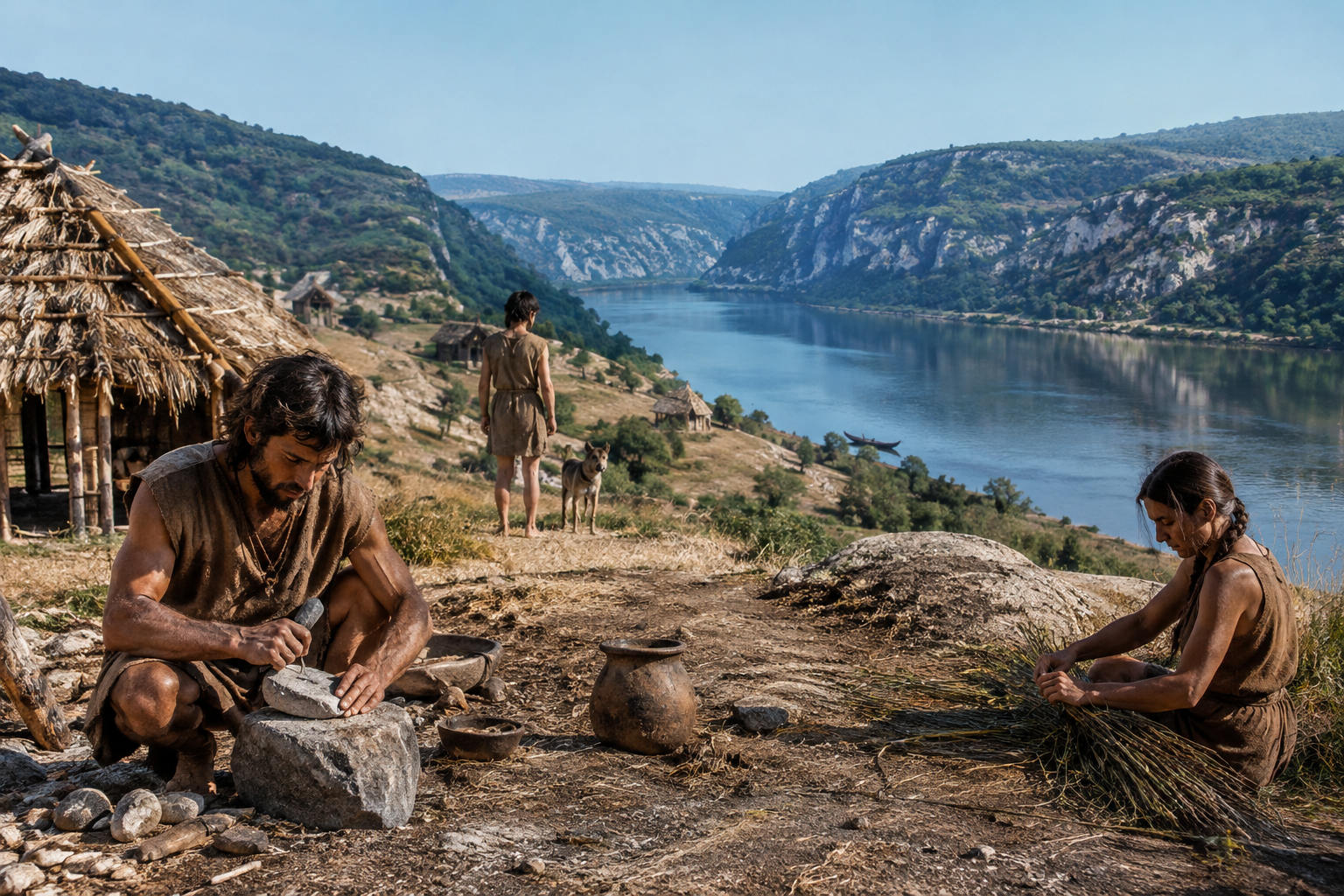
At Padina in the Iron Gates of the Danube, archaeologists uncovered a burial now catalogued as I5243, dated to around 2348 BC. That date alone makes the individual interesting: this is not a medieval nobleman or a much later tribal warrior, but a man from the Bronze Age in one of Europe's most important long-term contact zones, where the river cuts between the Balkans and the Carpathian world. He is reported here in connection with the Y-DNA haplogroup I2a1b1a1b1b1.
That matters because the Iron Gates is one of those places where prehistory refuses to sit still. For millennia, this stretch of the Danube saw hunter-gatherers, early farmers, and later Bronze Age communities overlap, mix, and replace one another in complicated ways. A paternal lineage such as I2a1b1a1b1b1 traces only one direct male line, not a person's total ancestry, but in a place like Padina even that single line can illuminate deep local continuity and change.
Padina is famous in Balkan archaeology because it belongs to the wider Iron Gates landscape, a region with an unusually rich record from the Mesolithic onward. The Danube gorge was not just a border or a corridor. It was a lived-in world of settlements, burials, and repeated human presence across thousands of years.
By the time of I5243, the old Mesolithic world of the gorge was long gone, yet the place still mattered enough for burial and remembrance. That is often the striking thing about prehistoric landscapes: people kept returning to the same river terraces and promontories, even when their economies, languages, and ancestry profiles had changed. A Bronze Age man at Padina therefore sits inside a much older story of place, not in isolation from it.
An ancient DNA study of the broader region, published in Science, helped sharpen that larger picture by showing how populations in Southeastern Europe were repeatedly reshaped through interaction between local groups and newcomers. The importance of I5243 is not that he stands for all Bronze Age Serbians, still less for every carrier of I2a1b1a1b1b1 today, but that he anchors this paternal branch in a real archaeological setting on the middle Danube.
The wider haplogroup I2 is one of the classic old European Y-chromosome lineages, with deep roots in the continent before and during the great demographic changes of the Neolithic and Bronze Age. But the article haplogroup here is not the whole of I2. It is the far narrower branch I2a1b1a1b1b1, and that distinction matters.
It would be a mistake to take everything ever said about I2 as automatically true for this exact subclade. Ancient DNA has shown again and again that broad haplogroups can survive through enormous cultural shifts, while their sub-branches rise, contract, or move in very different ways. So the value of a sample like I5243 is precision: it shows this paternal line, or a reported association with it, in the Bronze Age Danube zone rather than in some vague pan-European past.
That also helps counter a common misunderstanding. A Y haplogroup is not an ethnicity, not a language, and not a ready-made identity label. A man buried at Padina around the mid-3rd millennium BC could carry an old European male line while belonging to a population whose overall ancestry had already been shaped by many layers of mixture.
When people picture Bronze Age Europe, they often jump straight to wagons, warriors, and sweeping migrations from the steppe. Those movements were indeed important, but the Balkans were never an empty stage waiting for them. This was already a densely historical region in prehistoric terms, filled with communities who had their own local ancestry, their own sacred places, and their own relationships with major rivers.
That is one reason a lineage like I2a1b1a1b1b1 appearing at Padina is so suggestive. In Southeastern Europe, some paternal lines linked to earlier European populations continued into later periods even as the genetic profile of whole communities shifted. The Bronze Age did not simply erase what came before. It rearranged it.
In that respect, Padina fits a wider Balkan pattern visible in archaeogenetics: persistence alongside transformation. The same landscapes could witness cultural turnover, new ancestry components, and yet also the survival of older male lines. If your paternal ancestry falls in this branch, that does not prove descent from this man at Padina, of course, but it does place your line within a historical theater where continuity could be remarkably stubborn.
The Iron Gates is one of those regions where geography itself explains much of the history. The Danube connected the Pannonian Basin, the central Balkans, and the Black Sea world. People, materials, marriage networks, and ideas moved along it, but rivers also preserve local worlds. Communities living beside such routes can be both open and conservative at once.
That makes the Padina individual more than a dot on a map. He belongs to a river corridor where archaeologists can watch very long sequences of human occupation. A paternal lineage found here may reflect local survival, regional mixing, or both. What it should not be turned into is a simplistic tale of a single people marching unchanged from prehistory to the present.
Research into population history around the North Pontic and Balkan zones has increasingly emphasized this same point: the lands between the Carpathians, Balkans, and western Black Sea were repeatedly connected yet never genetically uniform. The Danube carried traffic, but it also accumulated history. Each ancient burial adds one more fixed point in that moving landscape.
There is only one ancient sample listed here, and that limitation should be taken seriously. One excavated individual cannot define a whole tribe, region, or millennium. Yet archaeology is full of cases where one securely placed burial becomes important precisely because it is securely placed. I5243 gives this branch a documented foothold in Bronze Age Serbia, at a site already central to European prehistory.
That foothold is useful in another way too. It keeps the discussion tied to evidence rather than fantasy. Without an ancient sample, people often fill the silence around a haplogroup with sweeping maps and romantic origin stories. With Padina, we can start somewhere concrete: one man, one site, one date range, one stretch of the Danube, and a paternal line associated with I2a1b1a1b1b1.
For readers interested in how ancient DNA is transforming our picture of this wider region, MyTrueAncestry has also explored related evidence from southeastern Europe and the Black Sea world in several other contexts.
The most responsible insight from this evidence is also the most interesting one. I2a1b1a1b1b1 is a deeply European paternal branch whose story, at least in this article's evidence, reaches into the Bronze Age Balkans and specifically to Padina in the Iron Gates. That places the lineage in a region famous for long-term human continuity, repeated interaction, and survival through major prehistoric transitions.
So if this is your Y-DNA line, the picture is not one of neat ethnic labels or a single heroic migration. It is something older and more archaeological: a male line present in a Danubian landscape where Europe kept remaking itself, but never entirely from scratch.


Comments