Haplogroup I2a1a2b1
– 5 min read


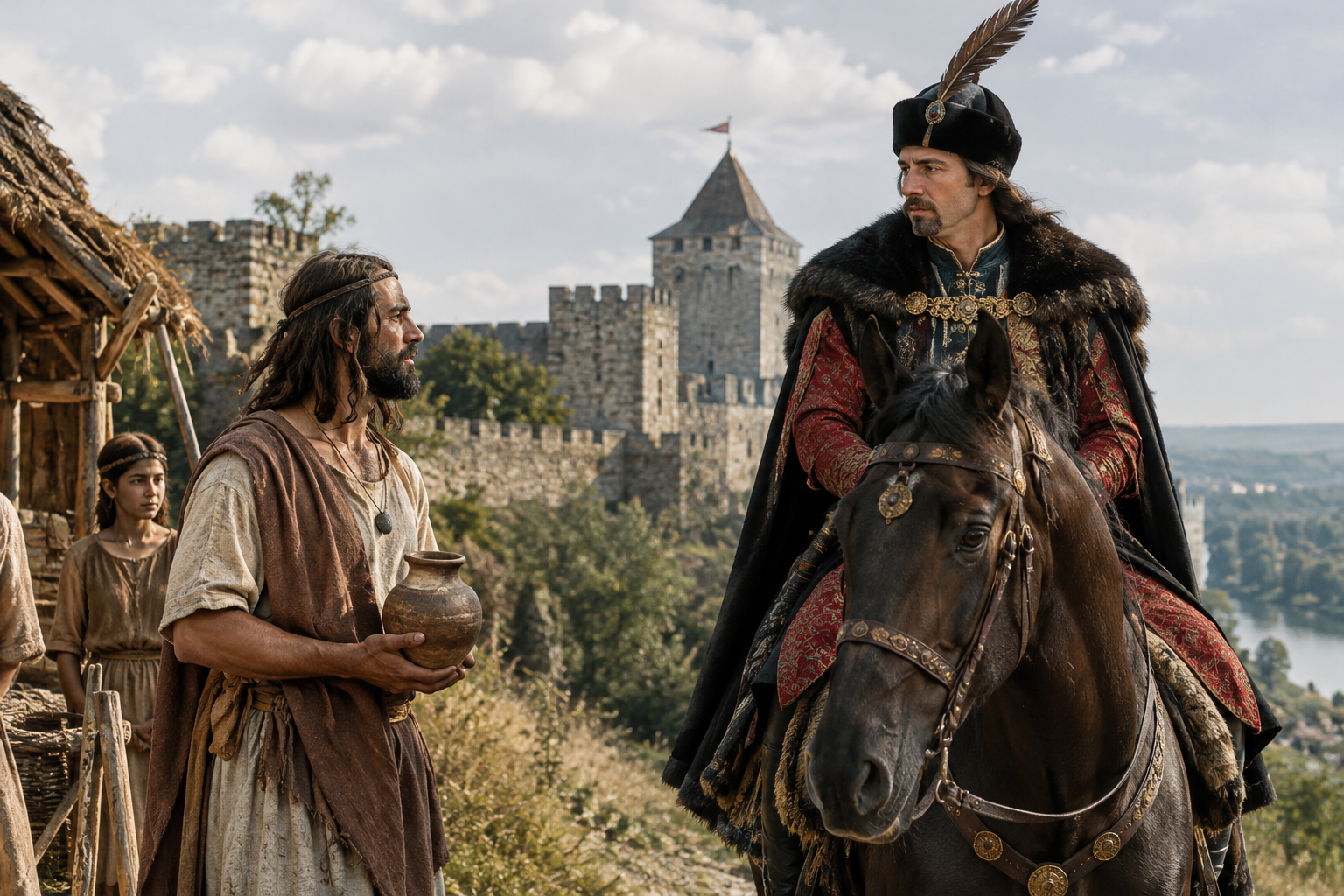
At Pericei in medieval Hungary, one male burial identified as PER02 has drawn particular interest because it belongs to a noble context associated with the Bathory family and is dated to around AD 1500. For anyone exploring Y-DNA haplogroup I2a1a2b1, that is an arresting starting point: not because one late medieval nobleman can define a whole lineage, but because he shows this paternal branch turning up in a documented social world of rank, land, and dynastic memory in the Carpathian Basin.
The surprise is that this is not only a medieval story. Another ancient individual linked here, YUN038 from Yunatsite in Bulgaria, dates to about 2838 BC in the Early Bronze Age. Put those two men side by side and the outline becomes much more interesting. The same Y-chromosome branch, or an assignment associated with it, appears in two very different settings separated by more than four millennia: one in prehistoric southeastern Europe, the other in a late medieval aristocratic milieu. That does not prove direct descent from one to the other, of course. But it does make I2a1a2b1 a lineage worth examining through the long archaeology of the Balkans and the Carpathian world.
Y-DNA follows a direct paternal line: father to son to son, across generations. That makes it unusually good for tracing one narrow strand of ancestry, while telling us only a limited part of any one person's full heritage. Haplogroup I2a1a2b1 is therefore best understood as a branch within the broader I2 family, not as a shorthand for ethnicity, language, or political identity.
That matters here because the two featured finds belong to entirely different worlds. An Early Bronze Age man from Bulgaria and a nobleman buried in medieval Hungary were separated by enormous changes in language, economy, religion, and state formation. The value of the haplogroup is not that it magically flattens those differences, but that it lets us watch one paternal thread reappear in changing historical settings.
The earlier of the two samples, YUN038, comes from Yunatsite in Bulgaria and is dated to around 2838 BC. Yunatsite is one of those southeastern European sites where archaeology forces us to think long-term. The region had already seen millennia of farming communities, contacts across the Balkans, and repeated local change before this man lived there in the Early Bronze Age.
That is precisely why a Y-DNA identification from Yunatsite matters. It places an I2-related paternal line in a region that has deep importance for European prehistory. A great deal of ancient DNA work has shown that the Balkans were not a backwater but one of the key zones where forager ancestry, incoming farmers, and later Bronze Age population changes met and mixed. Research on the wider region, including an ancient DNA study of Balkan population history, has helped clarify just how old and locally entangled some paternal lines in southeastern Europe can be.
We should be careful, though, not to over-claim. A single Early Bronze Age male does not establish the origin point of I2a1a2b1, nor does it show that every later carrier in eastern Europe must descend from one uninterrupted local line at Yunatsite itself. What it does provide is something more solid: evidence that a branch associated with this haplogroup was present in prehistoric Bulgaria long before medieval states and noble houses entered the picture.
If Yunatsite gives us the deep background, PER02 gives us a social and historical setting with names attached. This individual comes from Pericei and is described as a medieval Hungarian Bathory male nobility burial, dated to about AD 1500. That immediately shifts the scale of the story. We are no longer looking at broad prehistoric population history, but at a specific man embedded in the aristocratic society of late medieval eastern Hungary and Transylvania.
By around 1500, this was a frontier-rich, politically charged world. The Kingdom of Hungary sat at the intersection of Latin Christendom, regional noble power, and the growing pressure of the Ottoman advance. Families like the Bathorys mattered because they were not simply local landholders; they moved in the high politics of the region, holding offices and shaping military and dynastic affairs.
A genetic study examining medieval Hungarian elite burials, including material associated with such contexts, has helped place some of these individuals within wider patterns of ancestry and paternal descent in the region. Where PER02 is associated with I2a1a2b1, the point is not that the haplogroup was uniquely noble. Quite the reverse: a lineage with much deeper prehistoric roots could, by the late Middle Ages, appear within an aristocratic house. That is often how Y-chromosome history works in practice. Old paternal lines do not sit still; they pass through new languages, new loyalties, and new political orders.
The Bathory association is historically important, but it needs handling with care. A noble burial linked to the Bathory milieu can illuminate the paternal lineage of that individual or line of descent, yet it does not automatically define every branch of the wider family across all centuries. Medieval and early modern noble houses often had complicated genealogies, cadet lines, disputed attributions, and the occasional break between written pedigree and biological descent.
Still, Pericei matters because it anchors I2a1a2b1 in a documented human landscape. Here the haplogroup is not an abstract code on a phylogenetic tree. It belongs to a man who lived in a recognizable historical moment, in a region where politics, kinship, and inheritance mattered intensely. That gives modern testers something more tangible than a frequency map: a glimpse of the lineage operating inside the world of late medieval power.
The broader background of Hungarian dynastic and elite genetics also makes the point that medieval Hungary was no simple ethnic block. It was a meeting ground of older regional populations, steppe-linked arrivals, neighboring Slavic and Balkan influences, and elite lineages formed through centuries of alliance and mobility. In that setting, finding I2a1a2b1 in a noble burial is perfectly plausible as part of a layered regional history rather than a single dramatic migration tale.
What gives this small dataset its force is not quantity but contrast. YUN038 at Yunatsite shows that an I2-related paternal line was present in southeastern Europe in the Early Bronze Age. PER02 at Pericei shows a branch associated with the same haplogroup in a late medieval noble context far to the north-west of that prehistoric site, yet still within the broader Balkan-Carpathian zone.
That combination suggests durability. Not permanence in the simplistic sense of one family sitting in one village for 4,000 years, but durability in the more historically realistic sense: a paternal line surviving repeated cultural turnovers and reappearing in different societies. The Balkans and the Carpathian Basin are famous for exactly that sort of layered continuity. Populations changed, mixed, moved, and reorganized, but not every earlier lineage vanished when a new archaeological horizon or ruling elite appeared.
It also reminds us that Y-DNA stories are often more local and more complicated than old-fashioned migration myths allowed. A lineage like I2a1a2b1 may be best understood not as the badge of one people, but as one of the long-lived paternal threads woven through southeastern Europe's changing populations.
For someone who carries Y-DNA haplogroup I2a1a2b1 today, these finds offer one careful but meaningful insight. This lineage is visible in the archaeological record both in Early Bronze Age Bulgaria and in a late medieval noble context at Pericei, suggesting a paternal history with considerable time depth in southeastern Europe and the neighboring Carpathian world. That is not a promise of descent from a named dynasty, and it is not a complete account of your ancestry. But it is a good historical clue: your direct paternal line may belong to one of the older male threads that endured through the making and remaking of this region's past.


Comments