Haplogroup I2a1a2a2

– 5 min read


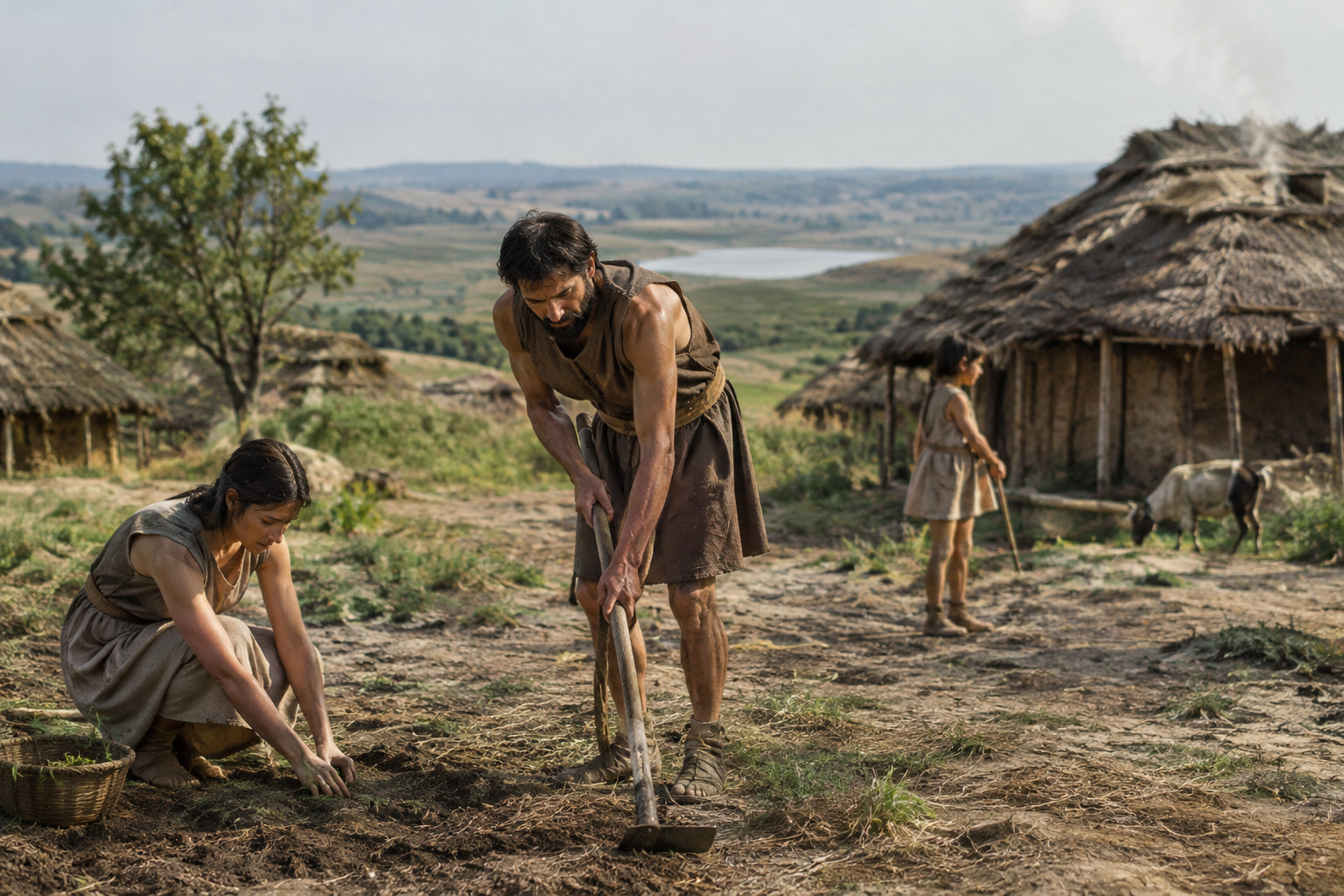
At Mokrin near Kikinda in northern Serbia, an Early Bronze Age cemetery has become one of the most revealing prehistoric family archives in the Balkans. Among the individuals recovered there is sample I23205, dated here to about 1800 BC and associated with the Y-DNA haplogroup I2a1a2a2. That is immediately interesting because Mokrin is not just any burial ground: it sits in the old crossroads zone between the Carpathian Basin and the Balkans, where movement, marriage, and local continuity all meet in the same archaeological landscape.
For anyone carrying I2a1a2a2 today, this is the sort of find that matters. Y-DNA follows one direct paternal line only, not a person's whole ancestry, but it can still show how a male lineage turns up in real communities. In the case of Mokrin, the question is not whether one man lived there, but what his presence says about Bronze Age society in a region with very deep Balkan roots and constant contact with neighboring worlds.
The cemetery at Mokrin belongs to the Early Bronze Age in the Banat region, an area that has long been important for understanding prehistoric southeastern Europe. Ancient DNA has made the site even more valuable, because the burials can be studied not merely as isolated skeletons, but as members of a structured community. Sample I23205, assigned here to I2a1a2a2, places this paternal line within that setting rather than in some abstract map of later populations.
What gives Mokrin its particular force is that it helps move discussion of Balkan Y lineages away from myth and toward evidence. Haplogroup I as a wider family is one of Europe's deep paternal branches, and several of its sub-branches have long histories in southeastern Europe. But the narrower label I2a1a2a2 should not be treated as a shorthand for all Balkan history. What the Mokrin evidence gives us is something much more useful: a documented Early Bronze Age occurrence of this paternal line in a real burial population.
A broader ancient DNA study of the region, published in Nature, helped show how dynamic the prehistoric Balkans and neighboring zones were, with ancestry shaped by long-term local populations as well as later movements. That wider context matters here. A paternal lineage such as I2a1a2a2 could persist through major social changes precisely because communities were not replaced in one simple sweep.
Modern discussions of haplogroups often jump straight from genetics to ethnicity, as if one paternal branch could be equated with a language, tribe, or nation. Mokrin is a good antidote to that habit. Around 1800 BC, there were no Serbs in the medieval sense, no modern national borders, and no tidy ethnic boxes that map neatly onto a Y chromosome.
Instead, we are looking at a Bronze Age population living in a frontier-like zone between larger cultural spheres. That makes I23205 significant for I2a1a2a2 because it anchors the branch in a place where local Balkan ancestry and wider continental interaction overlapped. It suggests that this paternal line was present in the male population of the region during the Bronze Age, not merely as a late historical arrival inferred backward from modern distributions.
This is particularly relevant in southeastern Europe, where ancient DNA increasingly shows both continuity and change operating together. Some genetic components run very deep in the Balkans, while later periods bring new ancestry and new social formations. A lineage like I2a1a2a2 can therefore be old in regional terms without implying a single uninterrupted identity from prehistory to the present.
The Banat plain was never an isolated corner. It linked river systems, farming communities, and exchange routes stretching toward the Carpathian Basin and farther south into the Balkans. A cemetery such as Mokrin belongs to that connected world. When a paternal lineage such as I2a1a2a2 appears here, the historical interest lies in its participation in a networked society rather than in any fantasy of a sealed-off bloodline.
That is where ancient cemeteries are so useful. They let us ask whether men sharing a broad region also shared the same paternal ancestry, whether communities drew spouses from outside, and whether social organization was built around tight male descent groups or something more flexible. Mokrin has been important precisely because such questions can be explored there in more detail than at many other Bronze Age sites.
The result is a more human picture of haplogroups. I2a1a2a2 is not just a code on a testing screen; at Mokrin it belonged to an actual man buried in an Early Bronze Age community shaped by family ties, local history, and wider interaction. That is a far richer and more historically responsible story than trying to force the lineage into a single later ethnic label.
One reason this branch draws attention is that the broader I2 family is often associated with old European paternal variation, especially in southeastern Europe. But one must keep the scales clear. The presence of a broad parent haplogroup in Mesolithic or Neolithic Europe does not automatically tell us the full story of the later and narrower branch I2a1a2a2. Subclades have their own histories, and those histories can include expansions, bottlenecks, and regional reshaping long after the parent branch first appeared.
Even so, the Mokrin sample sits comfortably within a bigger Balkan pattern in which ancient DNA has repeatedly challenged the idea that the region's past can be reduced to one migration at a time. The Balkans were home to foragers, early farmers, steppe-linked newcomers, and later historic populations, all layered across the same terrain. A paternal lineage surviving within that environment may reflect persistence through adaptation and integration rather than isolation.
This is why a single ancient sample can be so revealing. I23205 does not prove where every modern carrier of I2a1a2a2 comes from, but it does show that the branch had reached, or remained in, northern Serbia by the Early Bronze Age. That gives the lineage a documented foothold in one of Europe's most important contact zones.
Balkan continuity and shifting paternal lines
If your Y-DNA falls under I2a1a2a2, the Mokrin evidence offers something solid but modest: this paternal branch is attested in the Early Bronze Age Balkans, in a cemetery from northern Serbia that belongs to a connected prehistoric community. That does not make every present-day carrier a direct descendant of this particular individual, nor does it compress 3,800 years of history into one straight line of identity.
What it does suggest is that your paternal line belongs to a branch with a demonstrable place in the old Balkan-Carpathian world. It was there among real Bronze Age people, in a region where families, mobility, and local continuity all mattered. For genealogists, that is often the most valuable kind of result: not a legend, but a securely grounded glimpse of where one paternal thread was already woven into the human landscape.
The best current ancient clue for I2a1a2a2 in this article is not a king, a clan founder, or a heroic tradition. It is I23205 from Early Bronze Age Mokrin: a man from a Serbian cemetery in a region where Europe's older paternal lines and later population shifts met face to face. For anyone tracing this haplogroup today, that is a valuable starting point - evidence that your direct paternal line was already part of the Bronze Age Balkans' complicated, very human history.





Comments