Haplogroup I2a1a2a1a1b
– 5 min read


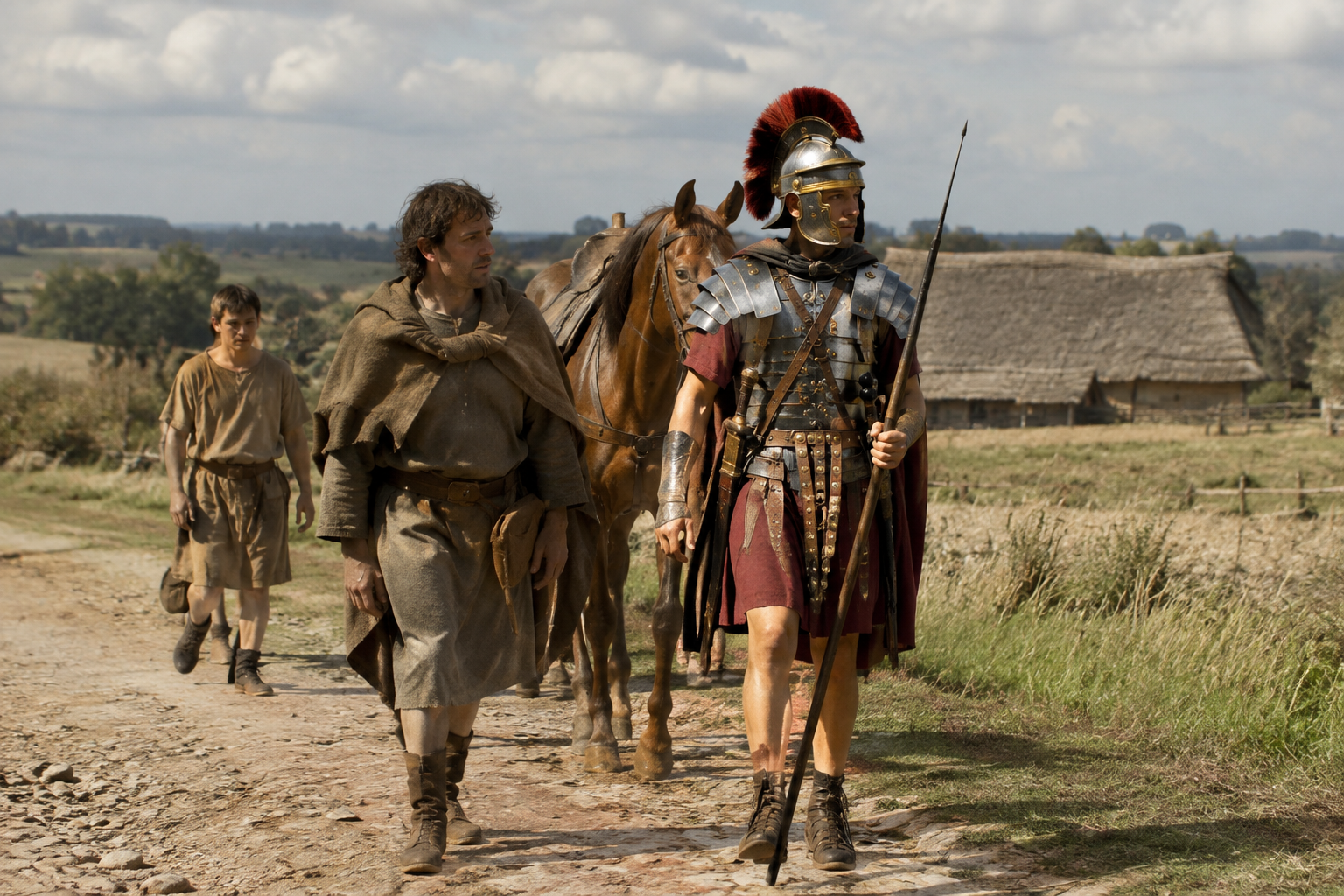
At Duxford in Cambridgeshire, one Roman-era man, catalogued as DUX001 and dated to around AD 200, gives us a rare and useful anchor for the Y-DNA haplogroup I2a1a2a1a1b. There is nothing flashy about that bare identification on its own. Yet that is precisely why it matters: it places this paternal line in a real excavated landscape of Roman Britain, in a county that sat close to roads, markets, military movement, and the busy agricultural life of the province.
For anyone carrying I2a1a2a1a1b today, DUX001 is a reminder that a Y-chromosome story is not the same thing as a whole ancestry story. Y-DNA follows one direct paternal line only. But when that line turns up in an excavated individual from Roman Cambridgeshire, it lets us ask a properly historical question: what did it mean for a paternal lineage associated with deeper European prehistory to be present in a settled community of imperial Britain?
Duxford sits in a part of eastern England that, during the Roman period, was neither a remote frontier nor an isolated village world. Cambridgeshire lay within a networked province, shaped by roads, farming estates, market exchange, and the social churn that came with Roman rule. A man buried there around AD 200 belonged to a Britain already centuries into imperial administration, taxation, local adaptation, and cultural mixing.
That makes DUX001 interesting beyond the simple fact of his haplogroup. The Roman world did not erase local paternal lines, but it did place them in new settings. A lineage like I2a1a2a1a1b could persist through local descent, arrive through mobility within Britain, or reflect older continental connections that long predated the Roman conquest. The point is not to force one answer, but to see that Roman Britain was a place where deep ancestral branches continued inside a very historical, very organized provincial society.
A broader ancient DNA study of Britain from the Roman and early medieval periods has helped sharpen exactly these kinds of questions, showing that continuity and change could sit side by side in the same region and even the same cemetery landscape. For context on that wider picture, see this genetic study of Roman and early medieval Britain.
Roman and Early Medieval Britain DNA
The larger haplogroup I is one of the old European Y-chromosome families, with deep roots in the continent's prehistoric population history. Within that wider tree, I2 and its many branches appear repeatedly in ancient European contexts, especially when archaeologists and geneticists examine the long relationship between hunter-gatherer ancestry, later farming populations, and the reshaping of male lineages over thousands of years.
But it is important not to overclaim. The article haplogroup here is not simply "I2" in general; it is the much narrower branch I2a1a2a1a1b. A narrow branch should not be made to carry every migration story ever told about its larger parent. What DUX001 gives us is secure historical placement in Roman Cambridgeshire. It does not, by itself, license a dramatic tale of one tribe, one invasion, or one named people.
Still, the presence of such a branch in Roman Britain fits a bigger European pattern in which old paternal lines did not vanish when new cultures, languages, or empires arrived. Instead, they were folded into changing societies. That is one of the most useful lessons of archaeogenetics: continuity in one line can coexist with major transformation in language, material culture, and overall ancestry.
When people imagine Roman Britain, they often jump straight to extremes: either a local Iron Age population carrying on beneath a Roman veneer, or a cosmopolitan imperial province crowded with migrants from every corner of the empire. The archaeology and the genetics point to something more interesting. It was both local and connected, often at the same time.
Cambridgeshire is a good region for seeing that balance. Its Roman communities were tied into agricultural production and exchange, but they were also close to routes that linked the southeast with the Midlands and beyond. In that sort of setting, a paternal lineage such as I2a1a2a1a1b need not be read as foreign or native in any simplistic sense. It may represent a line long established in Britain, a line that moved in from nearby regions, or one that had already been part of northwest European population structure before Rome ever appeared.
This is where one ancient sample earns its keep. DUX001 shows that the haplogroup was present in a lived Roman landscape rather than in a purely prehistoric or purely modern genetic abstraction. That grounded presence matters more than any romantic speculation about identity labels we cannot prove.
Cambridgeshire Through Ancient DNA
One of the temptations in Y-DNA writing is to apologize for small sample numbers. But archaeology often advances through exactly this sort of modest, well-placed evidence. A single dated burial from a known county and historical period can do real work, especially when it belongs to a narrow paternal branch that is not frequently discussed in popular writing.
DUX001 matters because he helps pin I2a1a2a1a1b to a specific social world: Roman provincial Britain in the second or early third century AD. That is a world of villas and roadside settlements, local traditions under imperial government, and communities that were shaped by both inheritance and movement. His Y-line is one thread in that fabric, not the whole cloth.
It is also worth saying that the Roman date is significant in another way. By AD 200, Britain had already seen generations of life under Rome. So this is not a first-contact horizon. It is evidence from a mature province, where lineages had already been living through long-term adaptation, marriage patterns, and changing local identities.
Many I2-related branches are better known from discussions of Europe's deeper past than from named historical settings. That can make later finds especially valuable. A branch becomes much more tangible when it appears in an excavated person from a datable historical period rather than only in reconstruction of distant population events.
Roman Britain is especially good for this kind of transition from deep ancestry to documented history. Ancient DNA from the island has repeatedly shown that Britain's population history was not a sequence of total replacements. Some paternal lines persisted across upheavals; others arrived and spread in later periods; many local communities were mixtures in ways the old textbook categories never quite captured. Readers interested in that wider problem of continuity and change may want to compare this with Ancient DNA in Post-Roman Britain, which explores the centuries after Roman rule.
There is also a useful caution here. The presence of I2a1a2a1a1b in Roman Cambridgeshire does not mean everyone with that haplogroup today descends from Britain, still less from Duxford itself. What it does show is that this paternal branch was part of the male-line landscape of Britain under Rome, and that alone gives the lineage a firmer archaeological footing than many people realize.
The real value of I2a1a2a1a1b in this case is not glamour but placement. Through DUX001, we can see the branch inside an ordinary but historically rich setting: Roman Cambridgeshire, around AD 200, in a province where local descent, regional mobility, and imperial structures all met. For someone researching this haplogroup today, that is a solid and meaningful clue. It suggests a paternal line that belongs comfortably within the long, layered population history of Europe and is archaeologically visible in Britain by the Roman period.






Comments