Haplogroup I2a1a1b1

– 5 min read


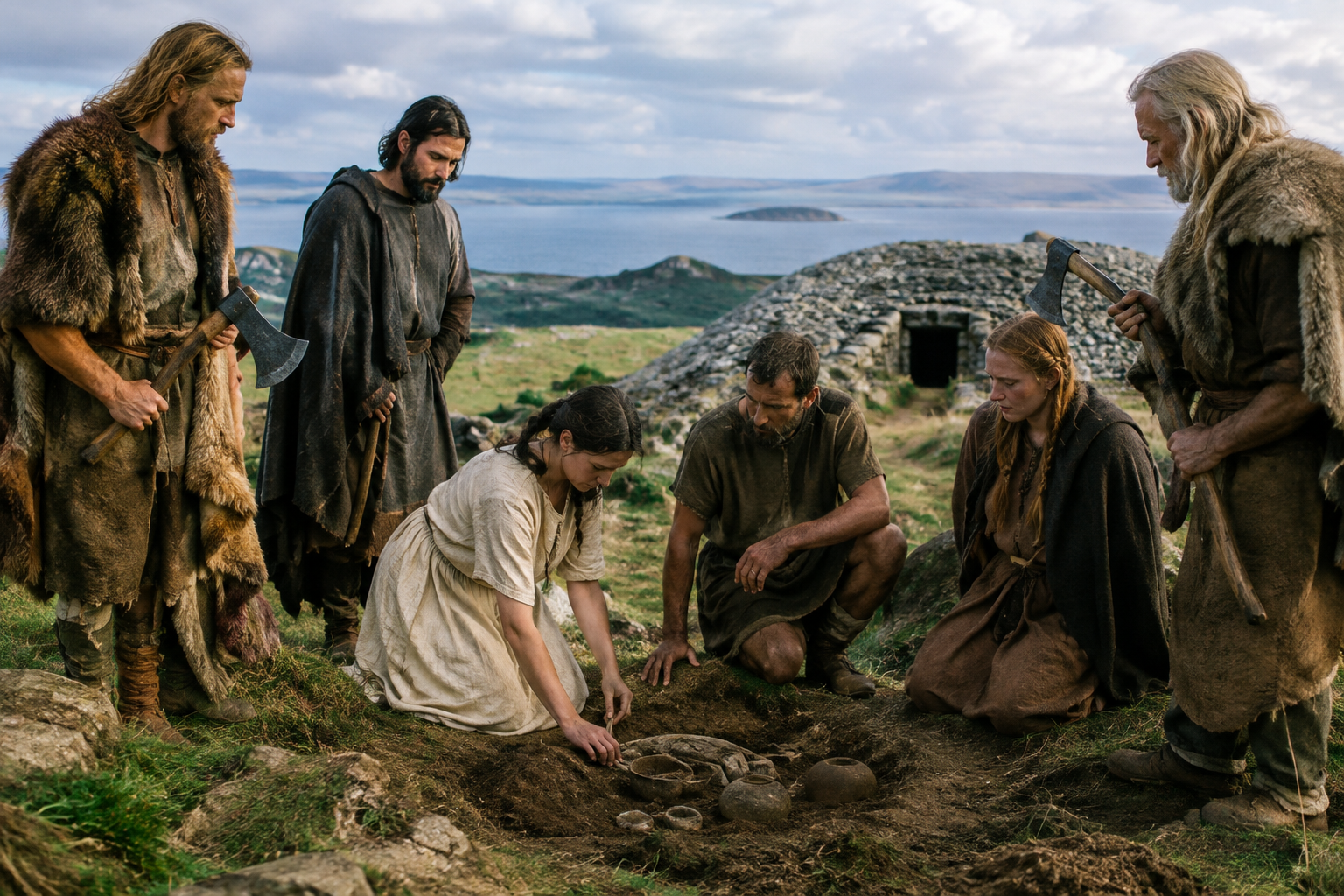
At Ajvide on Gotland, two men connected with the island's Battle Axe horizon, Ajvide58X and ajv52, bring haplogroup I2a1a1b1 into unusually sharp focus. They lived around 2750 BC, in a Baltic world where farming, seafaring, and older forager traditions were all meeting one another. That matters because I2 lineages are often discussed as if they belong neatly to one ancient way of life, when the archaeology keeps showing something rather more interesting: paternal lines can persist even as cultures, diets, and identities change around them.
For anyone researching this branch, that is the first useful point to hold onto. Y-DNA tracks one direct paternal line only; it does not sum up a person's whole ancestry. But when the same branch turns up in Neolithic Ireland, northern France, Bronze Age Serbia, and on prehistoric Gotland, it gives us a glimpse of long male-line continuity moving through very different communities and landscapes.
The Gotland evidence is probably the most striking place to begin because the island has become central to debates about how Neolithic and early Bronze Age populations mixed in the Baltic. Ajvide is better known from earlier Pitted Ware contexts, yet these two later individuals, Ajvide58X and ajv52, are associated with the Battle Axe cultural horizon, the Scandinavian expression of the wider Corded Ware phenomenon.
That does not mean that a Y-haplogroup by itself defines a Battle Axe identity. It does mean that the paternal line classified here as I2a1a1b1 appears within a cultural setting usually discussed in terms of major migration and ancestry turnover. In other words, the ancient record does not always show replacement in simple blocks. Local or regionally established male lines could survive inside new social formations.
A useful companion here is MyTrueAncestry's discussion of Gotland's prehistoric genetic complexity.
Research on Scandinavian Neolithic genomes has repeatedly shown that the Baltic was not some tidy frontier between farmers and foragers, but a zone of prolonged contact. A widely cited ancient DNA study of the region, published in Science, helped underline just how dynamic these northern populations were over time. The presence of I2a1a1b1 in this setting fits that broader picture of continuity mixed with change, rather than a single dramatic population switch.
If Gotland shows this lineage inside a changing Baltic world, Ireland shows something else: deep roots in Atlantic Neolithic communities. Three Irish samples linked with I2a1a1b1 stand out here: PB675 from County Clare, dated around 3486 BC; PB672, also from County Clare, around 3511 BC; and ASH3 from Ashleypark, Tipperary, around 3666 BC.
These dates place the Irish evidence well before the Battle Axe examples from Gotland. That is important. It suggests that this paternal branch, or a very closely related part of it, was already established among Neolithic populations on the western edge of Europe long before later Bronze Age and Corded Ware-related transformations reshaped other regions.
The Irish Neolithic has become one of the most revealing case studies in ancient DNA because tombs and burial places there have preserved not just genomes, but social patterns. A PNAS study on Neolithic Ireland drew attention to how these burial landscapes can illuminate kinship and social structure, even if each individual sample must still be handled carefully on its own terms. We should not assume PB675, PB672, and ASH3 were all close relatives simply because they share a broad paternal branch and belong to prehistoric Ireland. But together they do show that I2a1a1b1 was present in early farming communities there over several centuries.
The wider Irish context is worth following in its own right.
There is a tendency in popular writing to treat I2 lineages as relics of Mesolithic hunter-gatherers. The Irish evidence is a useful corrective. By the fourth millennium BC, lineages of this general family were clearly embedded in settled Neolithic worlds of farming, monument-building, and formal burial. Lineages endure; societies remake them.
The French sample 2H11 from Mon-Aime hypogee II, dated around 3213 BC, adds another piece to the puzzle. A hypogee is an underground burial chamber, and in Neolithic France such places often belong to communities with developed funerary traditions and strong regional identities. Even without inventing details that are not securely in hand for this individual, the setting alone places I2a1a1b1 in a formal collective-burial landscape in northern France during the later Neolithic.
That matters because it widens the map. We are no longer looking at a branch confined to one island, one migration event, or one archaeological culture. We have evidence for this paternal line in Atlantic Ireland, in Neolithic France, and later in the Baltic. The simplest responsible reading is not a single story of one people marching across Europe, but a long-lived male line appearing in several communities that were themselves connected by exchange, migration, and intermarriage.
Readers interested in the French Neolithic funerary backdrop may also want this related piece.
The latest sample in this set is I17916 from the Mokrin necropolis near Kikinda in Serbia, dated around 1950 BC. Mokrin is one of the major Early Bronze Age burial sites in the Balkans, and its importance lies precisely in its scale and social setting. By this period, southeastern Europe had already lived through the great demographic and cultural shifts of the late Neolithic and Copper Age, yet paternal lines connected with older European variation were still present.
So I17916 does not merely extend the date range of I2a1a1b1. It places the lineage in a very different world from Neolithic Ireland or Battle Axe Gotland: a Bronze Age mortuary community in the Balkans, in a region long known as a corridor of movement between central Europe, the steppe, and the Aegean.
That Balkan perspective has become increasingly important in archaeogenetics, not least because the region preserves both very deep local ancestry and repeated episodes of outside contact. MyTrueAncestry's broader look at prehistoric Balkan populations helps frame that long background.
Put these finds together and a fairly coherent pattern emerges. The branch I2a1a1b1 appears in western Europe by the later Neolithic, in Atlantic Ireland and northern France; it appears again in the Baltic within the Battle Axe horizon; and it remains visible in the Bronze Age Balkans. That is not proof of one continuous elite line, one ethnicity, or one simple migration route. It is evidence that this paternal lineage participated in several major prehistoric worlds.
That is, in fact, what makes it so interesting. Some haplogroups are tempting because people want them to point to a single tribe or a single homeland. I2a1a1b1 resists that kind of tidy labeling. The current sample set makes it look less like a badge of one people and more like a durable paternal thread woven through multiple European populations over more than a millennium.
If your paternal line falls under I2a1a1b1, these ancient matches suggest something both modest and meaningful: your direct male line was already part of prehistoric Europe before the later Bronze Age, and it appears in communities as different as Neolithic Ireland, Neolithic France, Battle Axe Gotland, and Bronze Age Serbia. The strongest lesson is not prestige or certainty, but depth. This is a lineage with a long archaeological footprint across several regions where Europe's earliest farmers, maritime communities, and later metal-age societies met and changed one another.






Comments