Haplogroup I2a1a1a1a1a2

– 6 min read


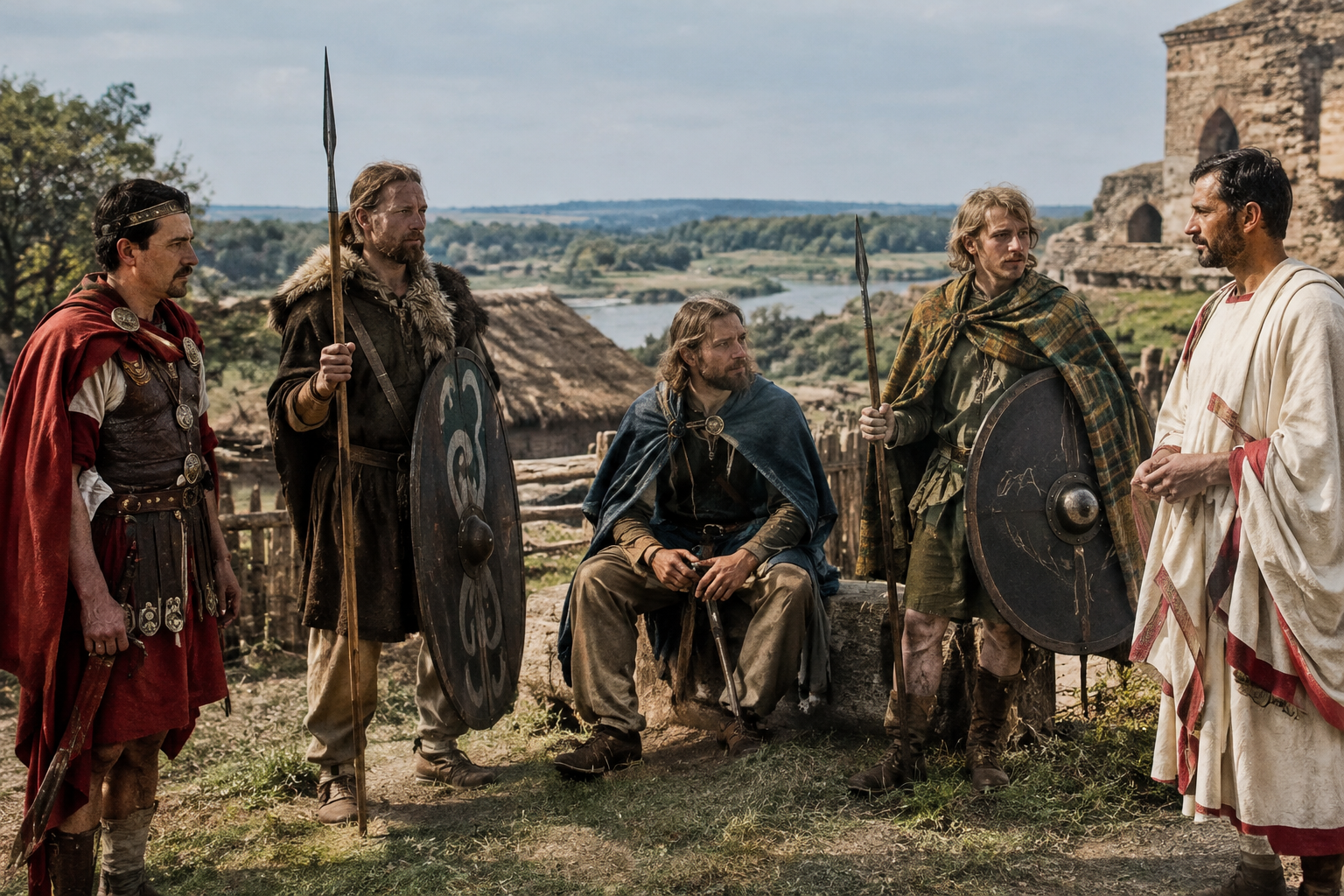
Some Y-chromosome lineages seem to sit quietly in the background of European history until ancient DNA gives them away. Haplogroup I2a1a1a1a1a2 is one of those cases. It belongs to the wider haplogroup I family, an old European paternal lineage, yet this very specific branch only becomes historically interesting when we begin to see where related men appear in the archaeological record: Iron Age France, Iron Age Britain, Gothic-era Pomerania, late Roman Spain, and late Roman Italy.
That spread matters, but it needs to be read carefully. A Y-DNA haplogroup traces one direct paternal line only: father to father to father. It does not describe a person's whole ancestry, culture, language, or identity. Nor should a narrow subclade like I2a1a1a1a1a2 be made to carry the entire history of haplogroup I. Still, when ancient burials from very different corners of Europe show related paternal signatures, they offer a remarkable way of tracking male-line continuity, movement, and survival across centuries.
In broad terms, haplogroup I is one of Europe's deep-rooted Y-chromosome branches, and its many subclades have long histories in different parts of the continent. The challenge with a highly specific label such as I2a1a1a1a1a2 is that we must resist the temptation to tell an overconfident grand story. What we can say is that this branch sits within a European paternal framework that appears in multiple ancient settings, including western and central Europe and in later contexts touched by Roman and post-Roman mobility.
The supplied ancient samples suggest that lineages close to this branch were present in a world shaped by Iron Age regional societies, by the movements associated with Gothic groups, and by the extraordinary mixing generated by the Roman Empire. That does not mean the haplogroup belonged to one people alone. Quite the opposite: the evidence points toward a paternal line that could pass through very different cultural worlds while remaining genetically recognizable along the direct male line.
The earliest signposts here come from Iron Age western Europe. One striking case is CGG023669, described as a Belgic Outlier from Iron Age France Les Moidons, dated to 350 BC. Even that short description is suggestive. "Belgic" places us in the complex cultural zone of later Iron Age northwestern Europe, where tribal identities, trade, migration, and local variation all overlapped. To call someone an outlier is a useful reminder that ancient communities were not genetically uniform little boxes. They contained newcomers, unusual family lines, and inherited diversity.
Then there is I12791 from Iron Age Gloucestershire England Greystones Farm, dated to 100 BC. Here the same wider paternal story reaches Britain before the Roman conquest. That matters because it hints that related male lines were already established on both sides of the Channel in the later Iron Age. This is not proof of one tribe marching neatly from France into Britain carrying a single Y lineage. History is never so tidy. But it does fit a landscape of repeated contact across the Channel, where marriage, mobility, exchange, and local continuity all helped shape populations.
That broader British context is worth comparing with MyTrueAncestry's discussion of Ancient DNA and matrilineal kinship in Iron Age Britain, which helps show how archaeology and genetics complicate older assumptions about Iron Age communities.
By the first centuries AD, the map becomes even more interesting. PCA0553, from Early Goth Pommerania Czarnwko Lebork County Wielbark, dated to 200 AD, places a related paternal signal in the Baltic world often linked archaeologically with the Wielbark horizon and with groups later described as Goths. Here again caution is essential. A haplogroup does not equal an ethnicity, and Gothic communities were not genetically uniform. But this sample does show that a lineage in this genetic neighborhood was present in a northern setting associated with one of late antiquity's most famous mobile populations.
Then we meet I13573, listed as Germanic Imperial Roman Spain Girona Sarria de Ter Pla de lHorta, dated to 400 AD. That single sample says a great deal about the late Roman world. A "Germanic" individual in Roman Spain is not a surprise to historians, but it is exactly the kind of surprise that written history rarely documents at the level of one body in one grave. Men, families, and warbands moved through imperial service, settlement, alliance, and conflict. Ancient DNA lets us glimpse those movements in human rather than purely political terms.
Readers interested in that Iberian setting may want to continue with Roman Hispania's Lasting Genetic Legacy, which explores how Roman-era and later movements reshaped the peninsula's genetic landscape.
Finally, R104 from Late Roman Outlier Crypta Balbi, dated to 500 AD, brings us to Rome itself, or at least to one of the great urban stages on which the late empire and its aftermath played out. An outlier at Crypta Balbi is exactly the sort of individual who reminds us that late antique cities were full of movement. Rome was not merely "Roman" in some simple sense by this period; it was a place of soldiers, migrants, clerics, traders, captives, and families from across the Mediterranean and beyond.
For more on that Italian transition from empire to early medieval society, see Genetic ancestry of ancient Amiternum from Roman to early medieval Italy.
So where does a medieval noble family enter the picture? Not as proof, but as context. The supplied noble association is the House Giffard and Bolbec Castle in the Cotentin area of Normandy. The castle was built in the 11th century, soon after the Norman Conquest, as part of the new rulers' effort to master land through earthworks, fortification, and lordship. Linked with the family of Hugh de Bolbec, the site belongs to that very Norman habit of planting power physically into the ground.
Mary Beard would probably insist that this is where we stop and look carefully at the dirt. Bolbec Castle was likely first a timber motte-and-bailey stronghold, not yet the romantic stone fortress of later imagination. Much of it has disappeared, leaving earthworks rather than glittering walls. But in some ways earthworks are more honest. They show conquest in its rawest form: a heap of raised soil, a ditch, timber, labor, fear, and ambition.
What has that to do with haplogroup I2a1a1a1a1a2? Only this: medieval Norman and Anglo-Norman families emerged in regions already shaped by many centuries of population mixture across northern France, Britain, the North Sea world, and the former Roman west. A shared broad Y-lineage background between ancient and medieval men in these regions can offer historical context, but it cannot by itself prove that the Giffards or the descendants of Hugh de Bolbec belonged to this exact branch. Castles preserve memory of families and power; they do not themselves certify a haplogroup.
Still, if you want to place this paternal story in the world after 1066, the Norman dimension is irresistible. The movement of names, families, retainers, and estates from Normandy into England after the Conquest belongs to the same long European history of mobility that ancient DNA keeps revealing in earlier centuries.
The most sensible way to read I2a1a1a1a1a2 is not as the badge of one tribe or one noble house, but as a durable paternal thread visible in several important European settings. In the supplied evidence, related male lines appear in Iron Age France, pre-Roman Britain, Gothic-era Pomerania, late Roman Spain, and late Roman Italy. That is a history of geographical breadth and cultural adaptability.
It also shows why ancient DNA matters. Traditional genealogy begins with documents, usually medieval at the earliest for ordinary people and often much later. Y-DNA and archaeology let us push the story back into periods with no parish register, no surname, and no family chronicle. They show continuity where none was suspected, and mobility where older histories imagined fixed peoples rooted forever in one place.
For readers who enjoy the overlap of lineage and lordship, MyTrueAncestry's The Giffard Family offers a fitting companion to this story of Norman memory, family identity, and the places where power was anchored.
If this haplogroup appears in your own Y-DNA results, the real excitement lies not in claiming a famous ancestor, but in seeing how your direct paternal line fits into the much larger human history uncovered by archaeology and genetics. Ancient matches can reveal meaningful historical context without proving descent from a specific warrior, Goth, Roman migrant, or Norman lord.
Upload your DNA to MyTrueAncestry and explore whether your results connect with ancient individuals such as I13573, PCA0553, CGG023669, I12791, or R104, and with the wider populations that shaped Europe across the Iron Age, Roman world, and Middle Ages.






Comments