Haplogroup I2a1a1a1a1a1a2

– 4 min read


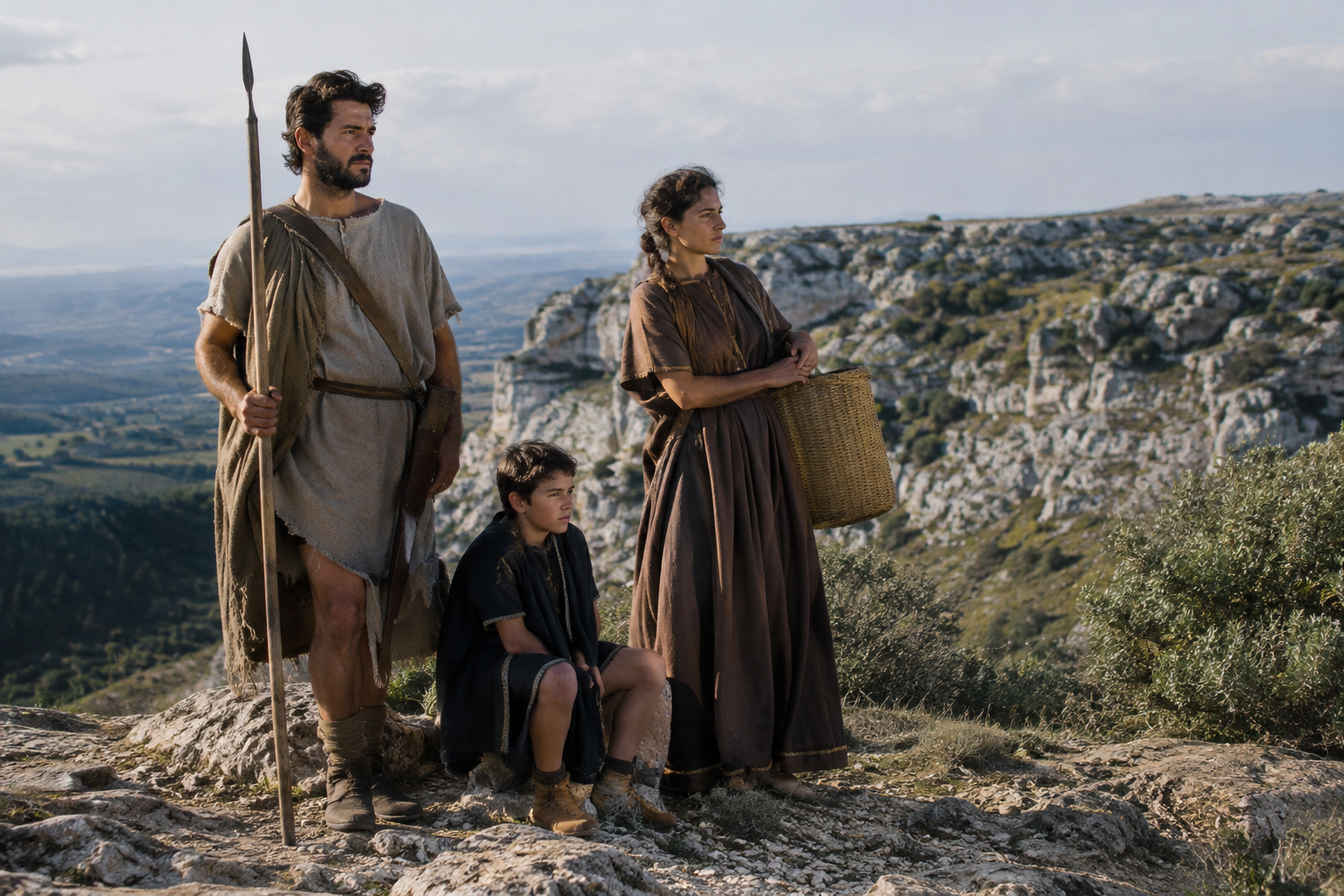
At Roquepertuse in Bouches-du-Rhone, an Iron Age man identified as I19918 gives us a rare fixed point for the Y-DNA haplogroup I2a1a1a1a1a1a2. He is dated to around 300 BC, which places him in the last centuries before Rome absorbed southern Gaul into its own political world. That matters because Roquepertuse is not just any site: it is one of those places in Mediterranean France where archaeology has long hinted at a complicated frontier, with local Celtic traditions, regional power, and outside contacts all meeting in the same landscape.
So this is not a lineage floating in abstraction. In this case, the haplogroup appears in an actual Iron Age individual from Provence, in a region that sat between inland Gaul and the sea routes of the western Mediterranean. Y-DNA traces one direct paternal line rather than a person's whole ancestry, but even so, a finding like this is valuable: it anchors I2a1a1a1a1a1a2 in a real community, at a real site, in a historically charged corner of ancient Europe.
Roquepertuse has long attracted attention because it seems to have been more than an ordinary settlement. The site is widely associated with ritual activity in Iron Age southern Gaul, and that alone makes sample I19918 more interesting than a bare dot on a distribution map. When a paternal lineage turns up at a place known for public and ceremonial importance, it tells us that this branch was present among the people participating in one of the region's best-known local traditions.
What we must not do is overreach. One man from one site does not define all the peoples of Provence, still less all Iron Age Celts. But he does show that the branch behind I2a1a1a1a1a1a2 had reached, or persisted in, southern France by the late Iron Age. In a region often discussed in terms of Greek colonies, Roman expansion, and Mediterranean trade, that is a useful reminder that local paternal lines remained part of the picture too.
Celtic language spread and DNA
The name is formidable, but the basic point is simple. I2a1a1a1a1a1a2 is a very narrow twig on the larger Y-chromosome tree of haplogroup I, one of the old paternal macro-lineages of Europe. The wider I2 family has deep roots in European prehistory and appears in many different times and places, but a narrow subclade such as this one cannot automatically be given the whole grand story of its parent branch.
That distinction is important. It would be easy, and wrong, to say that because broader I2 lineages are ancient in Europe, this exact subclade must have followed one neat route from Ice Age foragers to Iron Age Provence. Genetics rarely behaves so tidily. What Roquepertuse shows with confidence is presence, not an unbroken documentary trail. The finer history of this branch depends on more ancient samples appearing across time.
Ancient Provence is often squeezed into modern categories: Celtic, Ligurian, Greek, Roman. The reality was likely much messier, and more interesting. By 300 BC, communities in southern Gaul were living in a world shaped by trade with Massalia, by local elite competition, and by changing political ties inland and along the coast. A paternal lineage found here belongs to that mixed and active world, not to a sealed ethnic box.
This is where a site like Roquepertuse earns its keep in historical storytelling. It reminds us that the Mediterranean edge of Gaul was not merely being acted upon by outsiders. It had its own societies, sanctuaries, and lineages. Sample I19918 therefore matters not because he can be turned into a mascot for a tribe, but because he stands inside a local archaeological setting that historians have long known was significant.
For a wider look at how ancient DNA is reshaping our picture of France before and after farming, see this MyTrueAncestry article on Neolithic France and Cerny culture ancestry. It belongs to a much earlier period, of course, but it helps show just how deep and regionally varied the human story of France really is.
One reason this haplogroup is intriguing is that its broader parent family, I2, often appears in discussions of long-term European continuity. Yet continuity in genetics never means stasis. Between the Mesolithic, the arrival of farming, Bronze Age population change, and Iron Age political reorganisation, the male lines of Europe were repeatedly reshuffled, reduced, expanded, and redistributed. By the time we meet I19918, we are already at the far end of many earlier upheavals.
That makes the Roquepertuse sample useful in a very specific way. He shows that a branch within the I2 world survived into a late pre-Roman society in southern France, where it coexisted with all the ancestry layers that had accumulated over millennia. For family historians, that is often the most sensible way to think about Y-DNA: not as a badge of a single ancient people, but as one surviving thread passing through many different archaeological horizons.
Iron Age ritual burial in Iberia
There is a temptation, when only one ancient carrier is available, to shrug and move on. But archaeology is full of cases where one excavated individual becomes important precisely because he fixes a branch to a place and period that were previously uncertain. That is what I19918 does here. He gives I2a1a1a1a1a1a2 an Iron Age address in southern France.
He also sits in a region that later became thoroughly entangled with Rome. Readers interested in how genetic evidence tracks that longer transformation across the Iberian and western Mediterranean world may find a useful comparison in Roman Hispania's Lasting Genetic Legacy. It is not about Roquepertuse itself, but it shows how regional populations changed and persisted under imperial rule.
If your paternal line falls under I2a1a1a1a1a1a2, the clearest ancient signal here is modest but meaningful: this branch is documented in an Iron Age man from Roquepertuse in Provence around 300 BC. That does not make every modern carrier "Celtic" in a simple sense, nor does it tie the lineage to one tribe or dynasty. What it does suggest is that your direct paternal line was part of the human landscape of late pre-Roman western Europe, in a region where local traditions and Mediterranean connections met face to face.
That is often how the best ancient DNA evidence works. It does not hand us a mythic founder. It gives us something better: one real man, one real site, and a firmer historical footing for a living paternal line.






Comments