Haplogroup I2a1a

– 5 min read


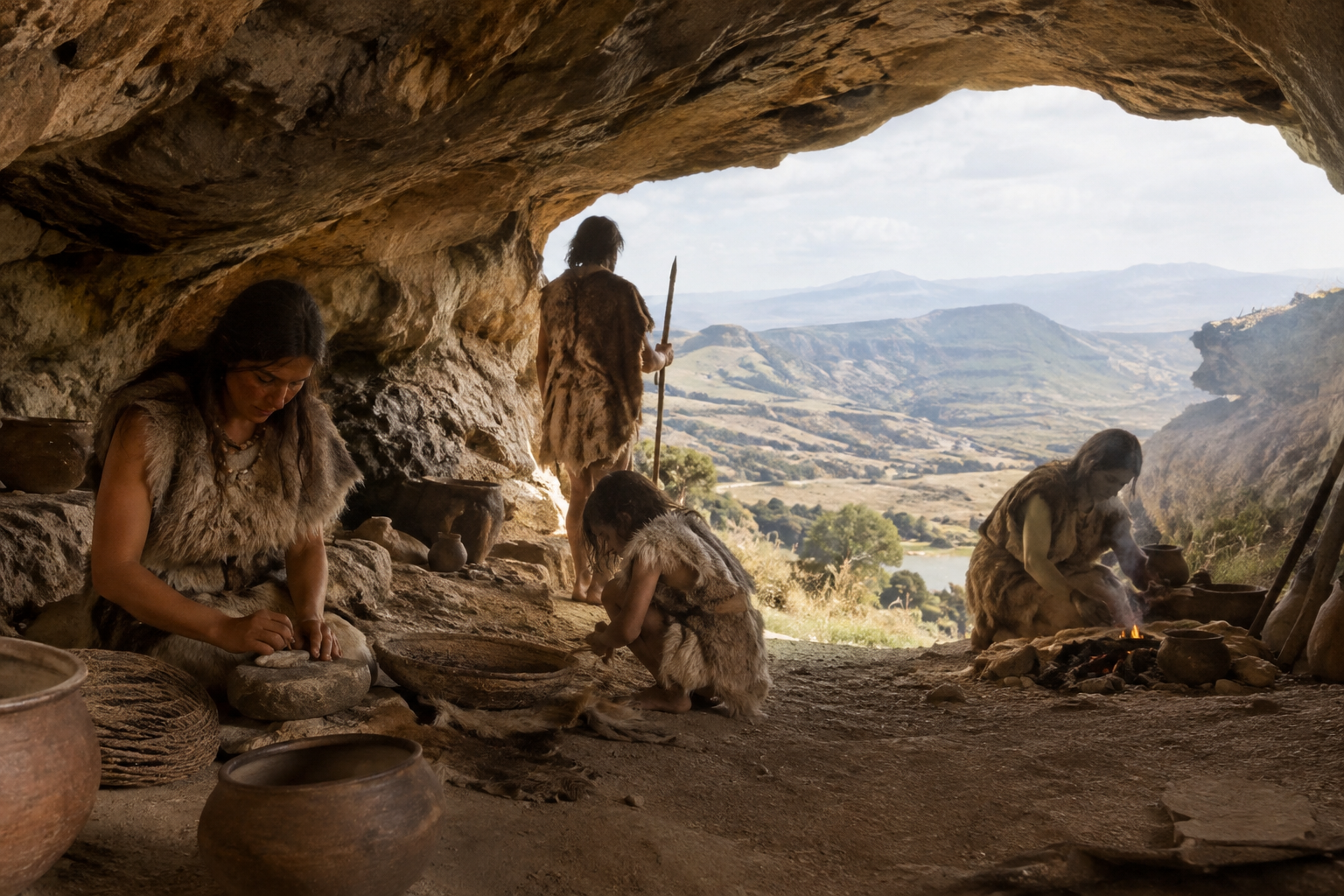
At Cueva de las Lechuzas in Bronze Age Iberia, one man has become a small but useful anchor for thinking about Y-DNA haplogroup I2a1a. He is catalogued as CLL003 and dated to around 2200 BC, a period when the Iberian Peninsula was already long familiar with farming, metalworking, and regional exchange, yet still carried deep traces of older local ancestry. The interest here is not that one burial can explain an entire lineage. It is that a paternal line associated with I2a1a appears in a real archaeological person from a very specific place and time.
That matters because I2 is one of the old European Y-chromosome families, with branches that reach far back into prehistoric population history. But the article haplogroup here is not all of I2; it is I2a1a, a narrower paternal branch. Y-DNA follows one direct male line only, so it tells us something precise but limited: not a person's whole ancestry, language, or identity, but one thread through the much messier fabric of the past.
The sample CLL003 places I2a1a in southern Iberia during the Bronze Age, around the centuries when communities across the peninsula were living through major demographic and social change. By this date, earlier Neolithic farmer ancestry, long-standing western hunter-gatherer ancestry, and later arrivals ultimately connected with steppe expansions had already been interacting for generations. A male line like I2a1a surviving in that setting is historically interesting because it hints at continuity as much as change.
That is often the overlooked part of Bronze Age genetics. New ancestry streams did not simply erase what came before. In many regions, old local paternal lines persisted beside newer ones, and ancient DNA keeps showing that population history is rarely a neat replacement story. A genetic study of prehistoric Iberia published in Science Advances helped sharpen that picture by examining how ancestry shifted across the peninsula over time.
To understand why CLL003 is worth pausing over, it helps to remember that Iberia has an unusually deep archaeological sequence. The peninsula was home to Upper Paleolithic and Mesolithic hunter-gatherers, then early farming communities, then Copper Age societies, Bell Beaker networks, and Bronze Age regional cultures. In Y-chromosome terms, some branches of I2 are especially associated with Europe's older pre-steppe layers, even though later history scattered and reshaped them many times.
That does not mean every man with I2a1a in Bronze Age Iberia was a straightforward survival from the Mesolithic. Human populations do not work like museum cabinets. By 2200 BC, any surviving paternal line had passed through thousands of years of marriages, migrations, and cultural changes. What the lineage can suggest is endurance: an old European male line still present within Bronze Age societies that were already genetically and culturally mixed.
For family historians, this is one of the most useful lessons from haplogroup articles. A lineage may be ancient in one sense and locally transformed in another. If your paternal line falls under I2a1a, the important question is not whether it belongs to a single tribe or people, but how that line endured through multiple archaeological worlds.
Around 2200 BC, Iberia was no backwater. This was the era of fortified sites in some regions, striking local burial traditions in others, and strong differences between communities only a moderate distance apart. Ancient DNA has made that landscape even more interesting, because it shows that genetic turnover could be substantial while local diversity remained real.
So when we place CLL003 in this setting, we should imagine neither a frozen relic nor a representative of all Iberian men. He was one individual in a peninsula full of variation. His association with I2a1a shows that this paternal branch participated in Bronze Age Iberian society rather than belonging only to some much earlier prehistoric phase.
That point resonates with wider work on the peninsula's later past as well. Iberia repeatedly absorbed newcomers without losing every local thread. Roman rule, post-Roman movement, and medieval mobility all added fresh layers to populations that were already mixtures of mixtures.
One of the most striking patterns in European archaeogenetics is that paternal lineages can shift dramatically in some periods and yet older branches never vanish everywhere at once. That is especially true for the I2 family. In some places, I2-associated lines were very prominent among earlier European hunter-gatherers. In later periods, they survived unevenly, sometimes as minority lines, sometimes more robustly, and often in regions where local continuity remained strong despite broader continental change.
I2a1a belongs inside that larger story, but it should not simply be treated as a synonym for it. The narrower branch has its own history, and with sparse ancient samples one must be careful. The evidence from CLL003 shows a Bronze Age Iberian occurrence linked to this branch; it does not license sweeping claims that all Iberian I2a1a lines descend directly from a single local Mesolithic founder, still less that they map neatly onto one archaeological culture or language.
Still, the survival of such a line in Iberia does fit a pattern seen across Europe: paternal continuity can persist through enormous cultural upheavals. Pottery styles change, burial fashions change, metalworking changes, even ancestry profiles shift significantly, but some male lines keep going, quietly, from one historical chapter into the next.
The site name itself, Cueva de las Lechuzas, reminds us of something archaeologically important about Iberia: caves remained meaningful places for a very long time. Across the peninsula, caves served different roles in different periods - habitation, ritual, burial, storage, and sometimes combinations of these across centuries. They are not automatically signs of one uniform belief system, but they do show that landscapes could retain social meaning over the long term.
That makes a cave-associated Bronze Age individual especially evocative, even when the published information is limited. We are not dealing with an abstract dot on a genetic map. We are dealing with a man placed in a landscape with a history. Ancient DNA works best when it is tied back to such settings: real places where communities buried their dead, marked belonging, and passed through generations whose identities were more complex than any haplogroup label.
Iberian ancient DNA studies have increasingly made this point. The best work does not merely sort skeletons into ancestry clusters; it asks how mobility, continuity, and regional custom coexisted. That is why later evidence from places like Madrid, Roman Hispania, and medieval Iberian communities is so useful for context, even when it is much later than CLL003. The peninsula repeatedly shows local persistence alongside outside contact.
The clearest supported insight for haplogroup I2a1a here is modest but valuable. This paternal branch was present in Bronze Age Iberia, as shown by CLL003 from Cueva de las Lechuzas around 2200 BC, and it belongs to a wider family of lineages with deep roots in European prehistory. For someone researching a present-day I2a1a line, that does not provide a named tribe or a guaranteed homeland. What it does offer is a credible glimpse of endurance: a direct male line that could persist through the great rearrangements of prehistoric and historic Europe while becoming part of very different communities along the way.






Comments