Haplogroup I1a2a2a1a1a1

– 4 min read


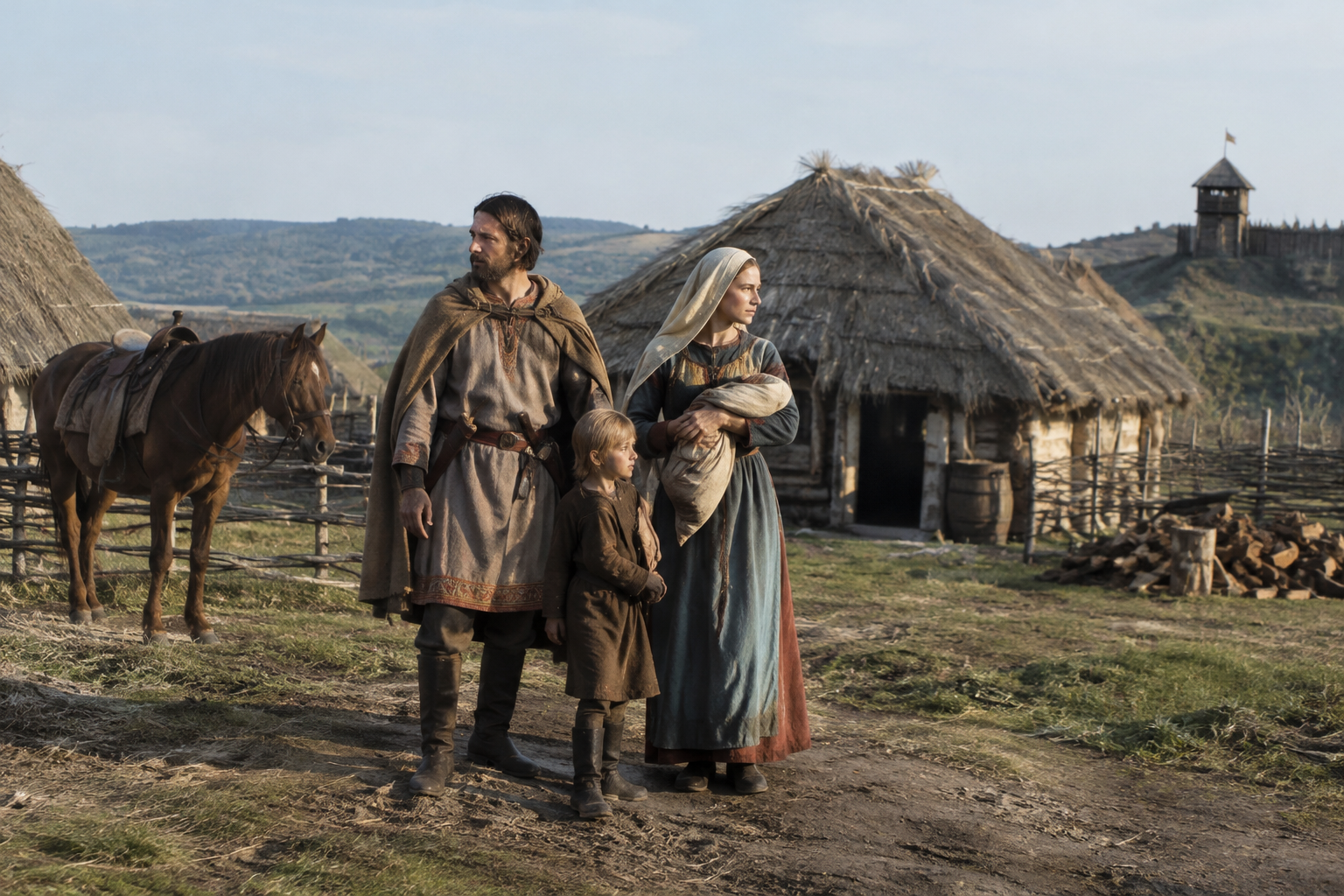
At Sarbogard-Tringer Tanya in medieval Hungary, one excavated man dated to around AD 950 carries a particularly interesting paternal label in MyTrueAncestry's tree: I1a2a2a1a1a1. He appears in the record as AHPS139, from a frontier landscape shaped by the Carolingian world, the Magyar conquest period, and the rapid re-ordering of power in the Carpathian Basin. That is already enough to make him worth pausing over, because this is not a lineage turning up in an obvious Scandinavian setting, but in a border zone where identities, loyalties, and populations were being actively remade.
The important thing to keep clear is that a Y-DNA haplogroup tracks one direct paternal line only. It does not tell us everything about a person's ancestry, language, or status. But when a branch such as I1a2a2a1a1a1 appears in an excavated early medieval burial, it gives us one sharp genealogical thread to follow through a much broader historical fabric.
The site description matters here. Sarbogard-Tringer Tanya sits in western-central Hungary, in a region that had long been exposed to Roman, Avar, Frankish, and then Hungarian political influence. By about AD 950, this was not an empty frontier waiting for newcomers. It was a lived-in and contested zone, precisely the sort of place where archaeologists expect to find mixed communities, old local lineages, and newly arrived families sharing the same landscape.
That makes AHPS139 useful beyond the individual level. A paternal line assigned to I1a2a2a1a1a1 points to a branch within the wider haplogroup I1, a lineage most strongly associated in broad terms with northern Europe, especially Germanic-speaking regions in later prehistory and the early medieval period. But one must not simply leap from that wider pattern to a neat story about a single man. In tenth-century Hungary, such a lineage could reflect earlier movements into the Carpathian Basin, frontier settlement, military service, intermarriage, or descendants of populations already present before the Magyar takeover.
A recent ancient DNA study of medieval Hungary's elite and surrounding populations helps frame exactly this kind of complexity, showing that conquest-period and early post-conquest communities could combine local European ancestry with steppe-linked elements in varying degrees rather than fitting a single ethnic template: research on medieval Hungary.
Because the article haplogroup is such a narrow subclade, caution is essential. We can say with confidence that I1a2a2a1a1a1 belongs inside the wider I1 paternal family. We should not, however, pretend that every historical statement made about I1 as a whole applies neatly to this exact twig of the tree. Branches split, expand, contract, and travel in different ways.
Still, the broad background is revealing. I1 is a lineage that becomes especially visible in northern Europe and in communities tied to the spread of Germanic-speaking populations during the Iron Age and early medieval centuries. When a downstream branch turns up in the Carpathian Basin around AD 950, that fits a well-known archaeological truth: central Europe and the Danube frontier were not sealed worlds. Men and families moved through armies, retinues, settlement projects, trade networks, and marriage alliances for centuries before and after the Hungarian conquest.
So the question is not, "Was AHPS139 simply Germanic?" That would be much too blunt. The better question is: what does a northern-linked paternal line look like when recovered from a tenth-century burial in a Hungarian border setting? The answer is that it looks exactly like the early medieval world itself - layered, mobile, and resistant to tidy labels.
Germanic languages and genomes
One of the great lessons of ancient DNA from Hungary is that each period added something without wholly erasing what came before. Roman provincial populations, post-Roman groups, Avar-period communities, Carolingian frontier populations, and incoming Hungarians all form part of the background to any tenth-century burial. That is why a lineage like I1a2a2a1a1a1 should be read as evidence of participation in that history, not as a shortcut to a single origin myth.
In practical terms, a man such as AHPS139 may represent a paternal line already circulating in the region through earlier western or northern connections. The Carolingian borderlands were full of such possibilities. Frankish expansion, earlier migration-period movements, and the settlement of mixed military populations had already connected the middle Danube to Bavaria, northern Italy, and the Germanic-speaking world to the northwest.
By AD 950, then, an I1-derived paternal line in Hungary is not some exotic interruption. It is part of the normal untidiness of frontier history. The archaeology of the Carpathian Basin repeatedly shows that political change did not produce simple biological replacement. Instead, it created new combinations of people, customs, and lineages.
It is easy to underestimate one sample because it is only one burial. In fact, named individuals are where archaeogenetics becomes most human. AHPS139 is not merely a data point for a frequency chart. He is an excavated person from a known region and period, whose direct paternal line survived long enough to be read nearly eleven centuries later.
That matters especially for descendants exploring a rare or narrowly defined Y-line today. Deep subclades often feel abstract in modern testing reports. Ancient individuals anchor them. They show that the branch was present in a real community, in a particular historical setting, during a moment of major transformation. In this case, the anchor is not a Viking ship burial or a northern royal pedigree, but a tenth-century Hungarian frontier burial - which is far more interesting, because it places the lineage inside a zone of contact rather than at a supposed point of origin.
It also reminds us that early medieval Europe cannot be divided into neat ancestral boxes. The same centuries that produced dynasties and kingdoms also produced local communities made up of people with very different paternal and maternal histories. Ancient DNA keeps bringing us back to that point.
Medieval Hungary's elite genomes
For this haplogroup, the strongest historically grounded insight is not a grand claim about a single people, but a specific kind of setting. The ancient evidence places this paternal branch in medieval Hungary at a time when the Carpathian Basin was absorbing, reworking, and connecting populations from several directions. The wider I1 background hints at northern European paternal ancestry somewhere back along the line, while the archaeology of Sarbogard warns against turning that hint into a simplistic ethnic label.
For someone researching I1a2a2a1a1a1 today, that is the valuable takeaway. Your direct paternal line belongs to a branch that appears in an early medieval borderland where identities were mixed and history moved quickly. It is a lineage best understood not as a badge of one fixed tribe, but as part of the lived complexity of European frontier society.






Comments