Haplogroup I1a2a1a1a2b3b

– 4 min read


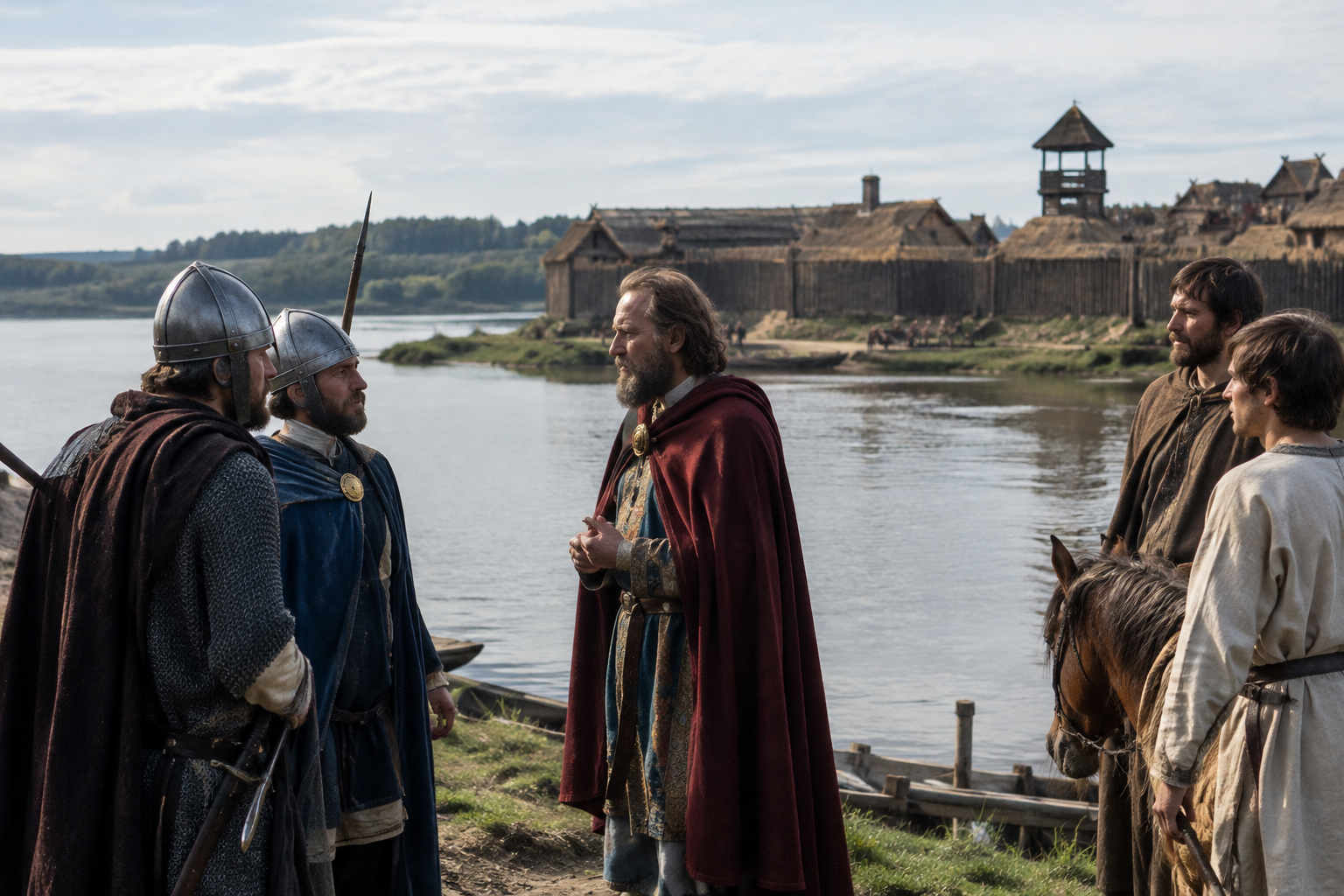
At Zalavar-Varsziget in western Hungary, one excavated man from around AD 850 carries a very precise paternal label: I1a2a1a1a2b3b. He is recorded as sample AHS16, from a Carolingian-period context in medieval Hungary. That is already enough to make him interesting, because Zalavar sat in a borderland where empires, languages, and local communities met face to face.
The haplogroup itself deserves a moment of explanation. I1a2a1a1a2b3b is a very narrow branch within the wider Y-DNA haplogroup I1, a paternal lineage best known from northern Europe. Y-DNA tracks one direct male line only, not a person's whole ancestry, but in a place like ninth-century Zalavar that single line can still tell a useful historical story: northern-linked paternal ancestry appearing in a Carolingian stronghold deep inside the Carpathian Basin.
Zalavar, near Lake Balaton, was no sleepy backwater in the ninth century. It lay in a zone shaped by the collapse of Avar power, the eastward reach of the Carolingians, and the political rearrangements that followed. By AD 850, this was a landscape of forts, churches, local elites, and communities adapting to new rulers without ceasing to be local.
That is the proper setting for AHS16. To find a man assigned to I1a2a1a1a2b3b here does not mean that Zalavar was somehow "Germanic" in any simple ethnic sense. What it does suggest is that paternal lines associated with the broader I1 world had become part of the male population in this frontier region by the mid-ninth century, whether through migration, military service, settlement, marriage networks, or longer-standing regional mixture.
An ancient DNA study of medieval Hungary has helped bring exactly these kinds of frontier populations into clearer focus, showing that elite and non-elite communities in the region could carry quite varied ancestries and historical backgrounds rather than fitting a single tidy origin story. For the broader research context, see this scientific study.
The broader haplogroup I1 is often discussed in connection with Scandinavia and the spread of Germanic-speaking groups in the first millennium AD. But one must be careful here. A narrow branch such as I1a2a1a1a2b3b is not automatically a badge of Viking identity, Frankish ethnicity, or any single named people. Ancient history is not that obliging.
Still, the setting matters. In the Carolingian age, the western Carpathian Basin was tied into political and ecclesiastical systems that linked Bavaria, Pannonia, and the eastern frontier of the Frankish world. A paternal lineage from the I1 family appearing at Zalavar fits that larger pattern of contact remarkably well. It belongs in a historical landscape where men, families, and retinues could move far beyond their grandparents' home district.
That is one reason this sample is more than a bare code in a lab table. AHS16 stands at the intersection of archaeology and big historical change: the aftermath of empire, the formation of frontier societies, and the movement of male lines across central Europe.
There is a bad habit in popular history of treating early medieval Europe as if every cemetery ought to belong neatly to one tribe, one language, one ancestry block. The archaeology of the period says otherwise, and genetics has only made that point stronger. Border regions in particular were full of layered histories.
Zalavar is a very good place to remember this. Before the Carolingians, the region had been shaped by the Avars; before them, by Roman Pannonia; and alongside all of this were local populations who did not simply vanish when political masters changed. A man with haplogroup I1a2a1a1a2b3b buried there around AD 850 was living in a world built from those accumulated centuries.
So the significance of AHS16 is not that he "proves" a single migration. It is that he shows how a lineage with northern European associations had become embedded in a Hungarian frontier community under Carolingian influence. That is a subtler point, but a better one.
Germanic Languages and Genomics
The date of AHS16 is especially useful because it falls into a narrow and often overshadowed window of history. This is Hungary before the Hungarian conquest in the traditional sense, but long after the Roman world had ceased to govern Pannonia. It was a period of Slavic settlement, Frankish intervention, Christian mission activity, and competition for control across the middle Danube.
That makes the paternal signal all the more revealing. If your own Y-DNA falls on a rare downstream branch like I1a2a1a1a2b3b, the ancient match is not telling you that your ancestors were straightforwardly "Hungarian," "Frankish," or "Viking." It is pointing instead toward the kind of male-line history that could pass through the frontier belt between the northern European world and the middle Danube.
This also fits broader archaeogenetic work on post-Roman and migration-period Europe, where communities often turn out to be more locally continuous and more genetically mixed than the old invasion maps suggested. Men with similar broad Y-DNA backgrounds could appear in quite different political settings, from Scandinavian homelands to continental military zones to newly Christianized settlements.
With only one ancient individual named here, caution is part of the job. We cannot turn AHS16 into a whole population, and we should not pretend that one Y-chromosome branch explains the full character of Zalavar. Nor should we silently inflate the evidence by claiming a tighter subclade resolution from the excavation than the reporting actually allows.
But one sample can still be historically valuable when it is well placed. AHS16 gives us a documented instance of the lineage I1a2a1a1a2b3b, or a reported association with that branch, in Carolingian-period Hungary at Zalavar-Varsziget around AD 850. In a frontier region where written sources are uneven and identities were fluid, that is a useful anchor point.
It is also a reminder that paternal lineages often travel through power structures as much as through mass migration. Military followings, estate management, church patronage, and regional marriage networks could all carry male lines across the map long before surnames or national identities fixed anything in place.
The most distinctive thing about I1a2a1a1a2b3b, in this case, is not vast antiquity in the abstract but its appearance in a sharply defined historical moment. Sample AHS16 places this paternal line in a Carolingian-era community at Zalavar, where the remains of Roman provincial life, Avar power, Frankish expansion, and emerging medieval Hungary all pressed together. For someone researching this haplogroup today, that does not promise a royal pedigree or a single ethnic label. It offers something better: a real glimpse of your direct paternal line in one of early medieval Europe's most complicated borderlands.


Comments