Haplogroup I1a2a1a1

– 6 min read


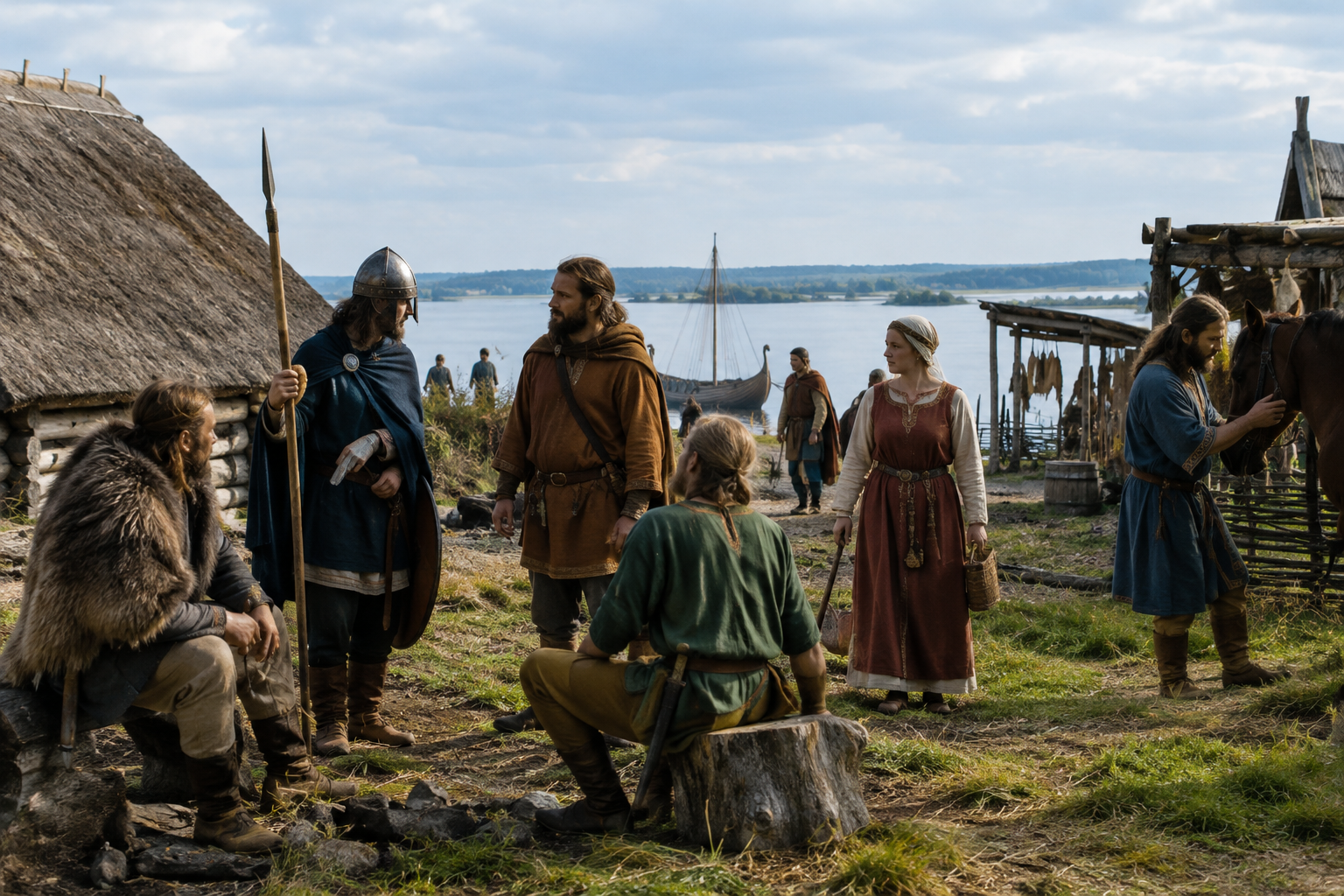
At Szeleste in western Hungary, one man from the Longobard period stands at a particularly interesting crossroads. The individual catalogued as SZL041, dated to around AD 525 in the Savaria region of Pannonia, is associated here with the Y-DNA haplogroup I1a2a1a1. That matters because this is not simply a Scandinavian story left in the north. It is a paternal line turning up in the archaeology of movement: in the former Roman frontier zone, in the age when post-imperial Europe was being made and remade by war bands, households, alliances, and migration.
The point is worth stating carefully. Y-DNA traces one direct paternal line only, not a person's whole ancestry or identity. But when the same branch appears in a spread of ancient contexts, it can show us where particular male lines were present. For I1a2a1a1, the strongest pattern in the samples here runs through southern Scandinavia, the Migration Period, and the Viking and medieval Baltic world, with one especially revealing appearance farther south in the Carpathian Basin.
SZL041 comes from a region that had once been firmly Roman and was, by the sixth century, something much more unsettled. Pannonia had become one of those borderlands where imperial structures, local communities, and incoming groups overlapped. A paternal line like I1a2a1a1 appearing here is historically suggestive because the Longobards are one of the peoples most often linked, in both archaeology and written tradition, to movements from the north toward central Europe and eventually into Italy.
That does not mean every man buried in Longobard-period Pannonia was a migrant from Scandinavia, nor that one haplogroup can define a people. But it does fit a broader picture in which some male lines with northern associations were present in these post-Roman frontier societies. Research on early medieval populations in this region has repeatedly shown that cemeteries could contain people of varied genetic backgrounds, which is precisely what one would expect in a mobile and politically fluid world. A useful parallel for readers interested in this setting is MyTrueAncestry's piece on post-Roman society in the Little Hungarian Plain, another window onto the same wider historical landscape.
There is also a broader scientific backdrop here. A major ancient DNA study of European populations across the Bronze Age to the historical era, published in Cell, helped establish just how dynamic northern and central European population history was over the long term. That does not by itself prove the exact biography of SZL041, but it does support the larger historical context in which northern-linked paternal lines could be carried into frontier provinces like Pannonia.
If Hungary gives us the surprise, Denmark gives us the backbone of the pattern. Two older samples from southern Sjælland are especially useful: CGG107507 from Vester Egesborg near Vordingborg, dated to about AD 175 and associated with the Danii, and CGG107416 from Præstø Endegårde, dated to about AD 375 and associated with a Nordic tribal context.
These are important because they place the branch in Zealand well before the classic Viking Age. In other words, I1a2a1a1 was not simply part of the late Viking dispersals visible to medieval chroniclers. It was already present in southern Scandinavian communities during the Roman Iron Age and the later Migration Period. That gives the lineage some chronological depth in the region most often connected with the wider I1 paternal family.
One should be cautious with labels like "Danii" and "Nordic tribe", which are historical and archaeological shorthand rather than neat biological categories. Even so, the pattern is striking. The male line appears in exactly the sort of southern Scandinavian zone that later sat astride the western Baltic, controlling movement, trade, raiding routes, and political influence between Denmark, Sweden, and the continent.
For readers interested in the deeper background of Denmark before these historical centuries, the transition into later Scandinavian population history is nicely complemented by this article on Denmark's Mesolithic-Neolithic transition.
A second mainland appearance comes from central Germany: OBM005, dated to around AD 500 from Obermöllern and classified with the Thuringii. This is exactly the sort of evidence that stops us telling too simple a story. If one only looked at the Scandinavian samples, I1a2a1a1 might seem purely northern. But the early medieval mainland was full of entanglements, and central Germany was one of the places where such lineages were being folded into new political formations.
The Thuringian kingdom stood in a world shared and contested by Franks, Saxons, Lombards, and others. A paternal branch found here does not identify the language spoken by the individual or the precise route by which his ancestors arrived. What it does show is that by about AD 500 this line was already part of the male population of central Europe, not merely a northern reserve waiting for the Viking Age.
This matters historically because the Migration Period is often described as though peoples moved as sealed ethnic blocks. They did not. Ancient DNA keeps showing something more complicated: mobility, mixture, and continuity side by side. A useful comparison is the MyTrueAncestry discussion of Roman-Barbarian blending on the German frontier, 400-700 CE, where frontier communities prove far less tidy than old textbook categories suggest.
The Swedish evidence brings the story forward into the age of towns, kingdoms, and Christianization. gor164 from Viking Age Stockholm Gorla, dated to about AD 1050, and mbs022 from medieval Sigtuna, dated to around AD 1100, place this paternal branch in eastern central Sweden just as the old Viking world was changing shape.
Sigtuna in particular is a site of unusual interest. It was one of early medieval Sweden's most important urban and royal centres, bound up with kingship, minting, trade, and conversion. A man carrying I1a2a1a1 there is not evidence of a dynasty on his own, but he does place the lineage firmly inside the social world of an emerging Christian kingdom. Research connected with medieval Swedish burials, including the project page at Riksbankens Jubileumsfond, has helped underline how much kinship and community structure can sometimes be recovered from these cemeteries when preservation is good enough.
The Stockholm-region sample gor164 is useful for a different reason. Together with Sigtuna, it suggests continuity of this paternal branch across the threshold between the late Viking Age and the medieval period. That is a small point, but quite an important one. Haplogroups survive not through grand abstractions like "the Viking expansion" but through ordinary generations of fathers and sons living through political change.
Readers interested in the Swedish side of this story may also want to compare the article on medieval Swedish multiple burials, which shows how genetics and archaeology together can illuminate family and community in the same broad regional setting.
One more sample deserves notice: R3660 from Scitarjevo in Croatia, dated to around AD 500 and assigned to the Migration Period. Like the Hungarian evidence, this is interesting because it places the branch well south of Scandinavia in a zone shaped by the collapse of Roman administration and the arrival of new military and political groups.
Scitarjevo lies in a region where late antique and early medieval histories overlap in sometimes awkward, sometimes fascinating ways. A lineage such as I1a2a1a1 turning up here need not mean mass settlement from the north. But taken alongside Pannonia and Thuringia, it helps map a corridor of presence stretching from southern Scandinavia into the continental world during the fifth and sixth centuries.
That pattern is a useful reminder that paternal lines can move with small groups as well as large ones. One successful lineage in a retinue, a family joining a migrating community, or generations of marriage inside a frontier zone can all spread a branch across surprisingly wide geography. MyTrueAncestry's article on shifting paternal lineages in Croatia gives helpful wider context for how dynamic the region's male-line history could be.
On present evidence, I1a2a1a1 looks like a paternal branch with a strong early footprint in southern Scandinavia and clear appearances in the Migration Period and early medieval worlds that linked Denmark, Sweden, Germany, Hungary, and Croatia. That is the distinctive point: not a single tribe, not a guaranteed royal pedigree, but a male line repeatedly visible where the Baltic and central European worlds met.
For someone researching this haplogroup today, the best-supported historical picture is one of Scandinavian-connected paternal ancestry that was already moving through continental Europe long before the end of the Viking Age. The ancient samples do not tell every family story. But they do place this branch in real communities, at real sites, in the centuries when northern Europe and the post-Roman world were being transformed.






Comments