Haplogroup I1a2a

– 5 min read


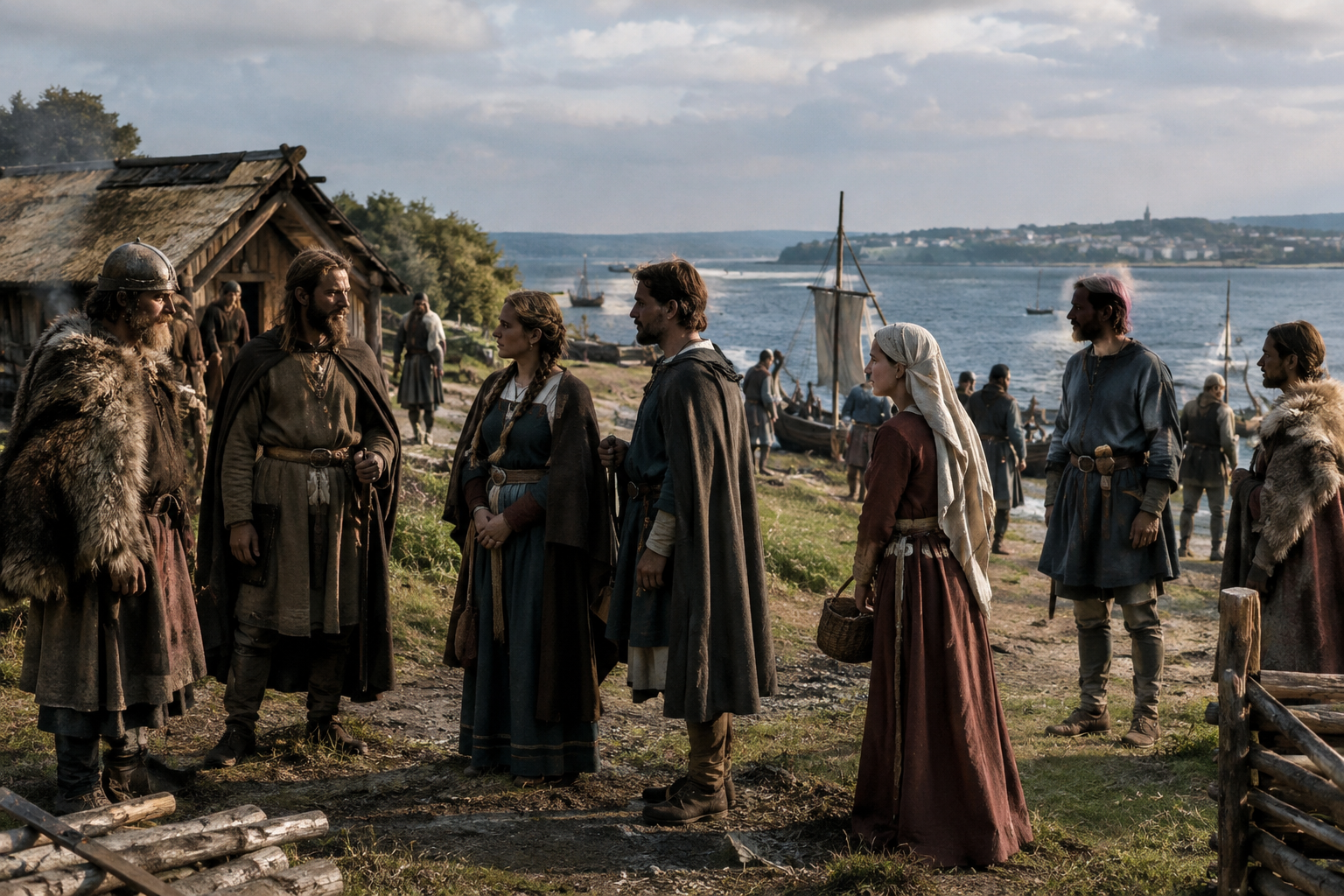
At Verket near Oslo, an Early Bronze Age male dated to about 1785 BC, sample CGG105650, pushes the story of Y-DNA haplogroup I1a2a surprisingly far back in Scandinavia. That matters because I1 is often discussed in broad terms as a northern European lineage, but here we have something more useful: a concrete ancient person, in a real archaeological setting, showing that this paternal branch was already present in southern Norway long before the Viking Age made Scandinavian movement famous.
That one grave does not make a people, still less a nation. But when CGG105650 is set beside later men from Denmark, Sweden, Anglo-Saxon England, and Bavaria, a pattern begins to come into focus. Haplogroup I1a2a appears here not as a mythical "Viking marker," but as a paternal line moving through the actual historical worlds of Bronze Age Scandinavia, Migration Period communities, and the North Sea networks of the early medieval centuries.
I1a2a is a sub-branch within the wider Y-DNA haplogroup I1, a lineage strongly associated with northern Europe in both modern and ancient genetic work. Y-DNA follows one direct paternal line only: father to son to son. That makes it extremely useful for tracking one thread of descent, but it is never the same thing as a person's whole ancestry, language, or identity.
For this article, the interest lies in where this specific branch turns up archaeologically. The supplied ancient individuals place I1a2a, or reported association with it, across a long northern arc: Norway in the Early Bronze Age, Denmark and Sweden in the Viking Age, and several early medieval graves in England and southern Germany linked with Germanic-speaking populations. It is that spread through time, rather than any single heroic origin story, that gives the lineage its historical character.
The oldest sample in this set, CGG105650 from Verket in Oslo, is the crucial anchor. Dated to about 1785 BC, he belongs to the Early Bronze Age of southern Norway, a period when Scandinavian societies were tied into wider exchange networks reaching into continental Europe, yet still deeply local in how communities buried their dead and organized their landscapes.
Without inventing details that are not in evidence, we can still say why this matters. A paternal line associated with I1a2a was present in Norway well over two and a half millennia before the classic Viking expeditions. That does not mean uninterrupted descent can be read neatly from one burial to another. It does mean that later appearances of related northern paternal lines in Viking and post-Roman contexts are not historical newcomers out of nowhere; they have deeper roots in Scandinavian prehistory.
A large ancient DNA study of the region and its long-term population history has helped transform how we understand these northern lineages, showing that Scandinavian prehistory cannot be reduced to a single migration or one simple ancestral package. In that broader framework, Verket is exactly the kind of find that gives a named branch like I1a2a a real archaeological footing: https://www.cell.com/cell/fulltext/S0092-8674(22)01468-4.
By the early Viking Age, the branch appears again in a world that is much better known historically. Sample VK301 from Ladby Grav on Funen, Denmark, dated to about AD 765, sits close to the beginning of the period when Scandinavian mobility became dramatically visible in raids, trade, settlement, and political consolidation. Ladby is an especially resonant place-name in Viking archaeology because it belongs to a high-status Danish landscape, even if we should not automatically inflate every genetic result into aristocratic history.
Further east, sample gor161 from Viking Age Stockholm, dated to about AD 975, shows the same branch or reported association in Sweden. Put plainly, these two men matter because they are not from the same site or the same generation. They suggest that I1a2a was not a one-off local survival, but part of the wider paternal repertoire of Viking Age Scandinavia.
That said, genetics and culture must be kept separate. A man carrying I1a2a in Viking Age Sweden was not "more Viking" than someone with another Y-lineage. The useful point is narrower and stronger: this branch was present among the populations participating in the Scandinavian world of the eighth to tenth centuries.
Some of the most historically revealing appearances of I1a2a are not in Scandinavia at all, but in early Anglo-Saxon England. At West Heslerton in Yorkshire, two males from an Early Anglo-Saxon cemetery, I20640 and I20649, are dated to about AD 550. At Oakington in England, I0772 is dated to about AD 500 and OAI008 to about AD 470, again in an Anglo-Saxon period context.
These burials belong to the centuries after Roman administration ended in Britain, when new political identities, new burial customs, and new continental connections were reshaping lowland England. For decades, argument about the Anglo-Saxon migration lurched between extremes: either mass replacement or almost no migration at all. Ancient DNA has made the picture both clearer and messier. In eastern and central England especially, there is strong evidence for substantial continental North Sea ancestry, but also for mixture with existing local populations.
That is where I1a2a becomes historically interesting. Its presence in multiple early Anglo-Saxon graves fits the broader picture of North Sea-linked male lines appearing in England during the fifth and sixth centuries. Research on these cemeteries and the formation of the early English gene pool has been central to that discussion: https://www.researchgate.net/publication/363736520_The_Anglo-Saxon_migration_and_the_formation_of_the_early_English_gene_pool.
What these English samples do not show is that every bearer of I1a2a in Britain arrived directly from Scandinavia. North Sea populations in this period were already entangled, and similar paternal lines could move through regions now called Denmark, northern Germany, the Low Countries, and England. But the cemetery evidence does show the branch embedded in the making of early medieval England.
Roman and early medieval Britain
One more sample broadens the map in a useful way. STR486, dated to about AD 495, comes from Straubing-Bajuwarenstrasse in Bavaria and is described here in a Germanic tribal context. This is the late fifth century, when post-Roman Europe was being reorganized into new kingdoms and regional identities, and when older Roman provincial structures overlapped with incoming and locally formed elites.
Bavaria is important because it prevents us from telling too tidy a purely Scandinavian story. A branch like I1a2a can appear in southern Germany in the Migration Period without requiring a saga-style leap from fjord to Alpine foothill. Instead, it reminds us that paternal lines circulated within a larger northern and central European zone shaped by mobility, military service, marriage, and community formation over generations.
Seen together, the Bavarian, English, Danish, Swedish, and Norwegian examples form a historically plausible distribution for a northern European Y-lineage. Not a straight arrow, then, but a scatter of real men living in different political worlds that were nonetheless connected.
Roman-Barbarian frontier mixing
The distinctive feature of I1a2a, on the evidence here, is continuity across changing northern European worlds. It is present in Early Bronze Age Norway, reappears in Viking Age Scandinavia, and shows up repeatedly in early medieval communities around the North Sea and beyond. That does not prove one unbroken family story between those graves. It does suggest that this paternal branch belonged to population networks with deep Scandinavian roots and long historical reach.
For someone researching I1a2a today, that is the valuable takeaway. Your direct paternal line may connect, at least at the level of deep ancestry, with the same broad northern European sphere that linked Bronze Age Norway, Viking Age Denmark and Sweden, and the Anglo-Saxon settlements of early England.






Comments