Haplogroup I1a1b1b1a
– 5 min read


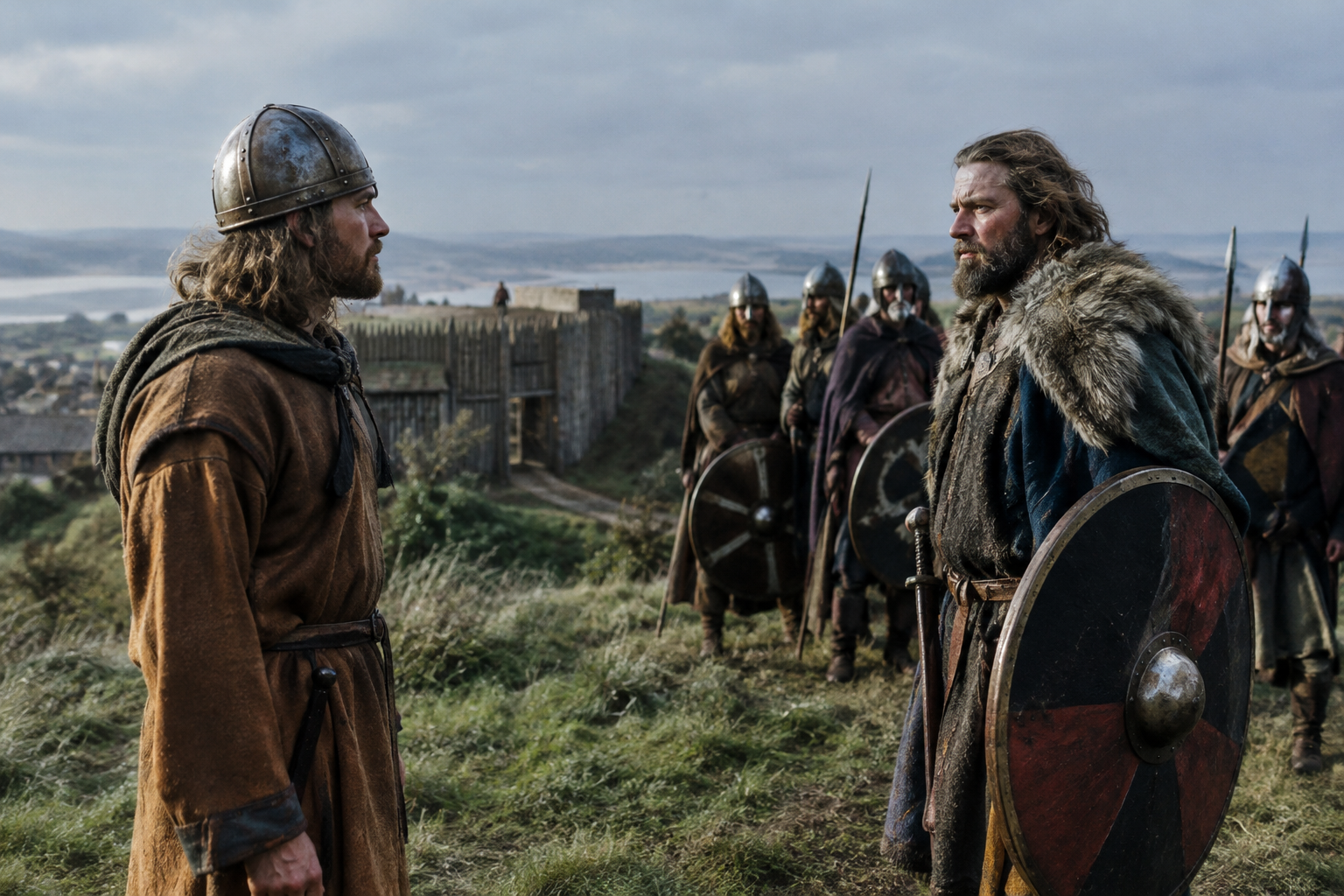
At Trelleborg in Sweden, an ancient man dated to around AD 275 appears in the record under the identifier CGG105936_CGG105937. That is an interesting moment to catch a Y-chromosome lineage, because late Iron Age southern Scandinavia stood on the edge of enormous historical changes: Roman influence reached north through trade and prestige goods, local societies were tightening their hierarchies, and the world that would eventually produce the Viking Age was already taking shape. In this case, the paternal line associated with him is reported here as I1a1b1b1a.
That narrow label matters. Y-DNA follows one direct paternal line only - father to son across generations - so it does not describe a person's whole ancestry, language, or identity. But when a specific branch turns up in more than one well-separated ancient context, it can show us something concrete about continuity in male-line descent. For I1a1b1b1a, the most striking pattern in the evidence supplied here runs from Iron Age Sweden to a Viking-age burial connected with violence far across the North Sea in England.
The Trelleborg sample sits several centuries before the classic Viking period. That alone is useful, because it reminds us that many lineages associated in the public imagination with "Vikings" were already present in Scandinavia long before longships raided monasteries or kings carved out overseas realms. The man identified as CGG105936_CGG105937, dated to around AD 275, belongs to a southern Swedish setting in which local communities were already tied into wider northern European networks.
We should be careful here. A single sample from Iron Age Sweden does not let us claim that this exact subclade defined a tribe, a kingdom, or a whole region. But it does place the branch in Scandinavia at a historically revealing time: the centuries when older Nordic Iron Age societies were developing the social and political foundations from which later Scandinavian expansions emerged.
An ancient DNA study on Scandinavian material and related contexts has helped expand this broader picture of population history, even when individual subclade resolution can vary from sample to sample. One of the research leads associated with this material is this ancient DNA preprint, which reflects the kind of work now making it possible to place single burials into much larger historical patterns.
The haplogroup name itself tells us that this is not the whole of I1, but a much more specific twig within it. That distinction is important. The wider haplogroup I1 is strongly associated with northern Europe, especially Scandinavia, in both ancient and modern discussions of paternal ancestry; yet a downstream branch like I1a1b1b1a has its own much narrower history, and we should not casually assign to it every movement ever proposed for I1 as a whole.
What the present evidence does support is modest and valuable: this paternal branch, or an assignment associated with it, appears in a late Iron Age Swedish individual and again in a Viking-age individual from England. That is not proof of an unbroken documented family line between the two men. It is, however, exactly the sort of pattern that makes archaeogenetics so powerful, because it links a specific paternal signal to the long Scandinavian horizon that stretched from homeland communities to overseas expeditions.
The second ancient individual is much later and much more dramatic in setting: VK257, dated here to around AD 998, from Ridgeway Hill in England and identified as a Viking invader. Ridgeway Hill has become one of the most discussed Viking-age burial discoveries in Britain because it captures a brutal moment of conflict, punishment, or both, in the tense relationship between England and Scandinavian raiders at the end of the 10th century.
Even without embellishing the scene, the context is powerful enough. By the late 900s, Scandinavian activity in England was no longer a matter of occasional raids from the horizon. It involved armies, tribute, settlement, and increasingly organized confrontation. A paternal lineage associated with I1a1b1b1a appearing in this context fits well with a Scandinavian-connected male line moving within that larger North Sea world.
Research investigating Viking-age mobility and ancestry in Britain has done much to sharpen this picture, and another relevant research lead linked with the supplied evidence is this study on ancient DNA. The larger lesson is not that one haplogroup equals one ethnic label, but that some paternal lines can be tracked in both homeland and expeditionary contexts with a clarity historians once simply did not have.
Put those two men together and the geography becomes the real story. One appears in southern Sweden in the 3rd century. The other appears in England at the close of the 10th century in a burial associated with Viking violence. That does not give us a straight line from one named person to another. What it does give us is a securely northern frame for this paternal branch across the long centuries in which Scandinavians moved from regional Iron Age societies into the maritime political world of the Viking Age.
This is also a good reminder that "Viking" is a historical activity and period label, not a biological type. The Trelleborg man was not a Viking in the usual chronological sense, yet his paternal line sits in the same deep Scandinavian background from which later Viking-age populations emerged. In that sense, I1a1b1b1a is interesting precisely because it bridges two different historical worlds: pre-Viking Scandinavia and the age of Scandinavian expansion overseas.
For MyTrueAncestry users, that is often the most meaningful kind of evidence. Not a fantasy of a single heroic ancestor, but a real glimpse of how one male line could belong to ordinary Iron Age life in Sweden and also turn up centuries later amid the hard politics of invasion and resistance in England.
North Sea migrations to Britain
Because the evidence here is limited, it is worth valuing exactly what is solid. We are not dealing with a legendary genealogy or a later medieval family trying to claim ancient prestige. We have two ancient individuals, from two very different moments, whose reported paternal signal is associated with the same narrow haplogroup label. That is far more useful than a grand but unsupported tale of migration.
The Trelleborg sample anchors the branch in Iron Age Sweden before the Viking Age. The Ridgeway Hill sample shows it in a Scandinavian-linked man present in England during the violent closing years of the first millennium. Between those points lies the whole transformation of northern Europe: changing chiefdoms, expanding sea routes, and the emergence of the North Sea as a zone of warfare, trade, settlement, and cultural mixing.
The distinctive thing about I1a1b1b1a in this evidence is not sheer quantity, but historical position. It appears in late Iron Age Sweden and again in a Viking-age context in England, giving this paternal line a plausible place within the long Scandinavian story before and during overseas expansion. If this is your branch, the most careful takeaway is a good one: your direct male line fits into a northern European, very likely Scandinavian-connected historical landscape that can now be seen not just in modern DNA, but in ancient men who lived on both sides of the Viking world.



Comments