Haplogroup I1a1b1a4a1a1c

– 5 min read


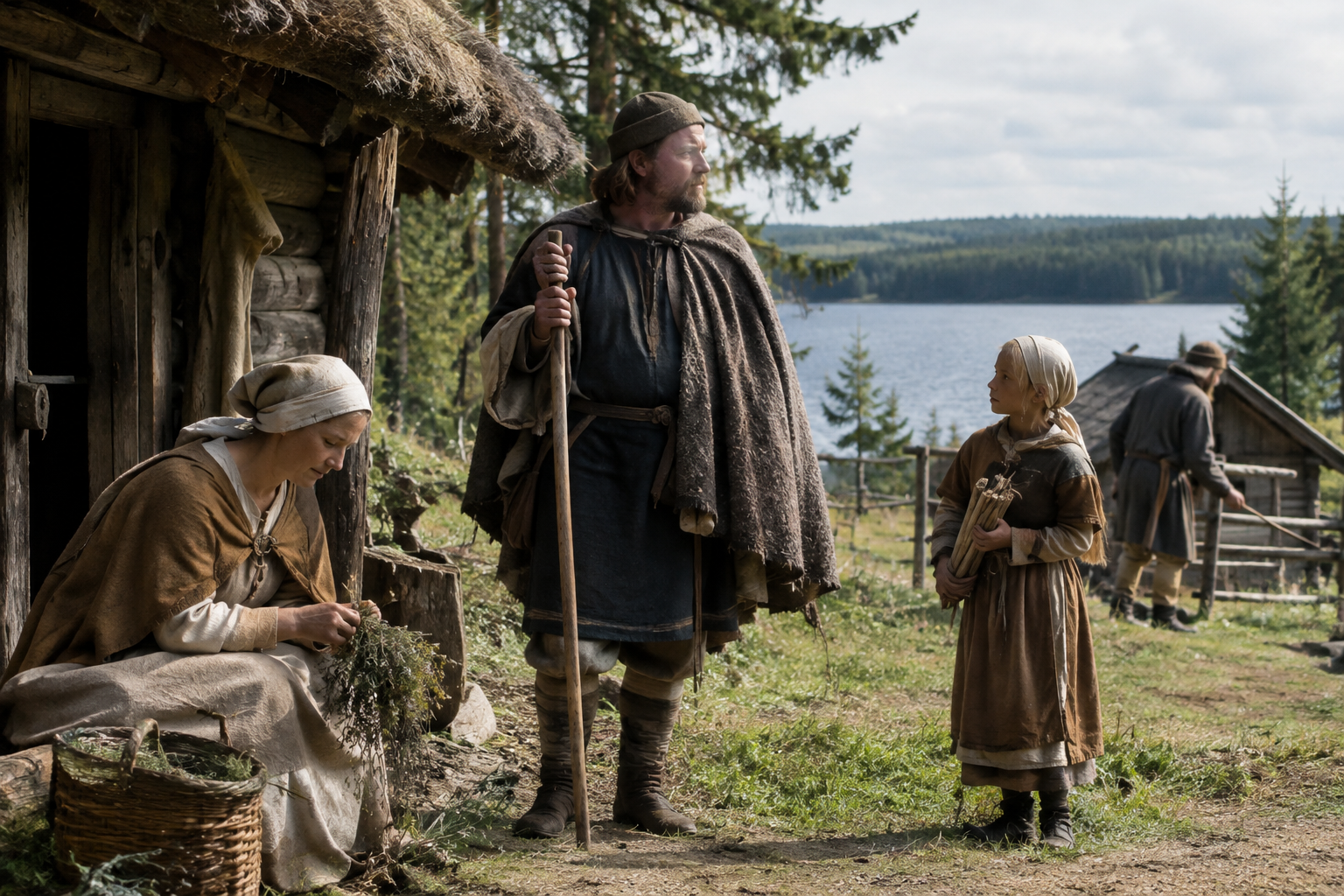
In the middle of the 16th century, in Tavastia at Pälkäne in southern Finland, one man now known simply as PLK003 was buried into a world already being pulled between old local traditions and the expanding structures of the Swedish kingdom. His reported Y-DNA assignment, linked here to I1a1b1a4a1a1c, is a very narrow paternal branch within the much broader I1 lineage that is often associated with northern Europe. That makes this not a story about a vast, timeless "people," but about one direct male line turning up in a very specific late medieval Finnish setting.
That specificity matters. Y-DNA follows a single father-to-son line, so it tells us something precise but limited: not the total ancestry of PLK003, nor his language or identity on its own, but one thread in the much denser fabric of late medieval Finland. In a region like Tavastia, where eastern and western influences met for centuries, even a single securely placed paternal line can be historically revealing.
Pälkäne lies in the old historical province of Tavastia, inland rather than coastal, in an area central to the formation of medieval Finland. By around AD 1550, this was no untouched frontier. Christianity was long established, the Reformation was transforming religious life, and Finnish communities were tied into the political world of the Swedish Crown. Yet local settlement patterns, kin groups, and regional identities remained deeply rooted.
PLK003 belongs to that moment. The interest of the sample is not that it confirms some dramatic migration event all by itself, but that it anchors a fine-grained Y-DNA branch in a documented Finnish medieval population. That is especially useful for I1 subclades, because broad I1 is common enough across Scandinavia and parts of the Baltic world that only narrow branches begin to tell a more local story.
The haplogroup named here, I1a1b1a4a1a1c, sits far down the Y-chromosome tree. Its importance is precisely that it is narrower than the parent haplogroup I1. Broad I1 has a long and complicated history in northern Europe, especially in Scandinavia, but it would be careless to pour all of that history directly into one tiny descendant branch without specific supporting evidence.
So the safest way to read PLK003 is this: by the 16th century, a man in Tavastia carried a paternal lineage belonging to an extremely specific twig of the wider I1 tree. That may reflect local continuity, movement across the Gulf of Bothnia, older Scandinavian-linked settlement, or several generations of regional mixing within Finland itself. The sample is valuable because it fixes that paternal line to a time and place, not because it magically identifies an ethnic label.
This is also why late medieval Finland is such a good testing ground for ancient DNA. The region was shaped by interaction: western ecclesiastical and administrative institutions, Baltic contacts, internal Finnish population structure, and in some areas Sámi and eastern connections as well. A narrow Y-lineage found there may belong to a story of continuity, mobility, or both.
For anyone carrying I1a1b1a4a1a1c today, the obvious temptation is to leap straight to "Viking" or "Swedish." Tavastia advises caution. Medieval Finland was tied to Scandinavia politically and religiously, but it was never just an appendage of Sweden. It had its own regional histories, and paternal lines could persist locally for centuries after arriving, whether their earlier roots lay in Finland, Sweden, or elsewhere around the Baltic.
That is where archaeology and genetics work best together. Historical Tavastia was not defined by one single ancestry source. Instead, it was a contact zone in which population structure formed over long periods through settlement, marriage, trade, warfare, church organization, and taxation. A paternal branch like I1a1b1a4a1a1c could therefore be both northern in its deeper background and thoroughly Finnish in its documented historical setting.
An ancient DNA study connected with these Finnish burials is archived through this research record, which provides the scientific framework behind the sequencing project. Even without inflating the evidence beyond what the sample itself can bear, the result is important: it places this branch in real medieval Finnish ground, rather than leaving it floating in modern surname projects or abstract haplogroup maps.
Ancient DNA from the later medieval and early modern north can be oddly underappreciated. Prehistory gets the glamour; Viking Age burials get the headlines. But a sample like PLK003 sits at a historical hinge point. By AD 1550, Finland had written administration, church structures, and recognisable regional societies, yet populations were still far closer to older local demographic patterns than many modern communities are.
That makes PLK003 particularly useful for genealogical interpretation. If your own Y-DNA falls close to I1a1b1a4a1a1c, the significance is not that you are "from one medieval Finn" in any simple sense. Rather, it suggests that your paternal line belonged to the same narrow lineage pool that was present in inland southern Finland during the late medieval period. This is the kind of finding that helps narrow a historical zone of interest, especially when combined with documented family history and modern Y-DNA matching.
It also reminds us how much northern history happened away from famous royal courts and saga heroes. One man in Pälkäne can tell us something that an entire shelf of nationalist myth cannot: that particular paternal lines were embedded in ordinary regional communities, surviving through centuries of change.
Because I1 is so often discussed in connection with Germanic-speaking populations, readers naturally wonder whether PLK003 should be read through that lens. The answer is: only carefully. Genetics can illuminate the spread and survival of paternal lines, and broader research has indeed been used to discuss northern population history and language dispersals, but no single late medieval burial can by itself prove what language a man's paternal ancestors spoke centuries earlier.
Still, the wider question is a good one. Finland sat beside the Scandinavian world for a very long time, and its western and southern regions saw sustained contact across water and land. A branch such as I1a1b1a4a1a1c appearing in Tavastia fits comfortably within that broader northern setting, even if the precise route and date by which this particular paternal line entered the region remain uncertain.
The real strength of this evidence is its modesty. PLK003 does not need an invented saga, a castle, or a noble pedigree to be interesting. He shows that the paternal branch I1a1b1a4a1a1c, or a very closely associated reported line, was present in late medieval Tavastia at Pälkäne around AD 1550. For descendants exploring this branch today, that points toward a northern European story with a firm foothold in historical Finland, especially in a region shaped by long contact with the Scandinavian and Baltic worlds.
That is often how ancient DNA is most useful: not by offering grandiose certainty, but by giving one sturdy historical anchor. In the case of I1a1b1a4a1a1c, that anchor sits in Tavastia, in the life and death of PLK003.






Comments