Haplogroup I1a1b1a2a

– 5 min read


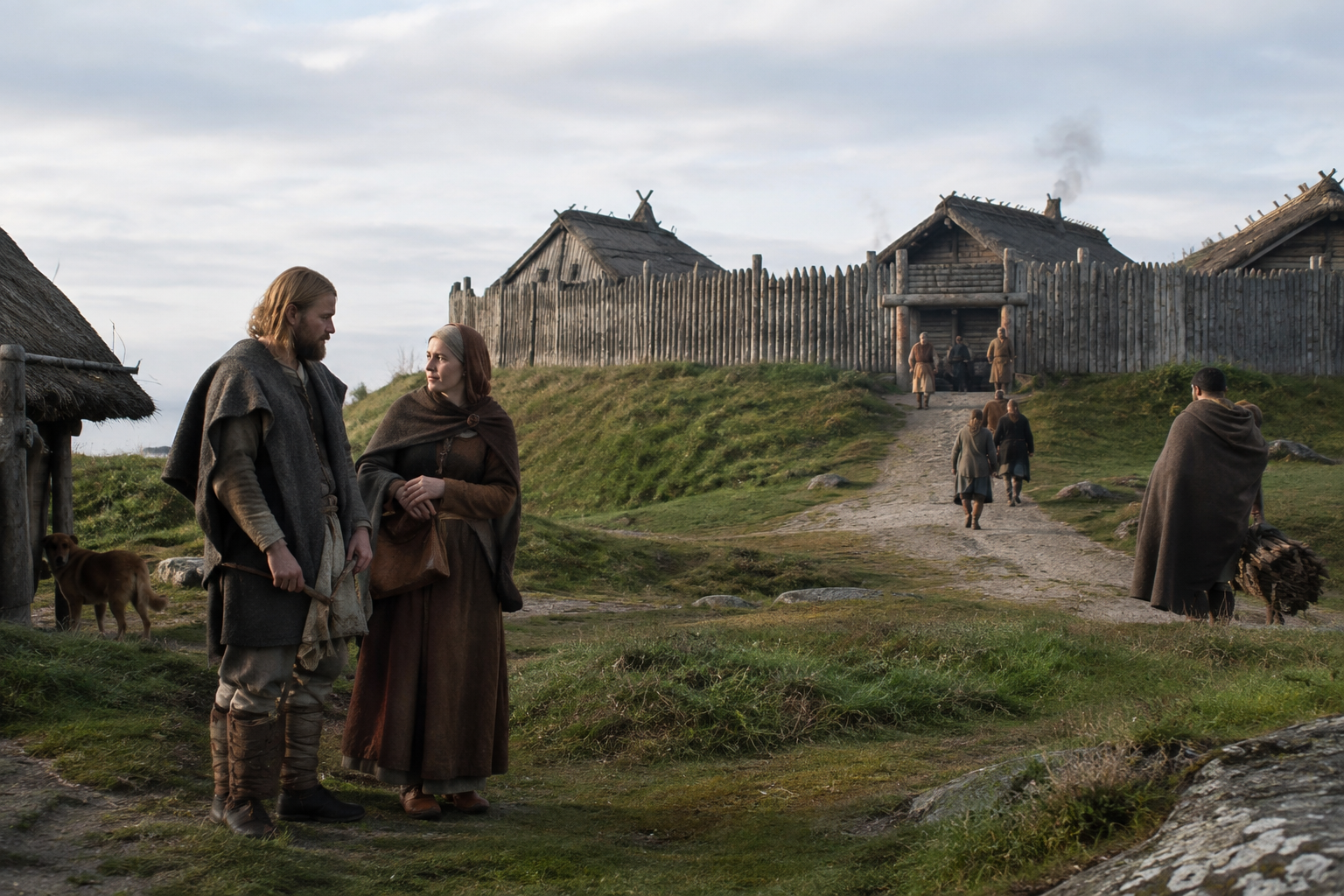
At Sandby borg on the island of Oland, archaeologists uncovered one of the grimmest snapshots in Scandinavian archaeology: a Migration Period ringfort where people appear to have died suddenly and been left where they fell. Among the ancient individuals recovered from this fifth-century AD site is snb012, dated here to around AD 475 and associated with the Y-DNA haplogroup I1a1b1a2a.
That makes Sandby borg a particularly vivid place to begin. This is not a legendary king, nor a later medieval pedigree polished by scribes. It is a man from a fortified settlement in pre-Vendel Age Sweden, living in a Baltic world of local power, violence, exchange, and political instability. A Y-chromosome lineage like I1a1b1a2a traces only one direct paternal line, but at a site like this it can still tell us something important: that one branch of the wider I1 lineage was already present in eastern Scandinavia in the late Roman and Migration Period world.
Sandby borg is one of the many ringforts of Oland, but it stands apart because of the extraordinary archaeological context. The site belongs to the troubled centuries after the Western Roman Empire's collapse, when the Baltic and Scandinavian worlds were hardly isolated backwaters. They were connected to trade, prestige goods, martial networks, and shifting hierarchies that linked the islands and coasts of the north to wider European changes.
The sample snb012 comes from that environment. The date, around AD 475, places him just before the Vendel Period and well before the Viking Age, in a society that was already politically complex and regionally connected. In popular imagination, Scandinavian history often leaps from prehistory straight to Vikings, but Sandby borg reminds us that the centuries before that were dramatic in their own right.
A major ancient DNA study of Scandinavia and the Baltic world, published in Cell, helped place sites like this into a larger picture of mobility and population change. The broad lesson is not that one burial can define a people, but that eastern Scandinavia in this period was part of a living, changing network rather than a sealed genetic island.
The haplogroup in question, I1a1b1a2a, is a narrow branch within the broader Y-DNA haplogroup I1. That distinction matters. The parent haplogroup I1 has a well-known association with northern Europe, especially Scandinavia, but it would be careless to pour the whole long history of I1 directly into this one smaller sub-branch unless the evidence specifically supports it.
So what can safely be said? First, the presence of I1a1b1a2a in snb012 anchors this paternal line in Migration Period Sweden. Second, because the sample comes from Oland, it places the branch in a strategically important Baltic setting, not merely somewhere in a vague "Germanic north." Third, it helps remind us that paternal lineages visible in later Scandinavian and North Sea populations did not suddenly appear in the Viking Age; some were already embedded in earlier communities that lived through the upheavals of the fifth century.
That does not mean every man at Sandby borg shared this lineage, nor that the haplogroup by itself reveals language, rank, or ethnic identity. Archaeology, ancestry, and historical labels overlap, but they are not interchangeable. What the lineage does offer is a firm paternal thread running through a site that is already historically important for other reasons.
Oland was never just a quiet island off the Swedish coast. In later prehistory and early history it occupied a sensitive position in the Baltic, facing both the mainland and the sea routes that tied Scandinavia to Gotland, the southern Baltic shores, and beyond. Ringforts on Oland are often read as signs of organized communities and local defense, and Sandby borg fits that wider landscape of fortified settlement.
That setting matters for understanding a lineage such as I1a1b1a2a. A paternal branch found here is not simply "Swedish" in a modern national sense. It belonged to a man living in a maritime world where movement, alliance, raiding, and marriage could connect island communities to much larger historical processes. In other words, this is precisely the kind of place where we should expect both local continuity and wider contact.
The late fifth century was also an age when identities around the Baltic were being shaped in ways that later written sources only dimly reflect. Ancient DNA cannot supply the missing chronicles, but it can show that the male lines present in these communities were part of the same northern European demographic history that later fed into Vendel and Viking Age societies.
One of the most useful things about a sample like snb012 is chronological. It gives us a documented bearer of I1a1b1a2a from centuries before the age of rune stones, royal genealogies, and Icelandic saga memory. Too often, Scandinavian paternal history is imagined backwards from Viking fame. Sandby borg pulls us into an earlier world, where the foundations of later Scandinavian societies were already being laid.
This is also why Migration Period archaeology deserves more public attention. The centuries around AD 400 to 600 were a hinge in northern Europe. Power centers shifted, contacts intensified, and new elite cultures emerged. By the time the Vendel Period flowered in eastern Scandinavia, the people who had lived through places like Sandby borg had already passed through generations of adaptation, violence, and local competition.
For someone carrying I1a1b1a2a today, that is perhaps the most evocative historical connection available from the evidence at hand. Not a neat dynastic claim, and not a promise of descent from some named chieftain, but something more archaeologically solid: a demonstrated paternal foothold in the Baltic Scandinavian world before the Viking Age began.
There is only one ancient sample listed here, and that limitation is worth taking seriously. We are not looking at a large cemetery that lets us track a whole paternal clan across many generations. But scarcity can sharpen the significance. A securely placed ancient man from a famous and unusual site can sometimes tell us more than a longer but vaguer list of unconnected names.
snb012 matters because he joins a specific paternal branch to a specific historical landscape: Oland, around AD 475, in the aftermath of Rome and on the threshold of the Vendel world. The value lies in the combination of date, place, and archaeological setting. It is one thing to know that a lineage is associated broadly with northern Europe; it is another to find it inside a fortified Scandinavian community caught in a moment of crisis.
The clearest supported insight for I1a1b1a2a is that this paternal branch was present in eastern Scandinavia by the late fifth century AD, represented by snb012 from Sandby borg on Oland. That places the lineage in a real archaeological world of ringforts, Baltic connections, and Migration Period instability, long before the classic Viking Age. For a modern tester, that is the useful historical takeaway: this branch belongs within the deep northern European story, but its most vivid ancient witness so far stands in a very specific place, at a fortified settlement where history stopped suddenly and archaeology preserved the silence.






Comments