Haplogroup I1a1b1a1d3b2

– 4 min read


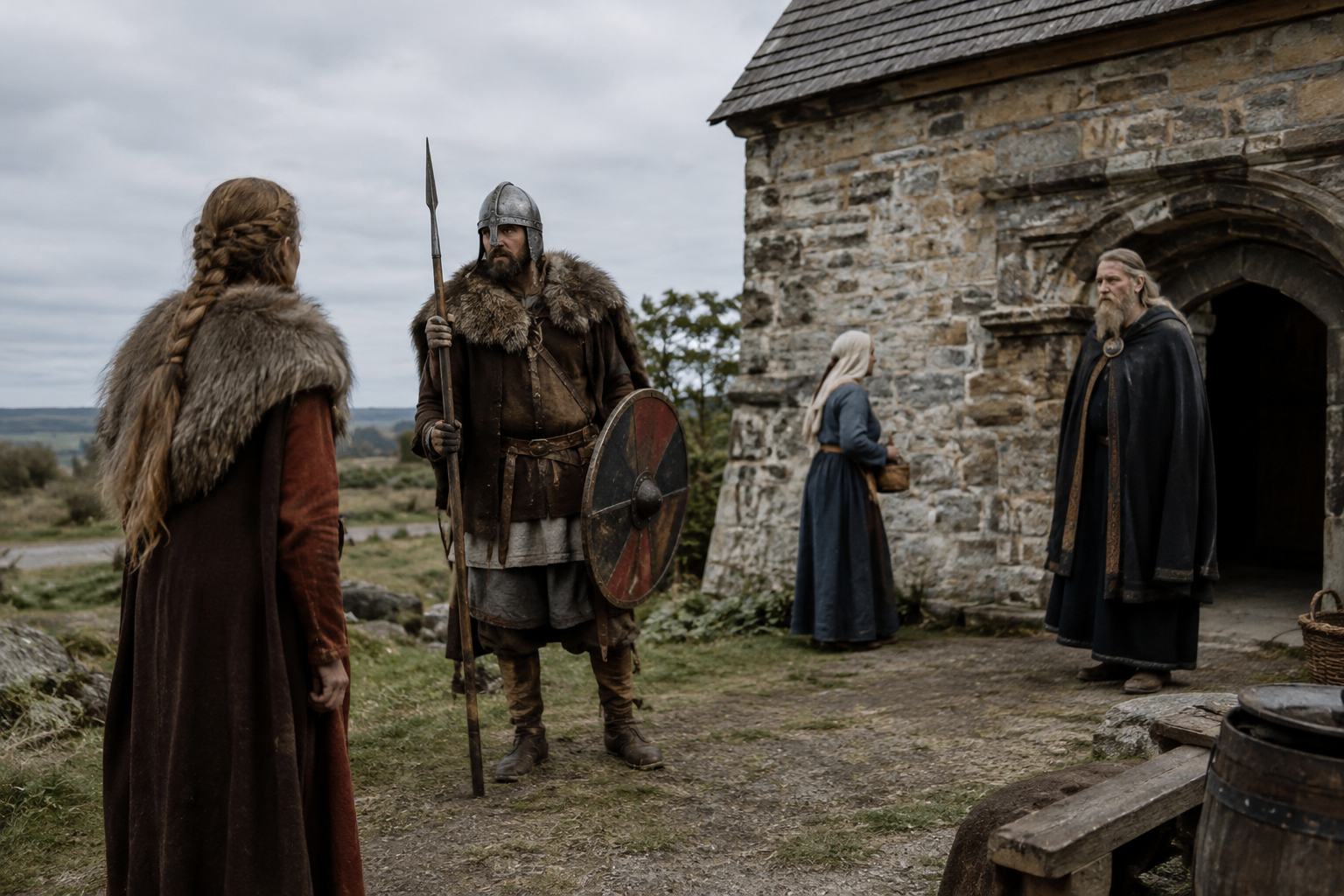
At Skara Varnhem in Sweden, one man dated to about AD 1050 appears in the ancient DNA record as sample VK400. That is already an evocative setting: Varnhem sits in one of the best known early medieval landscapes of Vastergotland, a region where Christianity was taking firmer hold while older Scandinavian traditions were still close at hand. In this case, the interest lies not in a saga hero or a named king, but in an ordinary excavated individual whose paternal line has been associated with the Y-DNA haplogroup I1a1b1a1d3b2.
That long label needs a little unpacking. Haplogroup I1a1b1a1d3b2 is a very narrow branch within the broader I1 lineage, a Y-chromosome line strongly associated with Scandinavia in both modern and ancient DNA work. Y-DNA tracks one direct paternal line only - father to son to son - so it does not describe a person's whole ancestry. But when a branch like this turns up in a Viking Age or immediately post-Viking Age burial, it gives us a useful, tightly focused glimpse into how male lines persisted in medieval Scandinavian communities.
The single most concrete anchor here is VK400 himself: an individual from Skara Varnhem, dated to around AD 1050. That date places him in a period of major change in Sweden. Royal authority was becoming more structured, regional elites were negotiating power in new ways, and Christian burial customs were spreading across landscapes that had long been shaped by older local traditions.
Varnhem matters because it is not an abstract point on a genetic map. It belongs to a historically important part of inland western Sweden, close to routes linking agricultural districts, assembly places, and emerging ecclesiastical centers. A man carrying a paternal line assigned to I1a1b1a1d3b2 in this setting is therefore best understood not as an isolated curiosity, but as part of the living population of medieval Scandinavia.
An ancient DNA study examining Viking Age and medieval Scandinavian material helped place sites like these into a wider genomic context, even if the main value of VK400 remains his very specific local presence in Varnhem. The research trail associated with this sample includes this study of ancient Scandinavian genomes, which is relevant for understanding how such individuals are situated within broader regional population history.
The narrow branch I1a1b1a1d3b2 sits far down inside haplogroup I1, and that distinction is important. We can say with confidence that I1 has deep roots in northern Europe and is particularly prominent in Scandinavian genetic history. What we should not do is simply project the entire deep history of I1 onto this exact terminal branch as though every movement and date were known in detail.
Still, the broad picture is useful. By the Viking Age, I1 lineages were well established across Scandinavia. That means VK400's paternal line fits comfortably within a male-line landscape that was already local to the region, rather than looking like an obvious newcomer from far outside northern Europe. In historical terms, this is less a story of dramatic arrival than one of continuity inside a changing medieval society.
That continuity is often the most interesting thing in archaeology. Grand narratives like raids, kingship, and conversion can make the headlines, but cemeteries remind us that history was also made by farmers, craftsmen, retainers, clerics, and households whose names are lost. Haplogroups do not restore those names, but they sometimes show that the men buried in such places belonged to paternal lines that had likely been part of the Scandinavian population for a long time.
The date around AD 1050 is especially telling. In Sweden, this was not a clean dividing line between "Viking" and "medieval," nor between "pagan" and "Christian." It was a period of overlap. Old kin structures still mattered; regional identities still mattered; and yet burial grounds, churches, and royal politics were increasingly tied into the Christian kingdoms forming around the Baltic and North Sea worlds.
So when we look at VK400 and his reported connection to I1a1b1a1d3b2, the most responsible reading is also one of the most historically interesting: this paternal line was present in a man living through that transition. He was not a symbol of all Sweden, and not proof of one tribe, dynasty, or ethnicity. He was one excavated person from a real community at a moment when Scandinavian society was being reorganized in durable ways.
One sample cannot map an entire haplogroup's medieval spread, but it can anchor discussion in place. Western Sweden was never peripheral to the Viking Age world. It faced both inland Scandinavian power networks and the wider North Sea zone. Goods, people, beliefs, and political ambitions moved through this region constantly, and its communities were participants in the making of medieval Scandinavia.
That is why even a sparse record like VK400 has value. The finer the haplogroup resolution, the more tempting it is to tell overly precise stories. Yet the real contribution here is subtler and better: a documented paternal branch within a securely medieval Swedish context. For men today who belong to I1a1b1a1d3b2, that offers a plausible historical setting for one part of their ancestry - not a family tree, but a landscape where their direct paternal line was present in the late Viking Age.
For readers interested in how ancient DNA is clarifying Swedish burial communities more generally, medieval Scandinavian kinship studies provide a useful comparison. They show how genetics can illuminate cemetery organization and local population structure without collapsing everyone into a single family or lineage.
For haplogroup I1a1b1a1d3b2, the standout point is not a legendary ancestor or a royal claim. It is the presence of this paternal line in VK400, a man from Viking Age Skara Varnhem around AD 1050, in the heart of a Scandinavian society moving into the Christian Middle Ages. That is a modest finding on paper, but an important one in human terms: it places this branch in a real burial ground, in a real Swedish region, at a real historical turning point.
If this is your paternal haplogroup, the best historical takeaway is careful rather than extravagant. Your direct male line belongs to a narrow offshoot inside a broader Scandinavian-associated Y-DNA tradition, and one ancient bearer of that line is documented in medieval Sweden. That does not make every modern carrier "Viking" in any simple sense, but it does give your paternal ancestry a tangible foothold in the archaeology of late Viking Age Scandinavia.
Comments