Haplogroup I1a1b1a1d3b
– 5 min read


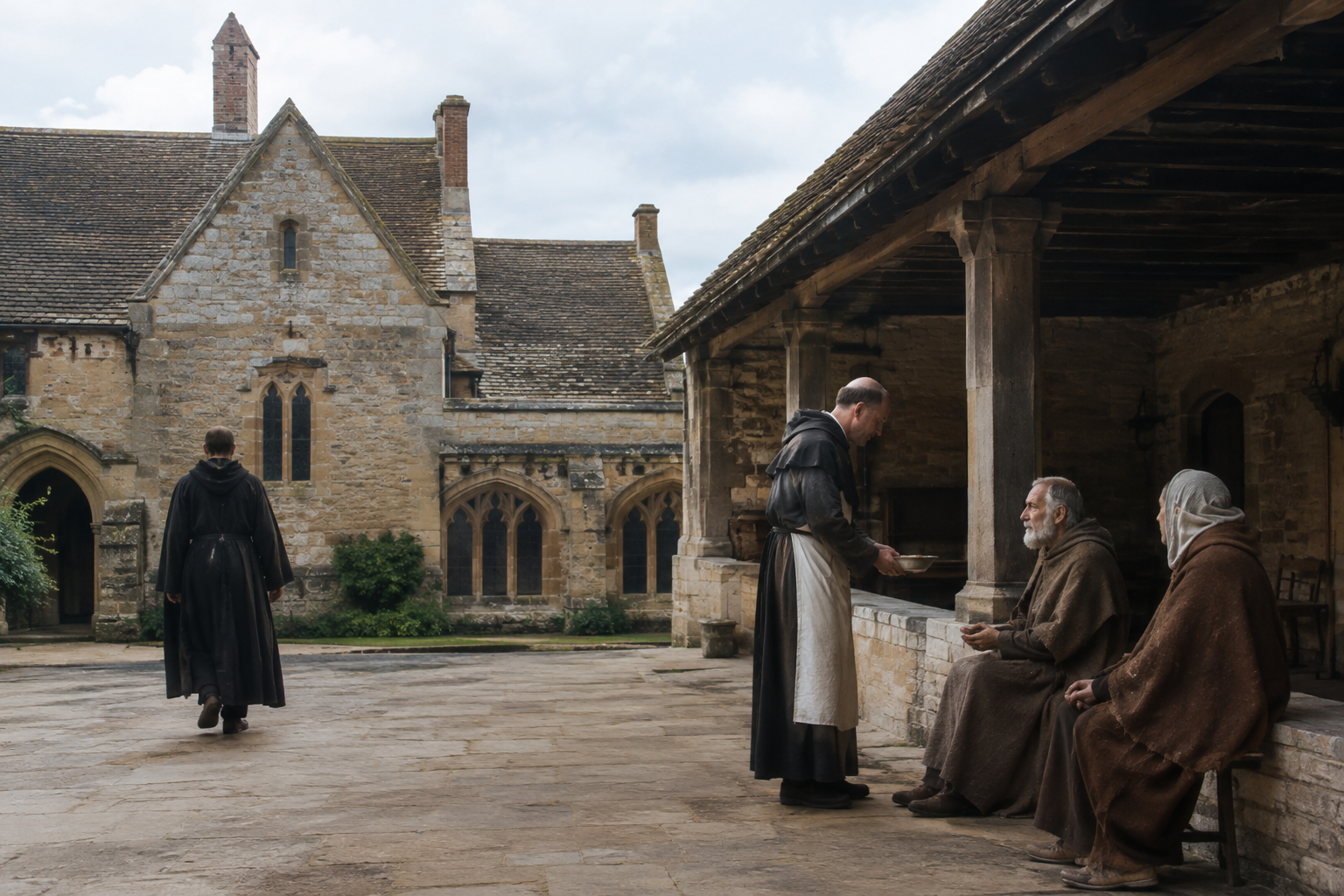
One of the clearest ancient signposts for the Y-DNA haplogroup I1a1b1a1d3b comes from medieval Cambridge. The individual identified as ATP_PSN_326, dated to around AD 1250 and associated with St John's Hospital, places this paternal line in a very specific world: not a saga landscape of legendary founders, but an urban English setting shaped by charity, illness, religion, and constant movement of people.
That matters because Y-DNA follows only the direct paternal line, and a subclade as specific as I1a1b1a1d3b is best understood through careful context rather than grand claims. In this case, the interesting story is not that one medieval man "explains" the haplogroup, but that he anchors it in a real archaeological population from a busy English town at a time when Cambridge was growing into one of the most important intellectual and ecclesiastical centres in the kingdom.
St John's Hospital in Cambridge was founded in the High Middle Ages as a charitable institution. Hospitals of this kind were not hospitals in the strictly modern sense alone. They could care for the poor, the elderly, the sick, travellers, and others on the edge of ordinary household support. A burial from this setting therefore offers a glimpse into the lived population of medieval England beyond kings, knights, and monastery chroniclers.
The sample ATP_PSN_326 is especially valuable because it fixes the branch I1a1b1a1d3b in a documented urban environment. Cambridge in the 13th century was a market town, a river crossing, a religious landscape, and increasingly a centre of scholarship. Men buried there might have been local, regional, or drawn in from elsewhere by work, study, service, or need. A paternal lineage found in such a place does not point to a single identity, but to the circulation of lineages within medieval English society.
A broader ancient DNA investigation of medieval and earlier populations in Britain has helped show just how informative these burials can be, especially when archaeologists and geneticists study them as communities rather than as isolated curiosities. One relevant research lead connected with this sample is this ancient DNA study on Britain, which reflects the kind of work that has made medieval burials newly legible at the genetic level.
Roman and Early Medieval Britain DNA
The haplogroup name here is very narrow, and that narrowness is important. The wider family behind it is I1, a well-known northern European Y-chromosome lineage with a long history in Scandinavia and regions tied into the North Sea world. But it would be careless to take everything ever said about I1 as automatically true for the much more precise branch I1a1b1a1d3b.
What the Cambridge individual gives us is secure evidence that this branch, or an assignment associated with it, appears in medieval England by about AD 1250. That is a historically plausible setting. By the 13th century, England had already absorbed many centuries of migration and mixture: prehistoric settlement, Roman-era mobility, Anglo-Saxon immigration, Scandinavian settlement, and Norman rule had all left their mark. A lineage under I1 in eastern or southern England is therefore not surprising, but the exact subclade should still be treated with appropriate caution unless a published study resolves it explicitly to that terminal level.
That distinction between broad branch and fine sub-branch is where good archaeogenetics becomes useful. It stops us from turning one medieval burial into a mythic migration map. Instead, it lets us say something modest but real: this paternal line was present in the social fabric of medieval England, in a town connected to both local countryside and wider European networks.
Cambridge was never an isolated settlement. Its importance rested on position as much as prestige: river traffic, trade routes, ecclesiastical institutions, and, from the 13th century onward, the emerging university world all helped draw people in. A man buried at St John's Hospital might have been from the surrounding fen-edge communities, from another part of England, or from farther afield. The hospital context itself reminds us that medieval towns collected lives from many directions.
That is one reason a Y-line such as I1a1b1a1d3b found here is historically suggestive. It fits a population shaped by the long afterlife of North Sea movements. In eastern and central England especially, paternal lineages can reflect contributions from pre-Conquest English populations and from later Scandinavian-linked settlement zones, though any attempt to choose one route for one individual would go beyond the evidence.
The archaeology of Cambridge has already shown how much can be recovered from ordinary burials: health, diet, mobility, kinship, disease, and local demographic change. Genetics adds another layer. It does not replace the archaeology of the graveyard or hospital, but it sharpens our sense that medieval English towns were full of lineages with deeper regional histories behind them.
Cambridgeshire Before and After the Black Death
If we step back from the single burial, the larger historical backdrop becomes clearer. Branches of I1 are often discussed in connection with northern Europe, especially Scandinavia and the wider North Sea zone. That does not mean every medieval English carrier arrived recently from Sweden, Denmark, or Norway. It means that over centuries of exchange, conquest, settlement, and marriage, these paternal lines became part of the genetic landscape on both sides of the North Sea.
England is a perfect place to see that complexity. Roman Britain had continental links long before the Anglo-Saxons. Early medieval migration then brought substantial new ancestry into parts of eastern England. Later Viking activity added still more movement, not only through raiding but through settlement, trade, and political integration. By the time of AD 1250, a man with an I1-derived paternal line in Cambridge did not need to be a newcomer at all; his paternal ancestors may have been in England for many generations.
This is precisely where genetic evidence works best when paired with history. It does not hand us a single label such as "Viking" or "Anglo-Saxon" for ATP_PSN_326. Rather, it places him within a medieval population whose paternal ancestry had been shaped by centuries of northern European contact.
North Sea Migrations to Britain
There is a temptation, when reading about ancient DNA, to focus only on royal tombs, weapon graves, or spectacular migrations. But hospital cemeteries can be more revealing for social history. They capture the people who actually made a medieval town function: labourers, servants, clergy-adjacent dependants, travellers, the infirm, and the poor. They are often closer to the demographic reality of the past than the famous dead.
So ATP_PSN_326 matters not because he was exceptional, but because he may have been ordinary. An ordinary man carrying a branch associated with I1a1b1a1d3b tells us that this paternal line had become embedded in medieval English life. That is often the most historically useful kind of evidence: not a founder in a legend, but a burial in a working community.
For readers interested in how post-Roman and early medieval ancestry formed the English gene pool, the wider picture is worth exploring alongside this one hospital burial.
Anglo-Saxon Migration and English DNA
For someone researching the haplogroup I1a1b1a1d3b, the medieval Cambridge sample offers a grounded and useful clue. It shows this paternal line present in England in a documented 13th-century context, within a town deeply connected to the wider North Sea world and to the layered population history of Britain. That does not prove a single ethnic identity or one neat migration story, but it does place the lineage firmly inside the historical population of medieval England.
In other words, this is a haplogroup with a traceable foothold in real medieval lives. Not in abstraction, and not only in later surnames or modern testing databases, but in one excavated person from Cambridge whose paternal line still speaks through the archaeology.





Comments