Haplogroup I1a1b1a1d2

– 5 min read


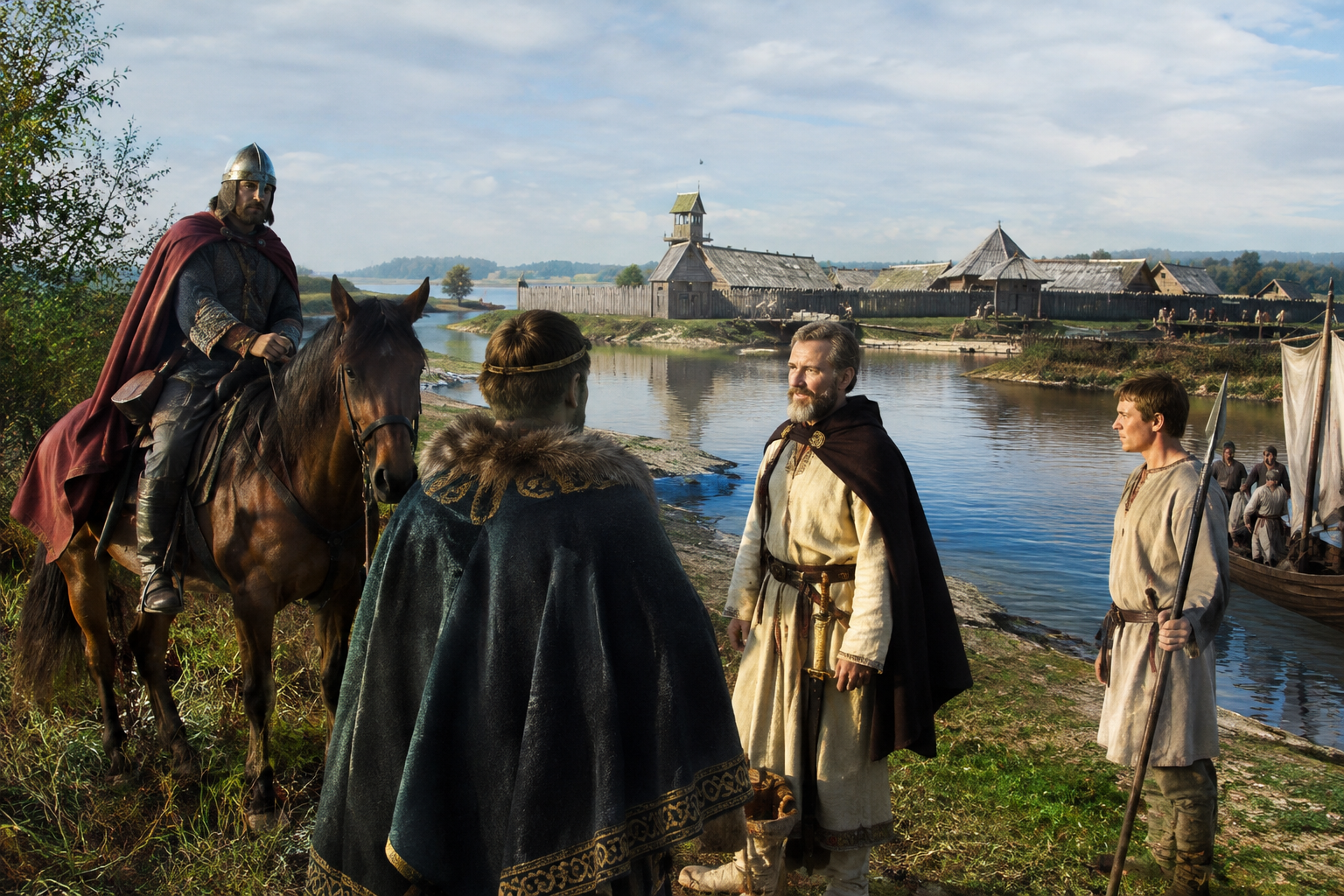
At Zalavar-Varsziget in western Hungary, one excavated man from about AD 850 carries an unexpectedly revealing paternal signal. The individual identified as AHS29, buried in the Carolingian-period settlement landscape at Zalavar, has been associated with the Y-DNA haplogroup I1a1b1a1d2 - a very specific branch of a wider paternal lineage more often discussed in connection with northern and Germanic-speaking Europe.
That matters because Zalavar was not some isolated village at the edge of nowhere. In the 9th century it sat in a politically charged frontier world between the Carolingian sphere, older Avar traditions in the Carpathian Basin, and the shifting powers that would soon include the incoming Hungarians. A paternal lineage like I1a1b1a1d2 appearing there is not a fairy-tale clue to a single heroic migration. It is something more interesting: a small, hard piece of evidence for how mobile, entangled, and socially mixed this region had become.
Zalavar, known historically in connection with Mosaburg, was one of the key centres in the swampy western reaches of the Carpathian Basin during the 9th century. This was a place where empires attempted to organise borderlands, missions, garrisons, and local elites. Archaeology here belongs to that awkward, fascinating post-Roman millennium when political control could change faster than populations themselves.
The sample AHS29 comes from this frontier setting, dated to around AD 850 and identified in the material provided simply as Medieval Hungary, Carolingian Empire, Zalavar Varsziget. That is enough to place him in an era when western Hungary was tied into Carolingian political structures, yet remained connected to older local communities and wider networks across central Europe.
An ancient DNA study of this broader historical landscape, published in Science Advances, has helped sharpen the picture of post-Roman and early medieval population history in the Carpathian Basin. Even when one particular individual is all we have for a narrow haplogroup article, the value lies in context: a single paternal line becomes meaningful when set inside a real archaeological region with known layers of continuity and change.
The lineage name here is very precise. I1a1b1a1d2 is not the same thing as the whole of haplogroup I1, and it would be careless to drag every grand claim about I1 directly onto this narrower branch. What can safely be said is that I1 as a broad paternal lineage has strong prehistoric and historic associations in northern Europe, and its appearance in early medieval central Europe often fits the movement of men through military, political, and settlement networks tied to Germanic-speaking populations.
But Y-DNA traces only one direct paternal line. It is not a shortcut to an individual's full ancestry, language, or legal identity. A man with a northern-linked paternal branch could have grown up locally, married into a local community, spoken more than one language in daily life, and been entirely at home in a frontier society like Zalavar.
That is why AHS29 is best understood not as a mascot for a tribe, but as evidence of male-line diversity in a strategically important early medieval centre. The power of the find lies in its modesty. One burial will not explain the whole Carolingian world, but it does show that lineages associated with the wider I1 family had reached, or remained present in, western Hungary by the mid-9th century.
If one wanted to design a region likely to produce mixed paternal histories, the 9th-century Carpathian Basin would do nicely. Long before the Hungarian conquest, this was already a zone shaped by Roman collapse, Lombard departure, Avar rule, Frankish expansion, Christian missions, and local survival. Populations did not vanish neatly when political labels changed. They stayed, adapted, intermarried, and sometimes rose into new systems of power.
In that light, the presence of I1a1b1a1d2 in AHS29 makes historical sense. A Carolingian frontier centre could attract administrators, retainers, craftspeople, clergy, dependants, and families with varied origins. Some paternal lines may have arrived recently; others may have been in the region for generations before receiving a new political label under Carolingian authority.
This is exactly the sort of pattern archaeogenetics keeps uncovering across early medieval Europe. Sites that older histories tried to sort into tidy ethnic boxes increasingly look like communities built from overlapping ancestries and loyalties.
The broader significance of AHS29 is that he fits a larger archaeological lesson: paternal lineages often travel with institutions as much as with mass migrations. Fortified centres, royal estates, military routes, and mission hubs can spread male lines far beyond the regions where those branches later become statistically common.
That is one reason historians must be careful. To say that a narrow I1 branch appears in Carolingian Hungary is not to say that everyone around AHS29 was of the same background, nor that the site itself was culturally uniform. It is better to think in terms of contact zones. The early medieval world repeatedly brought together descendants of Roman provincials, post-Roman local groups, newcomers from the west and north, and steppe-linked populations from the east.
For readers following the larger question of how northern-associated paternal signatures moved through Europe, MyTrueAncestry's discussion of Germanic language spread in ancient genomics is useful background. Language history and Y-DNA are not identical things, of course, but frontier sites such as Zalavar are exactly where those two histories can brush against one another.
One especially important detail is the date. AHS29 belongs around AD 850, which places him just before the great political transformation associated with the arrival of the conquering Hungarians at the end of the 9th century. That gives this lineage a chronological anchor in western Hungary before the new kingdom emerged.
This matters because it helps separate layers of history that are often blurred together. Medieval Hungary was never genetically or culturally created in a single moment. The kingdom that later developed under the Arpad dynasty inherited a landscape already populated by communities of varied origin. Some of those people were linked to Carolingian structures, some to older Avar-period populations, and some perhaps to even deeper local roots in the basin.
Readers interested in that later transformation may want to compare this frontier-era evidence with work on Hungary's Arpad-dynasty burials. The comparison is illuminating precisely because it shows that the Carpathian Basin's paternal history cannot be reduced to a single conquest narrative.
Ancient DNA articles sometimes rely on grand cemeteries or spectacular dynasties. This one does not. Its force comes from one named man, one site, and one date in a region where history was changing quickly. AHS29 shows that the branch I1a1b1a1d2 had reached the western Hungarian frontier by the Carolingian period, and that alone is a useful fixed point for anyone tracing this paternal line.
For a modern tester, the responsible takeaway is not a promise of noble descent or a neat ethnic label. It is something better grounded in evidence: this branch belongs to a paternal story that could intersect with the mobile, politically layered world of early medieval central Europe, where local continuity and long-distance connection existed side by side.






Comments