Haplogroup I1a1a3a
– 5 min read


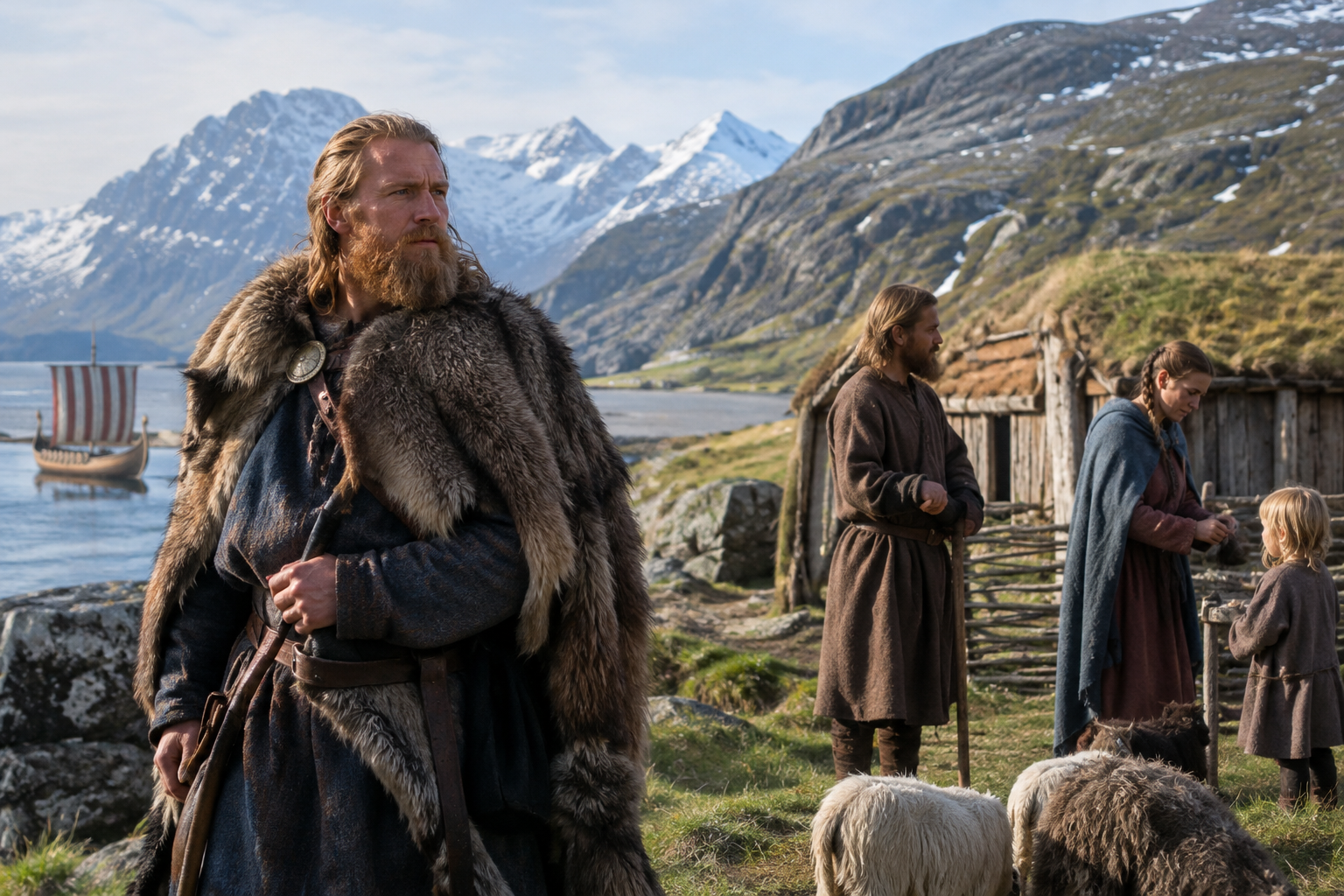
At Balsnes in northern Norway, one Viking Age man dated to around AD 775 offers a crisp starting point for the story of Y-DNA haplogroup I1a1a3a. He appears in the ancient DNA record as CGG107012, and even that bare combination of place, date, and paternal line is revealing. This is the far north, on the edge of the Norse world as it was expanding into wider maritime networks, and here we find a branch of the classic Scandinavian Y-chromosome family I1 in a clearly Viking Age setting.
A second sample pushes the picture westward across the ocean. At Brattahlid Farm in Greenland, the Viking settler VK179, dated around AD 990, is associated with the same article branch, I1a1a3a. That pairing matters because it does not merely place the lineage in Scandinavia; it places it in the world made by Scandinavian movement - from Arctic Norway to the Norse settlements of the North Atlantic.
Balsnes is not interesting because it gives us a grand saga hero. It is interesting for almost the opposite reason: it gives us an ordinary ancient man, securely located in time and place, who helps anchor a paternal lineage in the real archaeology of Viking Age northern Norway. For I1a1a3a, sample CGG107012 shows that this line belonged within the male population of the Scandinavian north during the later 8th century.
That is worth stressing because Y-DNA can easily be over-romanticized. It traces one direct paternal line only - father to son to son - not a person's whole ancestry, language, or identity. But when a lineage appears in a particular archaeological setting, it can still tell us something concrete about where that paternal branch was living and reproducing. In this case, I1a1a3a is not floating abstractly in "Germanic history"; it is visible in Viking Age northern Norway.
An ancient DNA study connected with this northern material is available at https://www.biorxiv.org/content/10.1101/2025.02.28.640770v1. Without pretending to more detail than the present evidence allows, the larger significance is clear enough: northern Norway was not peripheral in any cultural sense. It was part of the Norse maritime sphere, tied into movement, exchange, raiding, and settlement routes that linked fjords and islands to the wider North Atlantic.
The branch named here, I1a1a3a, sits within the broader Y-DNA haplogroup I1, a lineage strongly associated with northern Europe and especially with Scandinavia in many ancient and modern studies. But the narrower label matters. A subclade is not interchangeable with its parent branch, and one of the common mistakes in popular genetic history is to take everything known about I1 in general and paste it directly onto every smaller offshoot.
For that reason, the safest historical reading is modest and useful. These samples suggest that I1a1a3a, or at least lineages reported under that branch in this context, formed part of the paternal landscape of the Norse world in the Viking Age. That is already substantial. It places the lineage in a recognizably Scandinavian setting and, through Greenland, in the expansion of Scandinavian settlement overseas.
The important distinction is between a branch being present in a historical population and that branch somehow "belonging" to a single tribe, kingdom, or famous surname. With the evidence here, presence is the strong claim; dynastic storytelling would be the weak one.
The Greenland sample VK179, dated around AD 990 and described as a Viking settler from Brattahlid Farm, gives this article its most dramatic but also most defensible development. Brattahlid is one of the iconic places of Norse Greenland, associated with the first generations of settlement in a landscape that was difficult, remote, and entirely dependent on seaborne links back to Iceland and Scandinavia.
So when I1a1a3a appears there, the result is historically pointed. It suggests that this paternal line was carried not just by men who remained in Scandinavia, but by men involved in the outward push that created new Norse communities in the North Atlantic. That does not make every bearer of I1a1a3a a colonist, sailor, or Greenland settler, of course. It does show that the branch participated in that world.
One of the pleasures of archaeology is that it cuts through later mythology. Greenland in the Norse period can sound like pure saga country, all named explorers and family feuds. Yet the genetic sample VK179 reminds us that colonization was also a matter of ordinary households, farms, inherited male lines, and the hard business of building continuity in a new place. A research preprint linked to this North Atlantic context is available at https://www.biorxiv.org/content/10.1101/703405v1.
Taken together, CGG107012 and VK179 create a small but evocative map. One point lies in northern Norway in the later 8th century, before the full flowering of Viking expansion overseas. The other appears in Greenland around the end of the 10th century, by which time Scandinavian networks stretched through the North Atlantic island chain.
This does not prove a direct genealogical link between the two men, and it would be irresponsible to imply one. What it does provide is a historically coherent distribution. I1a1a3a is seen first in a northern Scandinavian setting and then in a settlement zone created by Scandinavian expansion. The branch therefore fits very comfortably within the demographic movements that carried Norse-speaking populations from mainland Scandinavia to more distant colonies.
That larger movement is important because Viking history was never simply about raids. It involved migration, farm founding, maritime adaptation, and the transplantation of communities into places such as Iceland and Greenland. A paternal lineage found in both northern Norway and Greenland belongs, at the very least, to that broader human geography.
There are haplogroup articles that drown the reader in labels and produce very little history. Here, the evidence is slimmer, but in a way more satisfying. Two samples in two meaningful locations can be more instructive than twenty unconnected names. Balsnes gives us local grounding in Viking Age northern Scandinavia; Brattahlid gives us overseas movement and settlement.
That also makes I1a1a3a a good example of how ancient DNA works best when it stays close to archaeology. A Y-chromosome branch by itself is only a technical category. Add a northern Norwegian context around AD 775 and a Greenland settler around AD 990, and suddenly the branch becomes historically legible. Not legendary, not magically traceable to a saga hero, but legible.
There is also a useful contrast here with studies of later medieval Scandinavian populations, where Christianity, urbanization, and changing social structures can reshape burial evidence and genetic sampling alike. Viking Age and early Norse colonial contexts capture an earlier phase, when the North Atlantic world was still being assembled.
What can someone with Y-DNA haplogroup I1a1a3a reasonably take from this evidence? Not a guaranteed link to one famous family, and not a complete biography of the paternal line. But there is a sound and attractive historical signal: this branch is represented in the Viking Age Scandinavian north and in the Norse settlement world of Greenland. In other words, it belongs to the real human background of the North Atlantic Norse expansion.
That is already a fine story - not because it is inflated, but because it is specific. I1a1a3a is not just "old European" in some vague sense. In the evidence we have here, it stands in the company of a man from Balsnes in northern Norway and a settler from Brattahlid Farm in Greenland, two points on the map of a world the Vikings made.






Comments