Haplogroup I1a1a1b3a

– 5 min read


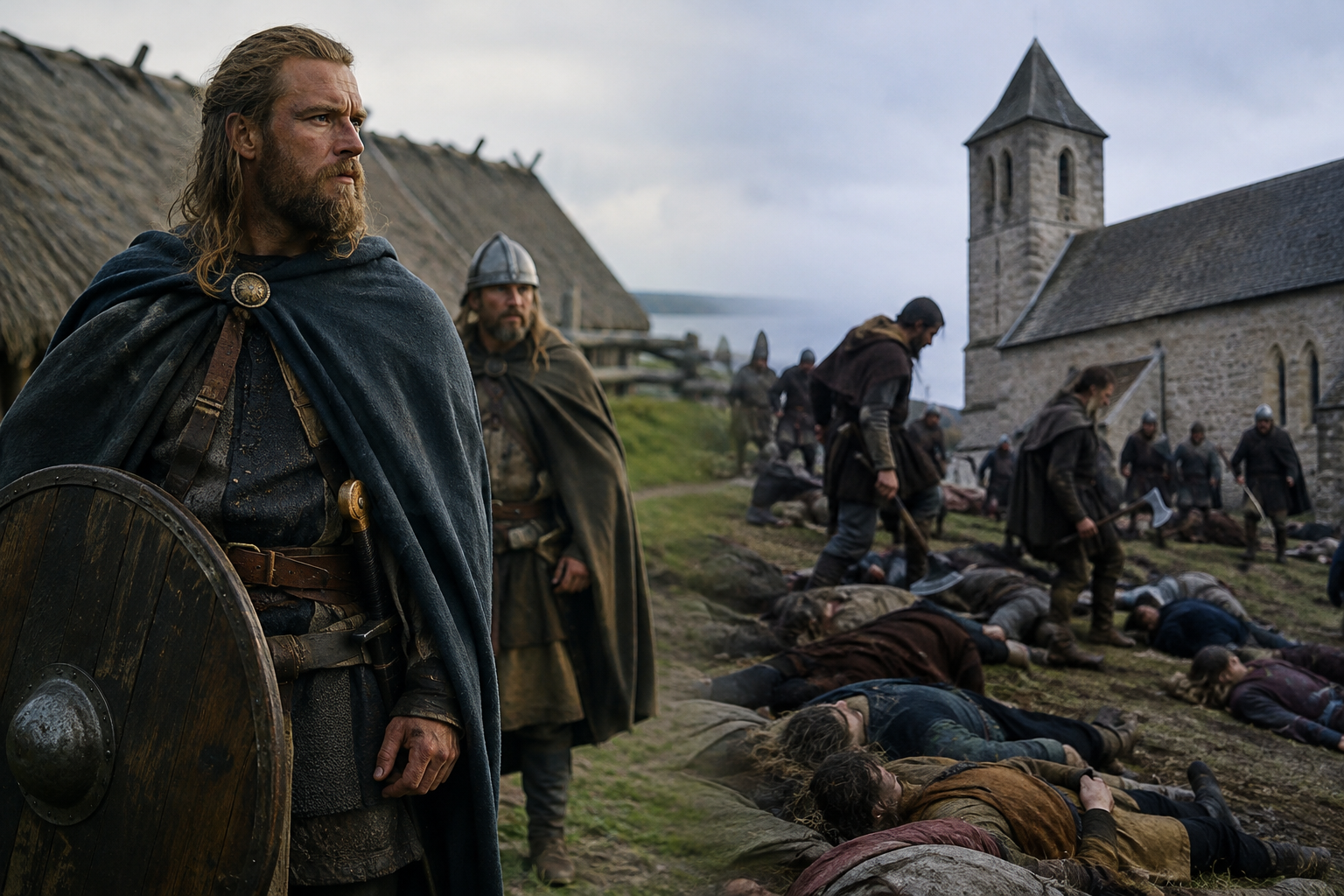
In Oxford, among the dead associated with the St. Brice's Day massacre of 1002 AD, one man stands out for anyone tracing the Y-DNA haplogroup I1a1a1b3a. He is known in the ancient DNA record as VK151, a Viking Age individual from the mass burial discovered at St John's College. This is not a saga hero and not a named king. It is, in a way, better than that: a real excavated person, caught in one of the most violent and politically charged moments of late Anglo-Saxon England.
The interest of this lineage grows when VK151 is set beside another man, VK306, dated to around 1050 AD at Skara Varnhem in Sweden. These two finds place I1a1a1b3a firmly in a Scandinavian and Viking Age setting, but in two very different worlds: one a victim of anti-Danish violence in England, the other a man buried in a major Christian landscape in western Sweden. Y-DNA tracks one direct paternal line rather than a person's whole ancestry, yet even that single line can be surprisingly revealing when it appears in such distinct archaeological contexts.
The St. Brice's Day massacre has long occupied that awkward borderland between chroniclers' rhetoric and excavated reality. King Aethelred II ordered the killing of Danes in England in 1002 AD, but for years historians argued over what that meant in practice. Was it a limited political purge, a local riot, or a wider slaughter? The Oxford grave gave the argument bones as well as words.
VK151 belongs to that story. The burial context is stark: a group of men deposited together, widely interpreted as victims of a violent event. This matters for haplogroup I1a1a1b3a because it anchors the lineage not in vague "Viking" generality but in a historically specific episode of Anglo-Scandinavian conflict. A man carrying this paternal line was present in England at the turn of the 11th century, during a period when Scandinavian networks linked the North Sea world from Denmark and Norway to English towns and military camps.
An ancient DNA study examining Viking Age populations, available here as research on Viking Age genomics, helped place individuals like these within a broader pattern of mobility around the North Atlantic and Baltic. Without inventing more than the evidence allows, VK151 can be read as part of that larger Scandinavian movement into England: traders, raiders, settlers, mercenaries, and, sometimes, the targets of political retaliation.
If Oxford shows this paternal line in crisis, VK306 from Skara Varnhem shows it in continuity. By about 1050 AD, western Sweden was deep in a period of religious and political change. Christianity was establishing firmer roots, burial customs were shifting, and places such as Varnhem would later become central to medieval ecclesiastical life in Sweden.
That makes VK306 especially useful. He belongs to a Scandinavian homeland context rather than an overseas episode. In other words, I1a1a1b3a is not merely turning up among Viking-connected people abroad; it also appears in Sweden itself, in a region important for the transition from the late Viking Age into the medieval kingdom.
We should be careful here. One burial does not make a dynasty, a tribe, or a ruling house. But it does show that this branch was part of the male population of Viking Age Sweden at precisely the time when Scandinavian society was reorganising itself around new religious institutions, stronger kingship, and denser ties to the rest of Europe.
The wider haplogroup behind this branch is I1, one of the best-known paternal lineages in northern Europe and especially associated in many studies with Scandinavian populations. But that larger background should not be lazily copied onto every descendant branch. I1a1a1b3a is a much narrower twig on that tree, and the article's evidence is about this specific branch as reported in connection with these Viking Age individuals.
What can responsibly be said is that the branch appears in two sites that fit the Scandinavian historical sphere of the 10th and 11th centuries. One is in Sweden itself; the other is in an English context shaped by Scandinavian presence. That is a useful pattern, but it is still a pattern made from a small number of published ancient individuals, not a complete map of the lineage's origin or spread.
This is one of the most important habits in archaeogenetics: keeping scale in view. A broad haplogroup may have a deep prehistoric history, while a narrower subclade may reflect much later expansions, local founder effects, or simply the accidents of survival and sampling. For people researching I1a1a1b3a today, the value lies in the documented medieval northern European context, not in overblown claims about a single ancestral people.
Taken together, VK151 and VK306 evoke the North Sea world at its most connected and combustible. Around 1000 AD, England and Scandinavia were tied together by war, tribute, migration, intermarriage, slavery, commerce, and service in royal retinues. The same paternal branch could be carried by men living on farms in Sweden, fighting in England, settling in Danelaw towns, or moving between these worlds in a single lifetime.
Oxford and Varnhem are therefore not random dots on a map. They represent two ends of a real historical corridor. In England, Scandinavian men could become victims of massacre or participants in conquest. In Sweden, men from related paternal backgrounds were part of the social fabric from which later medieval society emerged. That is exactly the sort of connection ancient DNA is good at illuminating: not a tidy ethnic label, but a human network spread across sea-lanes and political frontiers.
There is a temptation, whenever a Scandinavian-associated Y-line appears, to collapse everything into "the Vikings" as if that settled the matter. But archaeology is usually more interesting than stereotype. VK151 was part of an event of mass violence in an English town. VK306 belonged to a Swedish landscape moving into the Christian Middle Ages. Same broad world, different histories.
This is where ancient DNA earns its keep. It does not replace archaeology or written history; it sharpens them. A lineage like I1a1a1b3a becomes meaningful not because it sounds ancient, but because it turns up in named places, attached to excavated individuals, at moments we can actually situate in history.
For someone carrying Y-DNA haplogroup I1a1a1b3a, the most grounded historical picture is a northern European paternal line present in the Viking Age Scandinavian sphere, with ancient examples in both Sweden and Anglo-Scandinavian England. The branch is not a shortcut to a named dynasty, but it does place your direct paternal line in a world of real movement across the Baltic and North Sea, and in one case in the shadow of a documented massacre. That is a sober sort of ancestry, but also a very vivid one.
Comments