Haplogroup G2a2b2a1a1a1b
– 4 min read


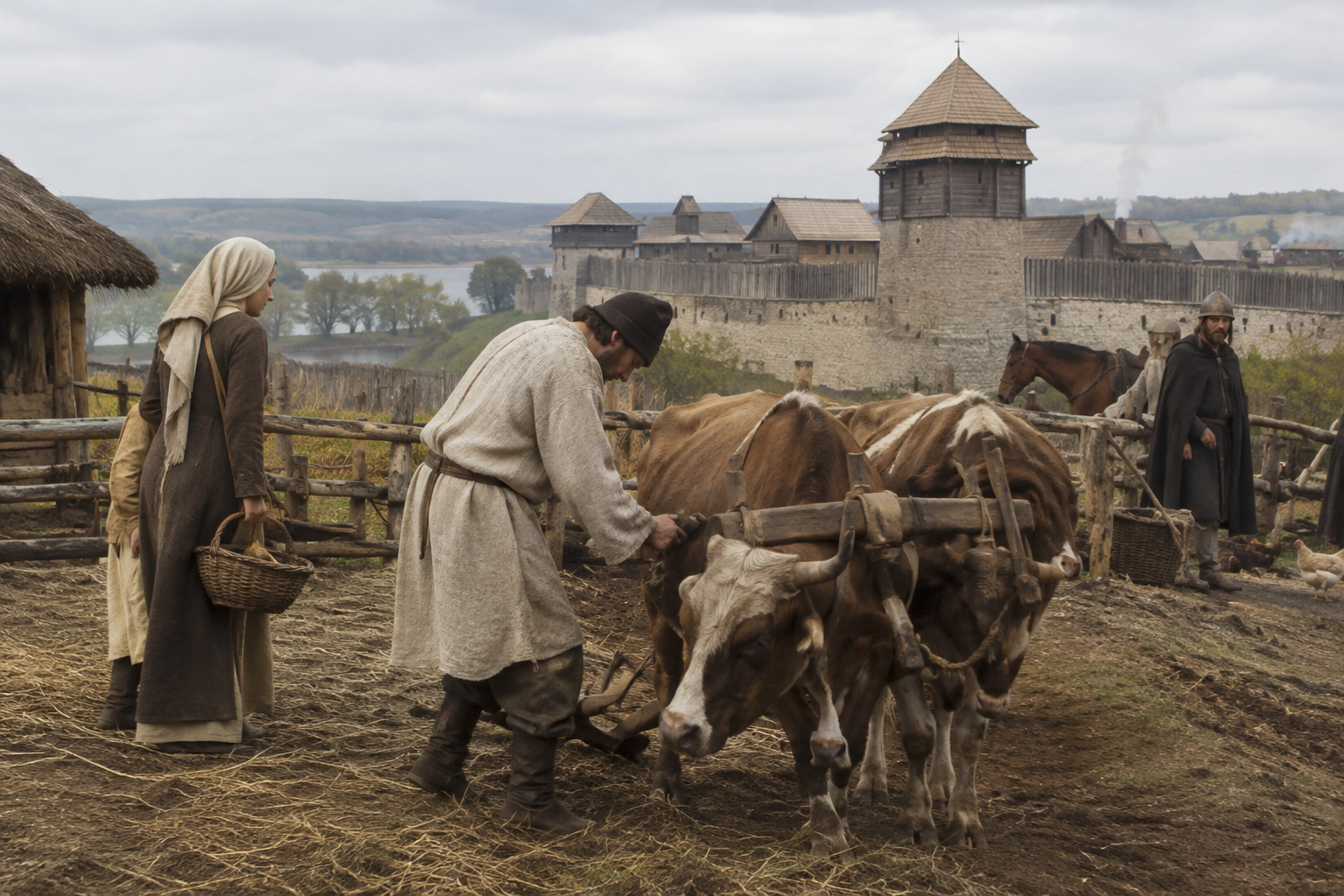
At Ploiesti Triaj in medieval Romania, one excavated individual stands out for anyone tracing the paternal line G2a2b2a1a1a1b: sample I10495, dated to about AD 980. It is only a single man in a cemetery, and that matters. Ancient DNA often gives us grand patterns, but sometimes the most revealing evidence is stubbornly local: one burial, one place, one paternal line turning up in a corner of southeastern Europe at the end of the first millennium.
That is especially interesting because haplogroup G, in its wider sense, has a very long history in western Eurasia. Yet a precise branch such as G2a2b2a1a1a1b is not the same thing as the whole parent haplogroup. Y-DNA follows one direct male line only, so it does not tell us a person's complete ancestry, language, or identity. What it can do, however, is pin a paternal thread to a real archaeological setting, and in this case that setting is the medieval Balkans.
The value of I10495 lies in context as much as classification. Ploiesti Triaj sits north of the lower Danube world, in a region that by around AD 980 was shaped by the afterlife of Rome, the expansion of Slavic-speaking communities, steppe contacts, Christianization, and the shifting pull of nearby powers. A man carrying G2a2b2a1a1a1b in that landscape is not a mascot for a single tribe or kingdom. He is better understood as evidence that this paternal branch was present among the mixed and changing populations of the region.
That wider setting has become much clearer thanks to ancient DNA work on southeastern Europe. A major genetic study of the area, published in Science, helped demonstrate just how complicated the medieval Balkans and neighboring regions really were, with local continuity sitting alongside movement and admixture. That is the sort of background against which a sample like I10495 becomes meaningful: not as an isolated curiosity, but as one male line embedded in a historically busy frontier.
Haplogroup G is one of the old lineages of western Eurasia, and its deeper branches are often associated in prehistory with populations connected to the Caucasus, Anatolia, and early farming expansions into Europe. But that broad story belongs to the parent haplogroup, not automatically to every much later sub-branch. By the medieval period, a lineage like G2a2b2a1a1a1b could have reached southeastern Europe by many routes long since blurred by centuries of settlement, empire, marriage, and migration.
That is why the medieval Romanian evidence should be read carefully. It does not mean that I10495 was a recent immigrant from the Caucasus, nor that everyone nearby shared his paternal origin. It means that one direct male line, with roots somewhere within the long and branching history of haplogroup G, had become part of the human landscape of late 10th-century Romania.
Romania around AD 980 was not a quiet backwater waiting for history to happen. It lay within reach of the Byzantine world, close to zones affected by Bulgar state formation, mobile steppe groups, and older Roman provincial populations that had never simply vanished. Archaeology and genetics alike increasingly suggest that the lower Danube was a place where ancestry was layered, not replaced in one neat sweep.
That makes a lineage such as G2a2b2a1a1a1b historically plausible in exactly this kind of environment. Small paternal lines can persist for long periods and then appear in surprising places when burial grounds are sampled. The point is not that G2a2b2a1a1a1b was dominant here, but that medieval southeastern Europe had room for many such lineages to survive side by side.
One of the temptations in writing about medieval DNA is to reach too quickly for famous names: Goths, Slavs, Magyars, Pechenegs, Byzantines. Real life on the ground was less tidy. Cemeteries do not sort themselves into textbook ethnic boxes, and a Y-chromosome certainly does not. The man behind I10495 may have lived in a community shaped by several of those historical currents at once.
That matters for readers with this haplogroup today. A paternal line can pass quietly through centuries of cultural change. Men speaking different languages, living under different rulers, and worshipping in different religious worlds may still belong to the same Y-DNA branch. In places like medieval Romania, where frontiers shifted more often than families disappeared, that continuity is exactly the sort of thing ancient DNA is beginning to catch.
The lower Danube and Carpathian zone also sit near regions where later medieval and early modern political formations emerged from earlier mixtures rather than from any single ancestral source. So when a branch like G2a2b2a1a1a1b appears in an AD 980 burial, it is a useful reminder that paternal history in eastern Europe was not written solely by the largest or most famous haplogroups.
There is a rather old-fashioned archaeological virtue in resisting overstatement. We have one named ancient individual here, not a dynasty and not a cluster of close male relatives. Yet even one securely placed sample can do important work. It anchors the branch in time and space. It tells us that G2a2b2a1a1a1b was present in a medieval Romanian setting by the late 10th century, which is far more informative than treating the haplogroup as an abstract label floating free of history.
Single finds can also become more valuable as the comparative map fills in. A medieval Romanian occurrence may one day be easier to interpret when more samples arrive from the Balkans, the Carpathian Basin, or the northern Black Sea zone. Already, broader regional studies are showing that the old habit of imagining neatly separated populations does not survive contact with actual genomes.
Deep Balkan Roots and Medieval Admixture
For someone researching G2a2b2a1a1a1b today, the most solid takeaway is modest but useful. This branch is not just part of a deep prehistoric story attached to haplogroup G in general; it is also documented in an actual medieval burial from Romania, sample I10495, around AD 980. That places your paternal line, or a close neighboring branch, within the lived human world of the late first-millennium Balkans and lower Danube region.
And that is often how real history works: not through a trumpet blast, but through one excavated man in one cemetery, quietly proving that a lineage was there.






Comments