Haplogroup G2a2b1a
– 4 min read


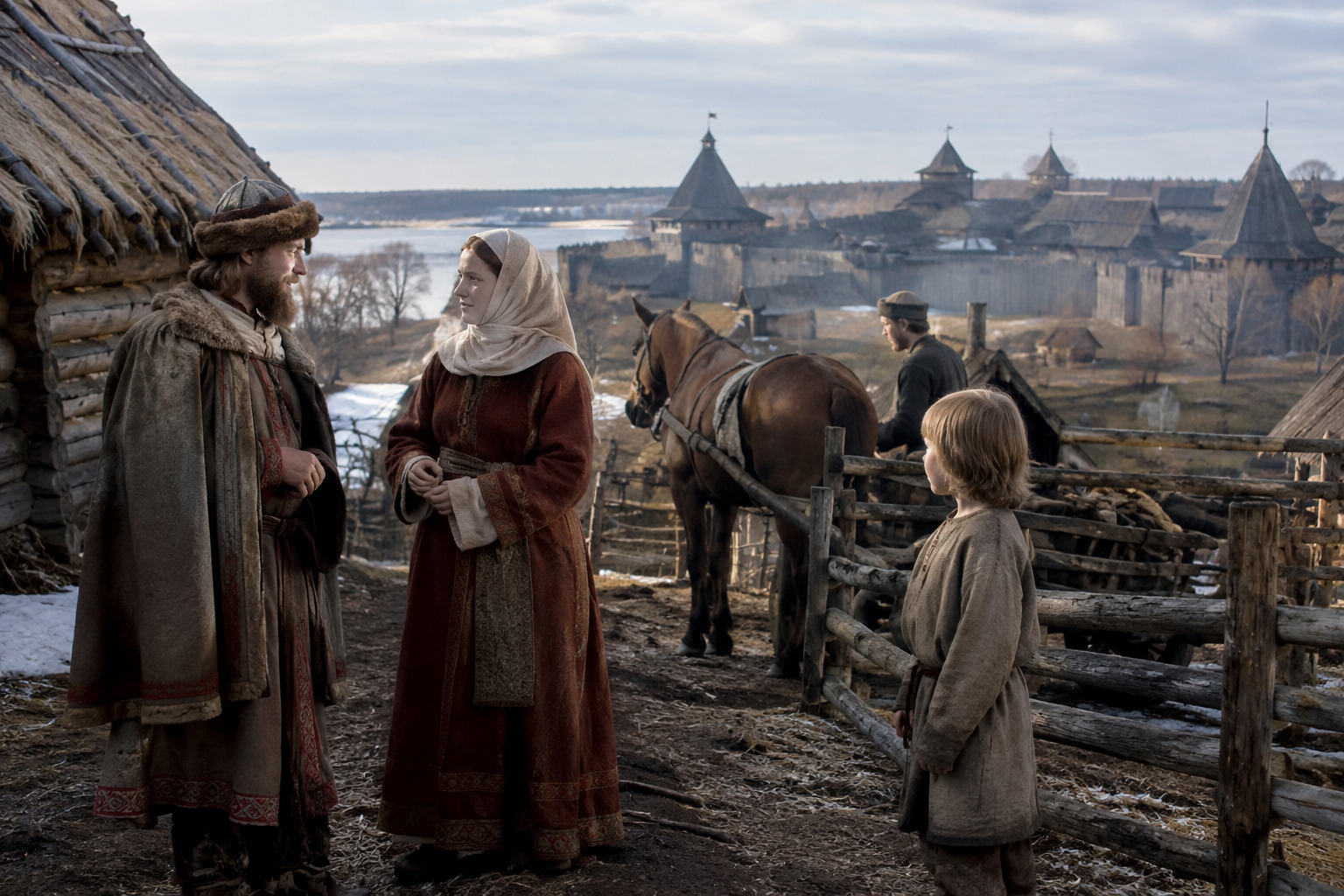
At Shekshovo in medieval Russia, one excavated man from around AD 1000, identified as SHE003, gives us a rare fixed point for thinking about Y-DNA haplogroup G2a2b1a. That may sound like a string of letters and numbers fit only for a laboratory notebook, but in practice it means that one direct paternal line, carried from father to son, can be placed inside the busy human landscape of early medieval northeastern Europe.
That is what makes this sample interesting. G lineages are often discussed in very broad prehistoric terms, especially in connection with early farmers in parts of West Eurasia, but a medieval individual like SHE003 reminds us that paternal branches did not simply vanish after prehistory. They survived, moved, narrowed into local family lines, and reappeared in later communities whose history was shaped by trade, settlement, and political change rather than by any single dramatic migration.
Shekshovo lies in the region of medieval Rus', in a zone that sat between river networks, woodland landscapes, and developing centres of power. Around AD 1000, this was not an empty frontier. It was a connected world of villages, exchange routes, craft production, and overlapping cultural influences from Slavic-speaking communities, Finnic populations, and the wider political orbit of the Rus' principalities.
Within that setting, SHE003 matters because ancient DNA turns one burial into a point of comparison. A man associated with G2a2b1a in this region tells us that the paternal makeup of medieval Russia was more varied than any neat ethnic label would suggest. Y-DNA follows only one line of descent, so it does not define the whole ancestry or identity of this individual, but it can show that lineages with deeper roots elsewhere in Eurasia were present within the population history of Rus'.
An ancient DNA study examining medieval Russian burials, including material from this broader research context, is available here: https://www.ncbi.nlm.nih.gov/pmc/articles/PMC7817100/. What matters most for our purposes is not a grand claim about a dynasty or tribe, but the simple and valuable fact that a G-line paternal branch was living in this medieval community.
G2a2b1a is a sub-branch within the wider haplogroup G, a major paternal lineage with a long and complicated history across western Eurasia. The wider family of G lineages appears in ancient DNA from several different times and places, especially in early farming contexts. But one should be careful here: the deep history of haplogroup G as a whole is not automatically the history of every later sub-branch, and certainly not the biography of one medieval man in Russia.
So the sensible reading is narrower and more useful. SHE003 shows that by the medieval period, at least one paternal line classified within G2a2b1a was part of the human mixture of northeastern Europe. That could reflect very old survivals, later regional movements, or intermediate dispersals across the steppe, forest zone, or trading corridors linking the Baltic, Volga, and Black Sea worlds. The sample is valuable precisely because it anchors the branch in a real archaeological person rather than leaving it floating in abstract maps.
There is no need to invent an epic migration to explain a lineage like this in medieval Russia. Early medieval eastern Europe was full of movement, but most of it was cumulative, local, and layered over generations. River routes connected the Baltic to the Volga and the Dnieper; merchants, warriors, craftspeople, and families moved through these systems; and communities absorbed newcomers without turning every arrival into a founding legend.
That matters because haplogroup G is sometimes treated as if it belongs neatly to one region alone. In reality, paternal lineages often have much broader and more fractured histories than modern identity labels imply. By AD 1000, the lands of Rus' had already been shaped by centuries of contact among forest-zone foragers, farming populations, steppe-linked groups, and Scandinavian-connected elites and traders. A G2a2b1a line in that environment is not anomalous; it is evidence of the diversity such a crossroads would produce.
The wider backdrop is worth keeping in view. Haplogroup G, in broad terms, is famously associated with some of the early farming populations that spread into Europe during the Neolithic. Yet ancient DNA has repeatedly shown that lineages rise, shrink, and persist in unexpected ways. A paternal branch that was once more common in one setting can later survive only in scattered pockets or reappear in places where history books would not especially expect it.
That is why medieval examples are so useful. They show which lines endured through all the churn of the Bronze Age, Iron Age, and early medieval centuries. If you carry G2a2b1a today, the most responsible historical lesson is not that you descend from one particular famous people, but that your paternal line belongs to a very old West Eurasian family of lineages whose later history was anything but simple. By the medieval period, it could be found not only in southern or mountainous regions often associated with haplogroup G today, but also in communities further north and east.
Neolithic Expansion Background
With only one named ancient individual here, caution is essential. SHE003 does not stand for all medieval Russians, all Slavs, or all men of G2a2b1a. Nor can one burial reveal when this line first entered the region. But a single well-placed sample can still do important work. It proves presence, fixes a date range, and enlarges the documented map of a lineage.
In archaeology, that is often how the story begins: not with a complete panorama, but with one excavated life that shows the question is real. From there, comparison with other medieval and earlier populations can start to build a fuller picture of how paternal diversity was maintained in the lands of Rus'. Studies of early medieval northern and eastern Europe increasingly point in exactly that direction: not uniformity, but a population history made from many strands.
Early Medieval Baltic Connections
The best way to understand G2a2b1a from the evidence of SHE003 is as a durable paternal thread appearing within the mixed and mobile society of medieval Russia around AD 1000. It does not hand us a ready-made tribe, kingdom, or noble pedigree. What it does offer is something better grounded: proof that this branch was part of the real population history of northeastern Europe, living among the communities that helped form the medieval world of Rus'. For anyone researching this haplogroup today, that is a useful reminder that paternal ancestry can survive across enormous spans of time and turn up in places where the written record alone would never have led us.






Comments