Haplogroup G2a2a2

– 5 min read


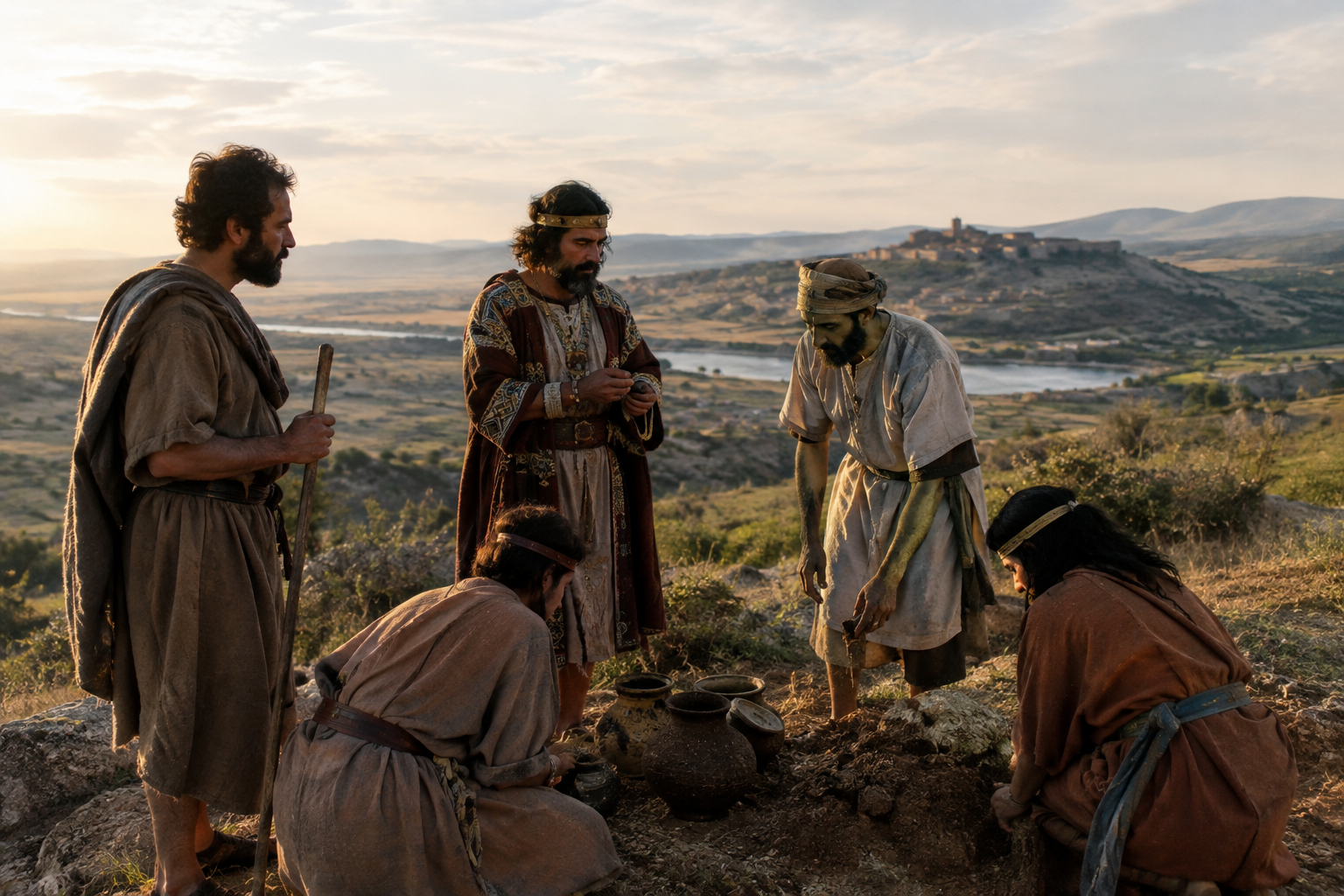
At Las Lomas del Molino in Epila, near Zaragoza, one man from around AD 600 carries an unusually revealing paternal marker for the early medieval western Mediterranean. The individual identified as I30597, from post-Roman Spain, is reported here under Y-DNA haplogroup G2a2a2. That matters because G lineages are often associated in broad terms with some of the earliest farming expansions into Europe, yet this particular branch turns up here not in the first Neolithic villages, but in a world shaped by Rome's collapse, new regional powers, and mobile communities crossing late antique Iberia.
That is the first useful lesson of G2a2a2: a Y-DNA haplogroup follows one direct paternal line only. It does not define a person's whole ancestry, language, or identity. Even so, when the same branch appears in ancient men from Spain, Armenia, and Bronze Age Uzbekistan, it gives us something far more interesting than a tidy ethnic label. It points to a paternal lineage with a long and geographically wide history across the greater Near East and into Europe, surviving through very different archaeological settings.
The most vivid anchor for this haplogroup in the present set of evidence is I30597 from Epila in Aragon, dated to about AD 600. This was a time when Iberia was no longer Roman in a political sense, but Roman habits, local traditions, and newer migration-period influences were all still entangled on the ground. A burial from this moment is never just "Visigothic" or "Hispano-Roman" by DNA alone; early medieval Spain was already a social mixture.
What makes I30597 valuable is precisely that it sits in this complicated transition. G2a2a2 is not the lineage most people would expect if they imagine early medieval Iberia only through the lens of northern European migrations. Instead, it reminds us that many paternal lines in Spain had deeper Mediterranean and Near Eastern histories long before the sixth and seventh centuries. A genetic study of ancient Iberian populations published in Cell helps frame that broader point: post-Roman and early medieval communities in Iberia were shaped by continuity as well as movement, not by simple replacement.
Seen in that context, I30597 is less a solitary curiosity than part of the stubborn complexity of Iberian history. The paternal line is one thread, but it belongs to a tapestry woven from local descent, imperial-era mobility, and fresh arrivals during the centuries after Rome. If your own direct paternal line falls under G2a2a2, this Spanish sample shows that such a lineage could be present in Iberia well into the early Middle Ages without needing a simplistic one-event explanation.
The second key sample is I19327 from Noratus in Armenia, dated to about 1340 BC. Here the setting is entirely different: not late antique Spain, but the South Caucasus in the Late Bronze Age. This is important because the Caucasus and adjacent highlands are one of the regions where haplogroup G, in its wider sense, has long had deep roots and significant diversity.
We should be careful with the wording. The presence of G2a2a2 in a Late Bronze Age Armenian individual does not mean the branch "originated" at Noratus, nor does it license a straight-line migration story from one grave to every later occurrence. But it does show that this paternal lineage was established in the South Caucasus by the second millennium BC, in a landscape that linked Anatolia, the Iranian world, and the steppe margins.
That matters historically because Armenia was never isolated. Even in the Bronze Age, the region sat at a crossroads of mountain pasture, metal exchange, local polities, and long-distance contact. A reported G2a2a2 assignment in I19327 fits well with the idea that some branches of haplogroup G remained embedded in these Caucasus-adjacent populations long after the first farming expansions of prehistory.
South Caucasus Genomic History
The third sample, I7420, comes from Sappali Tepe in present-day Uzbekistan and is dated to about 1800 BC. Archaeologically, that takes us into the Bronze Age world of Central Asia, where oasis settlements, farming communities, and exchange networks connected regions that modern maps tend to keep apart. This is a very different setting again from both Epila and Noratus.
Here G2a2a2 appears in an eastern context that broadens the story considerably. A paternal lineage found in early medieval Spain and the South Caucasus also appears in Bronze Age Central Asia. That does not prove a direct chain of descent between these particular men, and it certainly does not mean every bearer of G2a2a2 followed the same route. What it does suggest is that this branch belonged to populations moving within, or descending from populations shaped by, the great interaction zone stretching from the Iranian plateau and Caucasus into Inner Asia.
A major ancient DNA study of Bronze Age populations across Central and South Asia, published in Science, has shown just how interconnected that world could be. Without claiming more than the evidence allows for this one sample, I7420 fits the wider picture of Bronze Age Central Asia as a place where ancestry, mobility, and local continuity were all in play at once.
Bronze-Iron Age Mesopotamia DNA
It is tempting to tell every Y-DNA branch as though it marched neatly from one homeland to one destination. G2a2a2 resists that sort of tidy performance. In this small but telling set of samples, it appears in three very different historical worlds: a Bronze Age oasis community in Uzbekistan, a Late Bronze Age individual in Armenia, and a post-Roman burial in Spain.
That spread does not make the lineage mysterious so much as durable. The wider haplogroup G is famous in ancient DNA because it appears so often among early farmers in western Eurasia. But a narrower branch like G2a2a2 has its own later history, one that cannot simply be borrowed wholesale from the fame of its parent lineage. These samples suggest a branch that persisted across long-established agricultural and urbanized zones, especially in regions tied to the Caucasus, Iran, and the broader Mediterranean-Central Asian contact sphere.
In other words, G2a2a2 looks less like the badge of one people than the surviving paternal trace of old, interconnected landscapes. Men carrying it could end up in communities separated by thousands of kilometers and many centuries, yet still belong to the same deep paternal branch.
Roman Hispania's Genetic Legacy
If you belong to Y-DNA haplogroup G2a2a2, the most responsible takeaway is not a romantic claim about one tribe or one kingdom. It is something more historically satisfying. Your direct paternal line is part of a branch that appears, on current evidence here, in Bronze Age Central Asia, the Late Bronze Age South Caucasus, and early medieval Iberia. That is a lineage with reach, age, and staying power.
For family historians, that means G2a2a2 may point toward a paternal heritage shaped by the old corridor between the Caucasus, the Iranian world, Central Asia, and later Mediterranean populations. Ancient DNA cannot collapse that complexity into a single ancestor story, but it can show that this branch belonged to real men in real places across more than two millennia.






Comments