Haplogroup G2a2a1a2b

– 5 min read


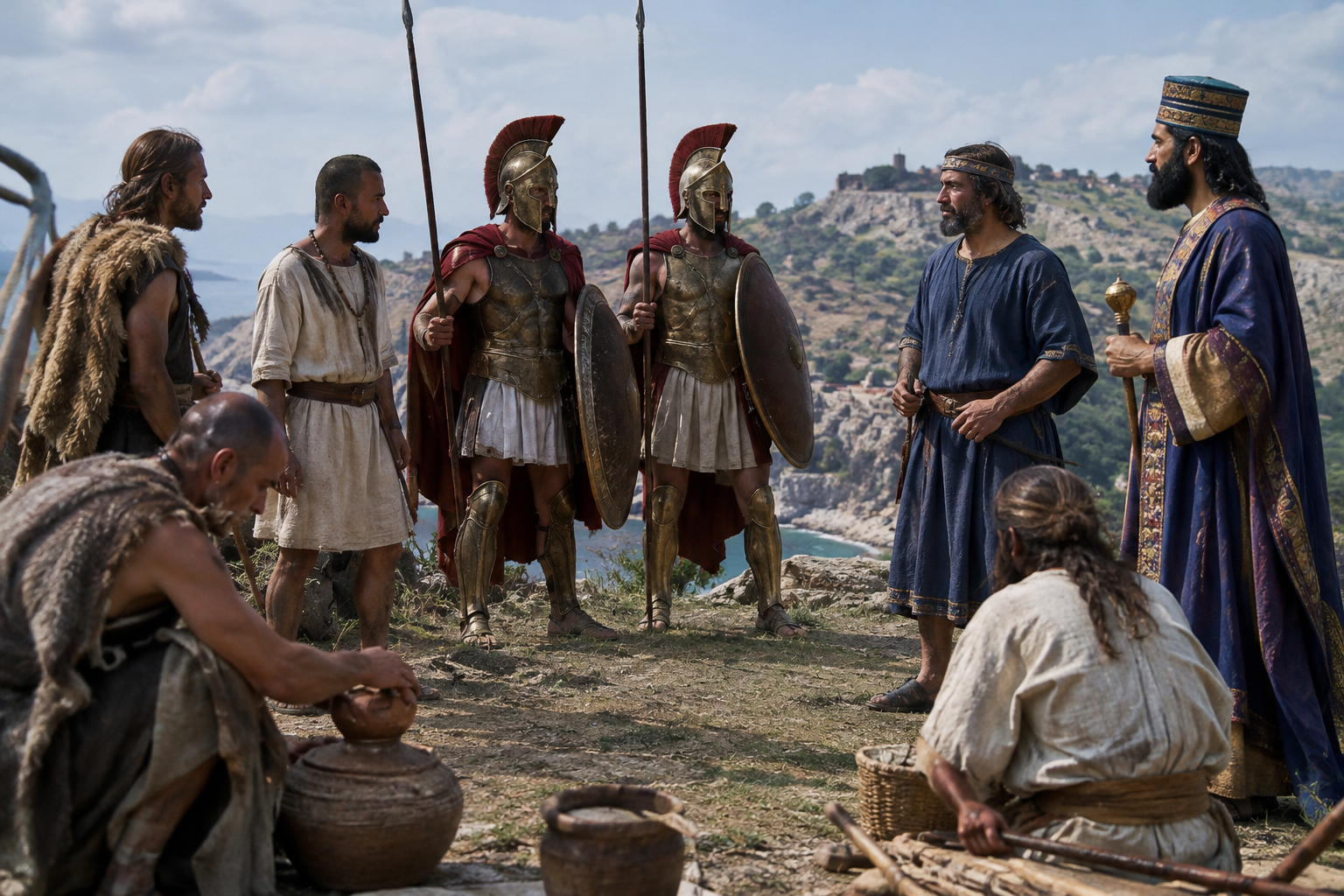
One of the more arresting appearances of haplogroup G2a2a1a2b comes from the battlefield dead at Himera in Sicily. Two men, identified as I7221 and I7221x, are associated with the First Sicilian War around 480 BC, the famous clash in which Greek forces defeated Carthage on the island's north coast. That matters because it puts this paternal line not in some abstract map of ancient migrations, but in a sharply historical setting: a Greek colonial world tied to war, movement, and the wider Mediterranean.
That is a good place to begin because G2a2a1a2b is not one of those Y-chromosome branches that can be lazily assigned to a single people. Y-DNA tracks one direct paternal line only, but even that narrow line can illuminate surprising connections. In the small set of ancient men linked here, G2a2a1a2b appears in contexts stretching from Copper Age Romania and Early Bronze Age Bulgaria and Hungary to Classical Sicily and Achaemenid-era Lebanon. The pattern is not one of a single empire or tribe. It is a Mediterranean and Balkan story of persistence, mixing, and movement.
The Himera samples are especially vivid because the site belongs to an event with a name, a date, and a political backdrop. Greek Sicily was not an isolated colonial fringe. It was a competitive, mobile world of settlers, soldiers, traders, and allies, where men could end up far from any original homeland. A paternal lineage like G2a2a1a2b appearing among the war dead fits that reality rather well.
What we should not do is leap too far. These two men do not prove that the haplogroup was "Greek" in any simple ethnic sense, nor do they let us identify their city of origin from Y-DNA alone. But they do show that this branch was present among men participating in the military world of Classical Sicily. That is a valuable historical anchor, especially when set beside broader work on ancient Greek-connected populations in the Mediterranean, including MyTrueAncestry's coverage of the genetic mosaic of the Classical Greek army.
Research on ancient Mediterranean island populations has repeatedly shown that Sicily was genetically and culturally mixed long before the Middle Ages. That makes the Himera finds doubly interesting: they belong to a moment of war, but also to a much longer history of people crossing the sea and settling on the island. For readers with paternal lines in G2a2a1a2b, Himera offers a concrete reminder that such ancestry could be woven into the colonial Greek world without being reducible to it.
If Himera gives us the historical drama, the deeper roots of the article's sample set lie further north and earlier in time. One of the oldest entries is Urzi60 from Urziceni in ancient Romania, dated around 4000 BC. Another is I2510 from Veliko Tarnovo in Bulgaria, dated to about 2806 BC. Together they place this paternal branch, or an associated reported lineage assignment, in the Balkans across a very long stretch of prehistory.
That continuity of region is striking, even if the societies themselves were very different. The world of 4000 BC Romania was not the world of the Early Bronze Age, and neither was the world of Classical Greece. Archaeology across southeastern Europe shows repeated social transformations in settlement, metallurgy, exchange, and mobility. A Y-line surviving across these changes does not mean stable ethnicity; it means that some paternal lines could persist through dramatic cultural shifts.
An ancient DNA study of southeastern European prehistory, published in Nature, helped establish just how dynamic this region was over millennia, with farmers, foragers, and later steppe-related ancestries all contributing to the human landscape. Against that backdrop, a lineage like G2a2a1a2b becomes interesting precisely because it appears in more than one age of Balkan history. It seems less like a fleeting intrusion and more like one thread that remained in circulation as populations changed around it.
The sample I18100, from Kunhegyes-Nagyallas-halom in Hungary and dated around 2750 BC, is associated in the input with a Yamnaya-related Early Bronze Age context. That is an intriguing placement. The Yamnaya horizon is often discussed in terms of steppe expansions and the spread of new ancestry into much of Europe, but ancient cemeteries connected with that broad world were not all genetically identical in paternal terms.
That is where this haplogroup becomes especially revealing. G2a lineages are often remembered for their importance among Europe's early farmers, yet by the Bronze Age they had not simply vanished. A branch like G2a2a1a2b appearing in a Yamnaya-linked setting in the Carpathian Basin suggests incorporation, admixture, or survival within a changing social world rather than neat population replacement. In other words, the archaeological label may point toward a steppe cultural horizon, while the paternal lineage hints at more complicated male-line histories on the ground.
That complexity is exactly what recent work on the North Pontic and Carpathian regions has emphasized. A study examining population histories in the wider area, available through PNAS, adds to the growing picture of mobility and mixture around the western steppe frontier. For G2a2a1a2b, the Hungarian evidence warns against simplistic formulas. This is not a haplogroup that belongs tidily to only farmers, only steppe herders, or only later Mediterranean peoples.
The eastern Mediterranean appearance comes from SFI-47, from Saifi in Lebanon and dated around 500 BC, within the age of the Achaemenid Empire. This is a useful counterweight to the Balkan and Sicilian material. By the first millennium BC, the eastern Mediterranean was an intensely connected zone linking Levantine ports, inland empires, Cyprus, Anatolia, Egypt, and the Greek world. Lebanon in this period was not peripheral at all; it was central to Mediterranean exchange.
Here again, caution matters. A Y-chromosome assignment cannot tell us whether SFI-47 identified culturally as Phoenician, imperial subject, local townsman, or something else entirely. But the placement of G2a2a1a2b in Achaemenid-era Lebanon shows that the branch was present in a region long tied to seaborne trade and imperial politics. Taken together with Himera, it suggests that this paternal line had a place in the human traffic of the Mediterranean on both its eastern and central shores.
Readers interested in how this broader island-and-sea world looked genetically may want to compare Sicily's later evidence too. The island repeatedly turns up as a meeting ground rather than a sealed population.
So what kind of historical picture emerges from these scattered but suggestive finds? Not a royal pedigree, and not a single migration tale with a clear starting gun. Instead, G2a2a1a2b looks, from this evidence, like a paternal branch at home in the old connective tissue of southeastern Europe and the Mediterranean: present in prehistoric Balkan communities, still visible in the Bronze Age Carpathian Basin, and later turning up in both Greek Sicily and Achaemenid Lebanon.
For someone researching this haplogroup today, that is the most useful takeaway. G2a2a1a2b may point toward deep paternal roots in regions where early farming, Balkan prehistory, steppe-era mixture, and Mediterranean mobility all overlapped. Its ancient appearances suggest endurance across changing cultures rather than attachment to just one historical identity.






Comments