Haplogroup G2a2a1
– 5 min read


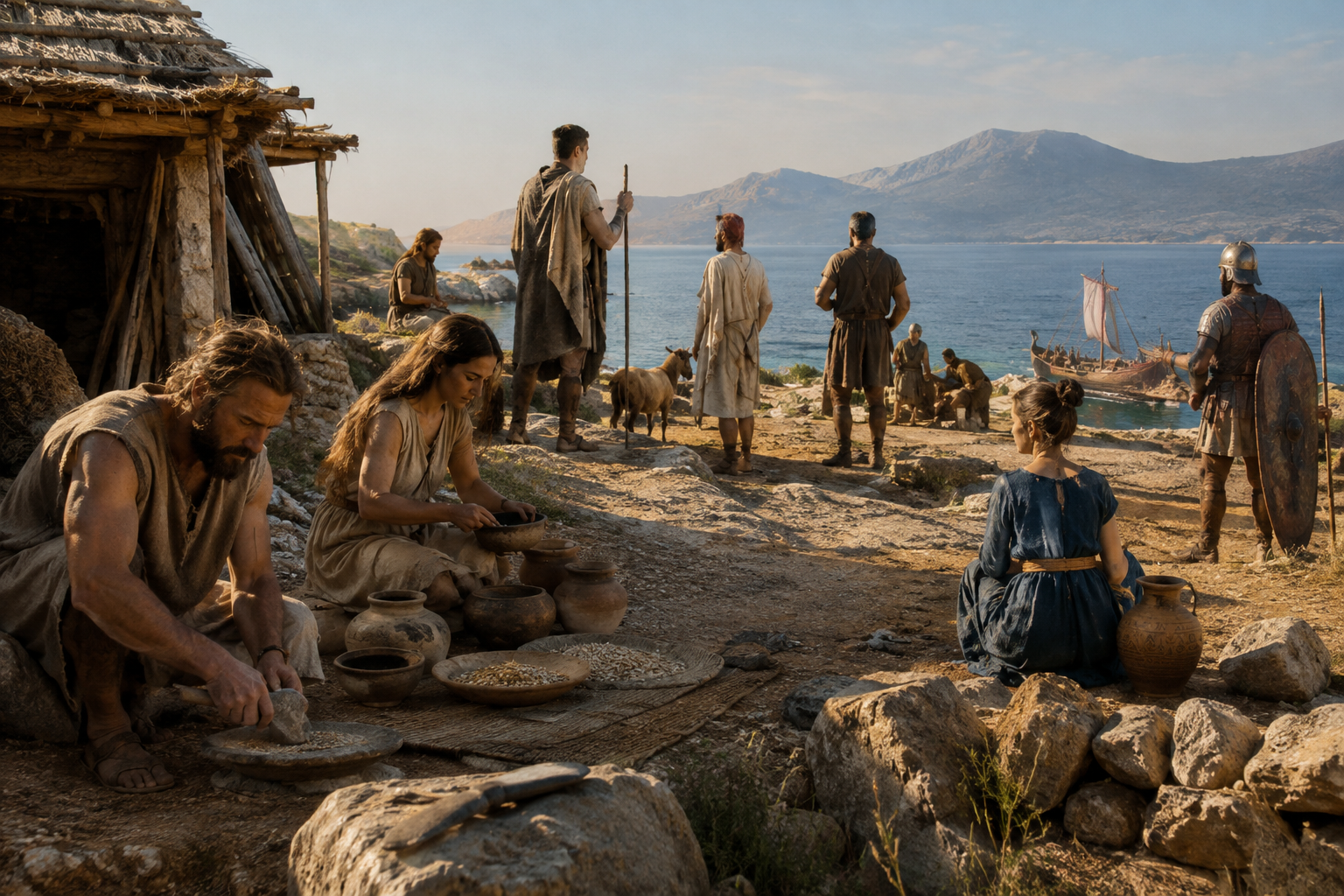
Some Y-chromosome lineages arrive in the ancient DNA record like political dynasties: late, loud, and impossible to miss. Others are older, quieter, and in some ways more revealing. Haplogroup G2a2a1 belongs to that second category. It appears not as the banner of a single empire, but as part of a much deeper story about the spread of early farming, the making of prehistoric Europe, and the long afterlife of paternal lines in places that would later become the landscapes of castles, lordships, and noble memory.
That is worth pausing over. A Y-DNA haplogroup traces one direct paternal line only: father to father to father across generations. It does not represent a person's whole ancestry, culture, language, or identity. But when ancient DNA places a lineage such as G2a2a1 in real burials, at real sites, across several thousand years, it gives us something wonderfully concrete. We can begin to see where some paternal lines were present, how long they endured, and how they moved through the worlds of Neolithic farmers, Bronze Age communities, and later historical regions.
Broadly speaking, haplogroup G is strongly associated in ancient DNA studies with early farming populations moving from southwest Asia into Europe during the Neolithic. That does not mean every branch of G followed the same path, nor that every early farmer belonged to G. But G lineages repeatedly appear in some of the earliest agricultural communities of Europe, making them central to the archaeology of the Neolithic transition.
Within that wider family tree, G2a2a1 sits inside a cluster of lineages often found in early European farming contexts. The safest way to describe its significance is this: it seems to belong to that old agricultural horizon which spread across the Balkans, Central Europe, and parts of the Mediterranean, and which ancient DNA has made far easier to track than ever before. Later prehistory brought major demographic shifts, including the rise of steppe-associated paternal lines in many parts of Europe, but lineages like G2a2a1 did not simply vanish. They remained part of the human landscape.
Explore the Neolithic Expansion
The earliest supplied evidence for this lineage comes from Neolithic Germany, and it is particularly telling. At Halberstadt-Sonntagsfeld, two Early Neolithic individuals, I0659 dated to 4979 BC and I0821 dated to 4942 BC, place G2a2a1 squarely inside one of the classic early farming zones of Central Europe. These are not shadowy theoretical ancestors. They are excavated individuals from a real settlement world of longhouses, cultivation, livestock, and the first profound remaking of the European landscape by agriculture.
A later German sample shows that the story did not end there. Warburg_2b, from Late Neolithic Germany Warburg and dated to 3150 BC, suggests the persistence of this paternal line well after the earliest wave of farming. By this date Central Europe was already changing fast, socially and genetically. Yet here the lineage still is, reminding us that population change is rarely a simple matter of total replacement.
Move southeast and the picture broadens. I14161, from Chalcolithic Romania Bodrogkeresztur Urziceni and dated to 4000 BC, places this haplogroup in the Carpathian-Balkan world during the Copper Age. That is a region crucial to the traffic of people, ideas, and technologies between southeast and central Europe. Then there is I16994, from Bronze Age Vrbicka Montenegro dated to 2500 BC, showing the lineage in the western Balkans as Bronze Age societies emerged.
The Mediterranean examples are especially striking. HGC025, from Minoan Hagios Charalambos Cave Crete dated to 1900 BC, carries the lineage into the island world of Bronze Age Crete. Then LAZ018, from Mycenaean Aegina Saronic Islands Greece dated to 1500 BC, places it in a Mycenaean context. That does not prove any single neat migration route from Neolithic Central Europe to Minoan or Mycenaean Greece. But it does show that paternal lines of this broader old-farmer world remained present across the Aegean as complex Bronze Age civilizations flourished.
Finally, I4893 from Bronze Age Prague Czech Kobylisy dated to 1813 BC adds another central European waypoint. Seen together, these samples do not tell one tidy heroic saga. They do something better: they show G2a2a1 appearing across a wide arc from Germany to Romania, Montenegro, the Czech lands, Crete, and Greece over millennia.
Discover Prehistoric Aegean DNA
It is tempting to look at that map and start drawing bold arrows everywhere. Archaeologists and geneticists have learned to be cautious. What we can reasonably say is that G2a2a1 fits well within the paternal landscape associated with early and middle farming societies in Europe, with continuing appearances into later prehistoric periods. The German, Romanian, Balkan, and Aegean finds suggest both geographical breadth and chronological depth.
What we should not say is that G2a2a1 belonged to one ethnicity, one language family, or one uninterrupted tribe marching through time under a single name. The men buried at Halberstadt-Sonntagsfeld, Warburg, Vrbicka, Hagios Charalambos Cave, and Aegina lived in very different worlds. Their shared paternal branch is a biological clue, not a ready-made historical identity.
Still, the wider significance is clear. Ancient DNA shows that paternal lines linked to the first agricultural expansion could survive into Copper Age and Bronze Age populations, even amid major shifts in ancestry and culture. That makes G2a2a1 an excellent reminder that European history was built from layers, not clean breaks.
Explore Carpathian Basin Ancient DNA
The supplied noble-family field does not provide usable family or castle details here, and that absence matters. It would be very easy to smuggle in grand claims about medieval houses or aristocratic descent simply because a haplogroup has deep roots in Europe. But that would confuse two quite different kinds of evidence.
Written genealogy begins late, usually in the medieval world of charters, monasteries, dynasties, heraldry, and landholding families. Y-DNA reaches far earlier, into periods with no surnames and no chronicles at all. The connection between the two is not imaginary, but it must be handled carefully. A paternal lineage can persist in a region for thousands of years, and later noble houses may have arisen within territories where that lineage had long existed. Yet broad haplogroup sharing is not proof that a medieval family descended from any particular Neolithic or Bronze Age man.
That is one of the most useful lessons of archaeogenetics. It does not replace history; it changes the scale of it. Castles, family archives, and royal pedigrees preserve one kind of memory. Ancient burials preserve another. Where they meet is not usually in direct identification, but in regional continuity: the same valleys, islands, and river corridors that mattered to prehistoric farmers often mattered later to chiefs, lords, bishops, and kings.
In that sense, G2a2a1 belongs to the very old foundations beneath later Europe. Before coats of arms, before stone keeps, before the legal fictions of noble blood, there were paternal lines moving with livestock, seed grain, and household traditions into new lands. Ancient DNA allows us to glimpse those men again.
Learn How Archaeogenetics Decodes History
For MyTrueAncestry users, haplogroup G2a2a1 is historically interesting precisely because it is not just a modern label on a testing report. It appears in some of Europe's earliest farming communities, continues into Chalcolithic and Bronze Age settings, and turns up in both continental and Aegean contexts. That gives it a long documentary life in ancient DNA, longer and more textured than many lineages can currently claim.
And there is something rather moving in that. A direct paternal line that once ran through Early Neolithic men in Halberstadt-Sonntagsfeld can still be studied today, not as a claim to status or as a badge of ethnic purity, but as a fragment of real human continuity. The line survived changing burial customs, new technologies, shifting alliances, and the rise and fall of entire ways of life.
If your own Y-DNA belongs somewhere near this branch, ancient comparisons may help place that lineage in a world of early European farmers, Balkan Copper Age communities, and Bronze Age Aegean societies. Not as proof that you descend from I0659, I0821, Warburg_2b, I14161, I16994, HGC025, LAZ018, or I4893 in any direct genealogical sense, but as evidence that your paternal line belongs to a chapter of history far older than surnames.
Upload your DNA to MyTrueAncestry and explore how ancient samples and historical populations may illuminate your paternal story, while remembering that genetic similarity to ancient people is a clue to deep ancestry, not automatic proof of direct descent or noble connection.






Comments