Haplogroup G1a1a1b
– 5 min read


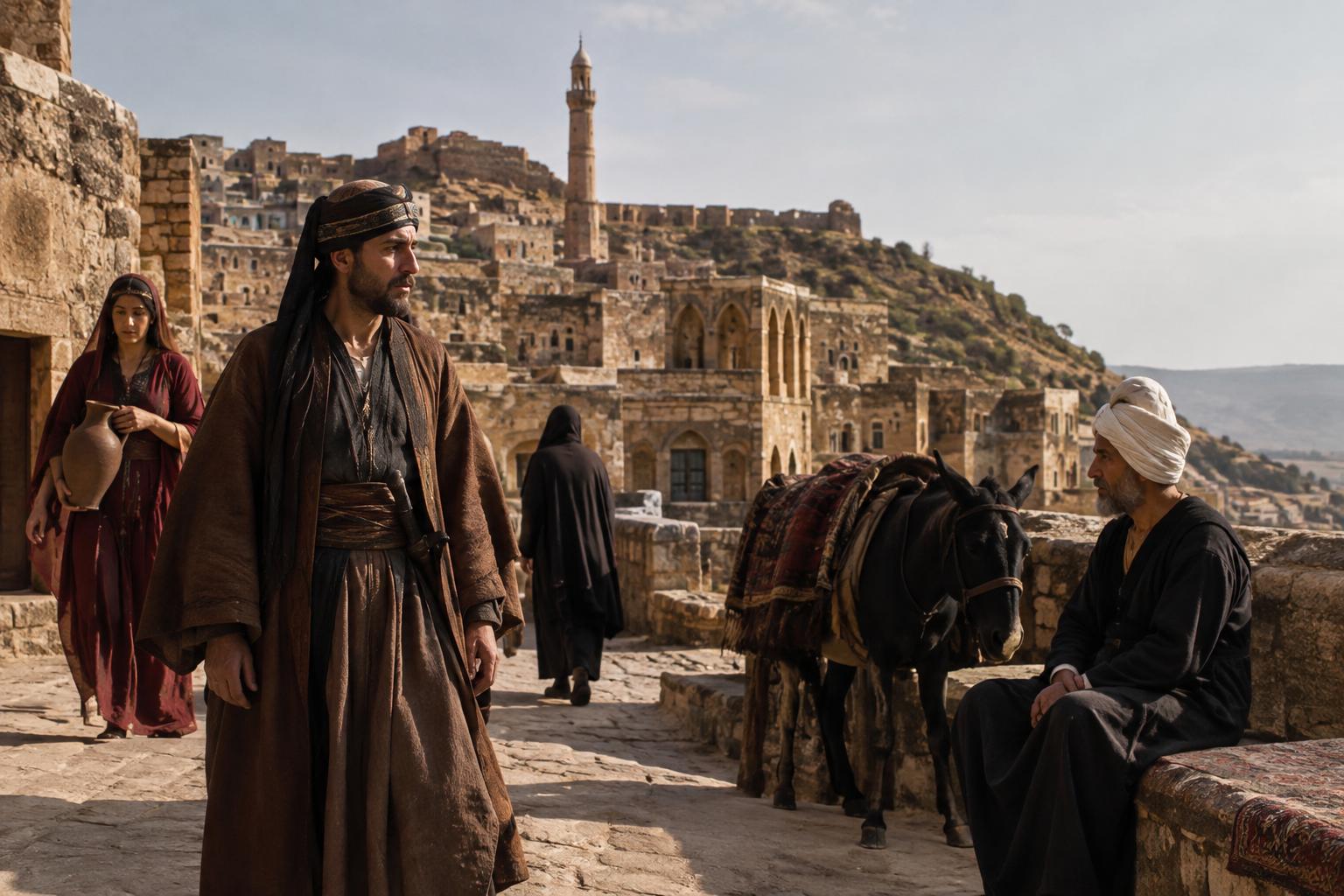
In 1536 AD, in Midyat in the Mardin region of southeastern Turkey, one man entered the genetic record as sample I4539. That is not much to go on if you want a dramatic tomb story. But in its own way, it is more interesting than drama. Midyat sits in one of the great crossroads of the Near East, on the northern edge of Mesopotamia, in a landscape shaped by Syriac Christianity, imperial frontiers, caravan routes, and centuries of movement between Anatolia, Iran, the Caucasus, and the Arab world. A Y-chromosome assignment to G1a1a1b in this setting is therefore a small but rather telling piece of evidence.
This matters because Y-DNA traces one direct paternal line only, not a person's whole ancestry. Even so, a single well-placed male lineage can reveal something important about where certain paternal branches persisted. In the case of G1a1a1b, the known ancient evidence here is modest, but it is anchored in a place where continuity and mixture were both part of everyday history.
Midyat is not a random dot on the map. It lies in Tur Abdin, a historic upland zone famous for monasteries, villages, and long-lived Christian communities, but also for its position between larger powers. By the early 16th century, when I4539 lived, this region had already passed through Roman, Byzantine, Islamic, Turkic, Mongol, and Kurdish political worlds. In 1536 AD it belonged to the early Ottoman period, though many local communities preserved much older linguistic and religious traditions.
That is what gives the sample its force. G1a1a1b does not appear here as a neat badge of one empire or one ethnicity. Instead, it turns up in a borderland where paternal lines could survive across enormous political change. The man from Midyat was living in a world of layered identities, and his Y-DNA reminds us that male-line descent often outlasts dynasties, language shifts, and changing rulers.
An ancient DNA study of populations from this broad region, published in Science, helped show just how informative such eastern Mediterranean and Near Eastern samples can be for reconstructing long-term population history. For a lineage like G1a1a1b, even one securely placed medieval individual becomes valuable because it links the branch to a real historical community in a real landscape.
Bronze and Iron Age Mesopotamia
Haplogroup G is an old and varied Y-chromosome family with a long history in western Eurasia. But one has to be careful here. It would be quite wrong to take the whole deep history of haplogroup G and simply paste it onto the narrower branch G1a1a1b. Subclades have their own, often much more specific, stories.
What can be said responsibly is that G1a1a1b belongs to a paternal lineage family more often discussed in parts of the Near East, Iran, the Caucasus, and adjoining regions than in Atlantic Europe. That makes a southeastern Anatolian medieval appearance plausible without making it predictable. The branch's presence in Midyat fits a zone long tied into northern Mesopotamia and Iranian-connected historical worlds.
It is also worth stressing that the assignment supplied here is already quite specific. We should not invent deeper SNP labels, migration dates, or a heroic founding ancestor. The value of the evidence lies in its exactness at one level and its restraint at another: one identified paternal branch, one identified man, one historically rich place.
People often expect ancient DNA to be most useful when it is extremely old. Archaeologically, though, later samples can be just as revealing, especially in regions with complicated medieval and early modern histories. Midyat in 1536 AD was not an isolated village at the edge of nowhere. It was part of a connected frontier society, close to routes running toward Diyarbakir, Mosul, the Jazira, Armenia, and western Iran.
So I4539 helps pin G1a1a1b to a lived historical setting rather than a vague prehistoric cloud. That gives researchers and family historians something firmer to think with. If your paternal line belongs to G1a1a1b, this sample does not prove descent from this individual or from one local community in Mardin. But it does show that the branch was present in the medieval to early Ottoman Near East, in a population zone famous for both persistence and mobility.
This is precisely the kind of evidence that complicates simplistic stories. A haplogroup found in Turkey is not automatically "Turkish" in an ethnic sense, just as a lineage found under Roman rule is not therefore "Roman." Southeastern Anatolia is a place where categories overlap untidily, and ancient DNA is often most illuminating when it refuses to behave like a neat national label.
The Mardin region has for millennia been a meeting ground. Assyrian heartlands lay to the south and east; Armenian and Anatolian highlands rose to the north; Arab and Persianate political influence repeatedly flowed across it; and later Turkic-speaking dynasties and the Ottomans folded it into still larger imperial systems. One of the lessons of such a place is that continuity does not require isolation.
For Y-DNA, that is particularly important. A paternal branch can remain locally rooted while language, religion, and imperial allegiance change around it. The man represented by I4539 may have belonged to a community whose recent ancestors had lived in the region for centuries, or to one shaped by migration within the broader Ottoman and pre-Ottoman Near East. With the evidence in hand, either is possible. What matters is that G1a1a1b was part of that historical human mix.
This is why southeastern Anatolia deserves more attention in public discussions of genetic history. It is too often treated merely as a corridor between better-known civilizations. In fact, it was also a place where lineages endured, adapted, and became woven into new social worlds without losing their paternal continuity.
Although this article rests on one directly relevant ancient sample, the broader historical picture invites comparison with neighboring regions where paternal diversity also reflects long-distance links. Northern Mesopotamia and eastern Anatolia were never sealed off from Iran or from more distant inland routes. Trade, war, pilgrimage, taxation, settlement, and forced movement all helped carry people across these zones.
That does not mean we should turn G1a1a1b into a roaming "Silk Road haplogroup" by sheer imagination. But it does mean that an appearance in Midyat makes best sense in a world of connected uplands and plains, not within modern national boxes. The same larger lesson appears again and again in archaeogenetics: regional histories are often entangled across frontiers that later maps make seem fixed.
Readers interested in eastern frontier populations may also find useful comparisons in studies of Black Sea and steppe-border mobility, where paternal lineages likewise sit inside complicated mixtures of culture and ancestry.
The best-supported insight from the current evidence is a simple one. G1a1a1b is not just an abstract branch on a phylogenetic tree; it is attested in a documented man from Midyat, Mardin, in 1536 AD, in one of the most historically layered regions of western Asia. That places the lineage within the lived history of northern Mesopotamia and southeastern Anatolia, where paternal continuity could survive amid intense cultural change.
For someone researching this haplogroup today, that is valuable precisely because it is concrete. It suggests that the branch belongs, at least in part, to the long human story of the Near Eastern borderlands: not a single people, not a single empire, but a durable male line moving through centuries of connected regional history.






Comments