Haplogroup E4a

– 4 min read


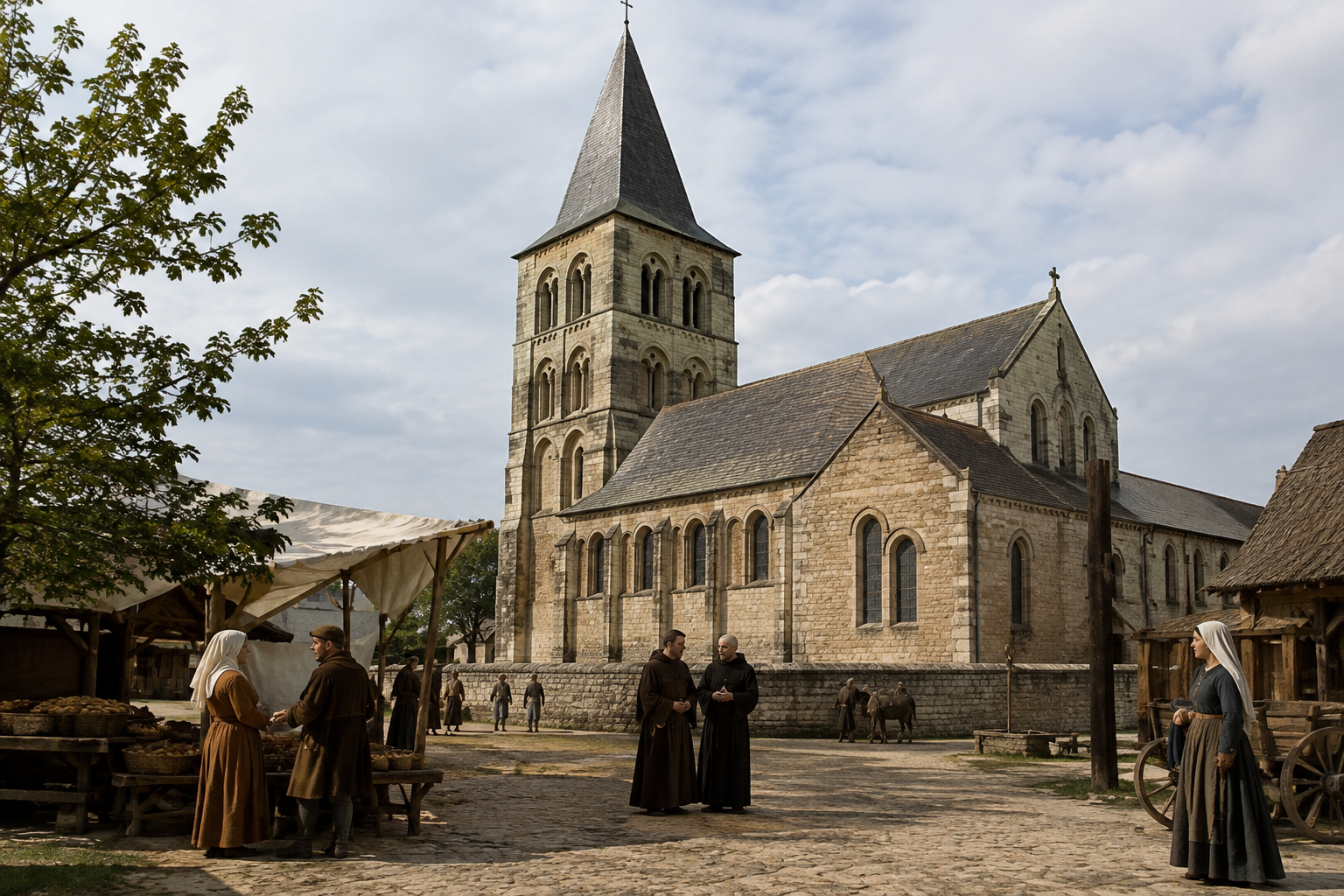
At Sint-Truiden in medieval Belgium, one excavated man has become unusually important for anyone interested in the Y-DNA branch E4a. The individual labelled ST2551, dated to about AD 900 and buried at Onze-Lieve-Vrouwekerk, places this paternal line in a very specific setting: an early medieval church community in the Low Countries, not in a heroic saga or royal genealogy, but in the lived world of a growing town.
That matters because Y-DNA is at its most useful when it stops being abstract. A haplogroup is a paternal line traced from father to son, not a person's whole ancestry, language, or identity. In the case of E4a, the evidence here is modest but valuable: a documented medieval bearer from Sint-Truiden gives us a real archaeological anchor in a region where urban life, Christianity, and mobility were all reshaping society.
Sint-Truiden was no isolated village. In the early Middle Ages it grew around an important religious foundation, and by around AD 900 it sat within a busy landscape of fields, estates, roads, and ecclesiastical influence in what is now Belgium. A burial from Onze-Lieve-Vrouwekerk therefore belongs to a world in which local families, clerics, laborers, and newcomers all met within the same expanding settlement.
Sample ST2551 is interesting precisely because he is not presented as a famous historical figure. He is one of the ordinary dead through whom archaeogenetics can see broader patterns. In a medieval urbanizing community, a paternal lineage like E4a does not arrive with a label attached. It appears simply as one thread among many in the male population.
An ancient DNA study examining these burials is linked with Sint-Truiden's wider medieval population history, and the sample belongs in that context rather than in isolation. Research on the site has been associated with questions of urbanization and population structure in the town, as discussed in this genetic study of medieval Sint-Truiden.
The temptation with a rare or less frequently discussed Y-line is always to make it stand for a people, a migration, or a dramatic historical episode. That is exactly what the evidence does not permit here. E4a is the article's target lineage, but with the information presently in hand, the safe historical claim is narrow: this paternal branch was present in a man buried in medieval Sint-Truiden around AD 900.
Even that narrow claim is useful. Early medieval Europe was full of paternal diversity that older national histories tended to flatten out. Churchyard burials, town cemeteries, and settlement populations increasingly show that communities were not genetically uniform blocks. A single Y-line in one individual does not define the town, but it does remind us that paternal ancestry in the Low Countries was more varied than tidy ethnic labels suggest.
That point sits well beside a broader pattern visible in other MyTrueAncestry discussions of early medieval population change, especially where language, identity, and genetics do not line up neatly.
Germanic Languages and Genomics
To understand why ST2551 matters, it helps to remember what the Low Countries had been through before AD 900. Roman rule had long since receded, but its roads, estates, military corridors, and habits of movement left their mark. Then came the shifting political formations of the post-Roman centuries: Frankish power, Christian institutions, local lordship, and the slow tightening of parish and monastic landscapes.
By the time ST2551 was buried, the region was not a frontier in the dramatic sense, but neither was it static. Men carrying different paternal lines could have deep local roots, or they could represent movement over generations through marriage networks, service, trade, ecclesiastical patronage, or resettlement. E4a in Sint-Truiden therefore belongs to a historical setting in which ancestry may be local, regional, or inherited from older movements that written sources never noticed.
That is one of the strengths of archaeology over grand ethnic storytelling. The grave does not tell us that this man was "from" a named tribe. It tells us that he was part of a Christian burial community in a medieval town, and that his direct paternal line falls within E4a.
Some readers may wonder whether a single ancient sample is too little to say anything meaningful. In one sense, yes: one burial cannot map the whole history of E4a. But in another sense, single burials are often where the discipline begins. Ancient DNA accumulates by individual lives, one excavated skeleton at a time, until an outline emerges.
ST2551 gives E4a a securely historical foothold in medieval northwestern Europe. That foothold is especially valuable because church cemeteries and urban communities can reveal the kind of paternal diversity that elite graves often miss. Not every lineage appears first in a princely tomb; sometimes it turns up in the quieter archaeology of parish life.
Studies of neighboring and comparable regions have repeatedly shown that medieval communities were mixtures of continuity and movement rather than simple replacements. That wider lesson is worth keeping in mind when reading a result like E4a from Sint-Truiden.
Lower Rhine Biomolecular Melting Pot
For a modern tester, the most responsible use of this evidence is not to leap to a named dynasty or a single migration route. It is to place your paternal line in a documented historical landscape. If you belong to E4a, ST2551 shows that this lineage was present in the medieval Low Countries by around AD 900, in a town shaped by religion, local continuity, and regional mobility.
That makes E4a less of a code and more of a human story. Not a king, not a legend, but a man buried at Sint-Truiden, in a church setting that belonged to the real machinery of medieval Europe. Sometimes that is the more interesting history, because it is closer to how most ancestors actually lived.
Readers interested in how ancient DNA is changing this kind of historical reconstruction may also want the broader background on the field itself.
The best current insight from this evidence is simple and sturdy. E4a is not just a modern test result floating free of history; it is attested in at least one real medieval individual, ST2551 of Sint-Truiden, buried around AD 900 at Onze-Lieve-Vrouwekerk. For anyone researching this paternal line, that is a useful anchor point: a reminder that your direct male ancestry may connect not only to big migrations and famous peoples, but to the ordinary, diverse populations who built medieval European towns.

Comments