Haplogroup E1b1b1b2a1a1

– 5 min read


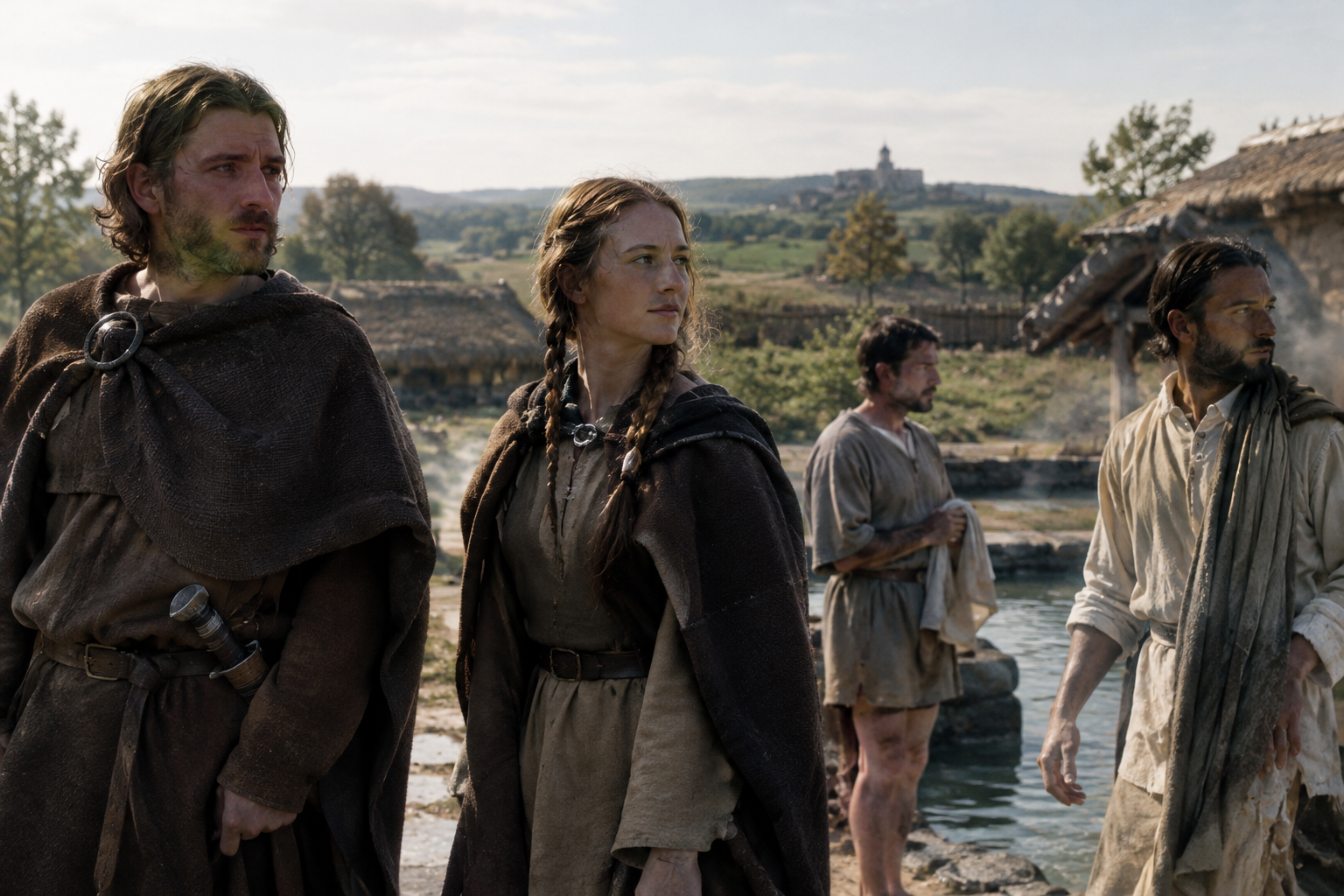
At Arrabona-Menfocsanak in post-Roman Pannonia, one man dated to around AD 550, identified as MFC017, offers a striking starting point for thinking about Y-DNA haplogroup E1b1b1b2a1a1. He lived in the Little Hungarian Plain at a time when Roman administration had collapsed, new political groups were forming, and communities in the Carpathian Basin were being reshaped by mobility, intermarriage, and shifting allegiances. A paternal lineage like this one is only a single line of descent, not a whole identity, but in a frontier world like sixth-century Pannonia it can still be historically revealing.
The interesting thing is not that one haplogroup appears in one grave. It is that this same branch, or an association with it, turns up in settings that are geographically wide and historically very different: Bronze Age Ebla in Syria, Bronze Age Armenia, post-Roman Hungary, and even an individual from Roopkund, the so-called Skeleton Lake in the Himalayas, dated here to around AD 830. That is not a tidy tale of one people marching from A to B. It is something more realistic and, frankly, more Roman in spirit: a history of connection zones.
MFC017 comes from the Arrabona-Menfocsanak area in northwestern Hungary, part of the former Roman province of Pannonia. By the mid-sixth century this was no backwater. It sat in a region where imperial traditions, local survival, and incoming groups met one another in daily life, in cemeteries as much as in settlements.
An ancient DNA study on post-Roman communities in the Little Hungarian Plain has helped show just how mixed that world could be, not in the vague sense of "diverse origins" as a slogan, but in the concrete sense that burial grounds contain people with quite different ancestries and family backgrounds. In that context, a lineage associated with E1b1b1b2a1a1 fits a broader archaeological picture of the Carpathian Basin as a place where Mediterranean, Balkan, steppe, and central European histories could overlap in a single generation.
That matters because E1b1b1b2a1a1 is a narrow branch nested within the much wider E1b1b1 complex. One should not lazily assign to it every story ever told about E1b1b. But the Pannonian evidence does show that by the post-Roman period, paternal lines of this family could be embedded in communities far from any simplistic homeland narrative. MFC017 is not a symbol of one migration; he is evidence of a society already shaped by many.
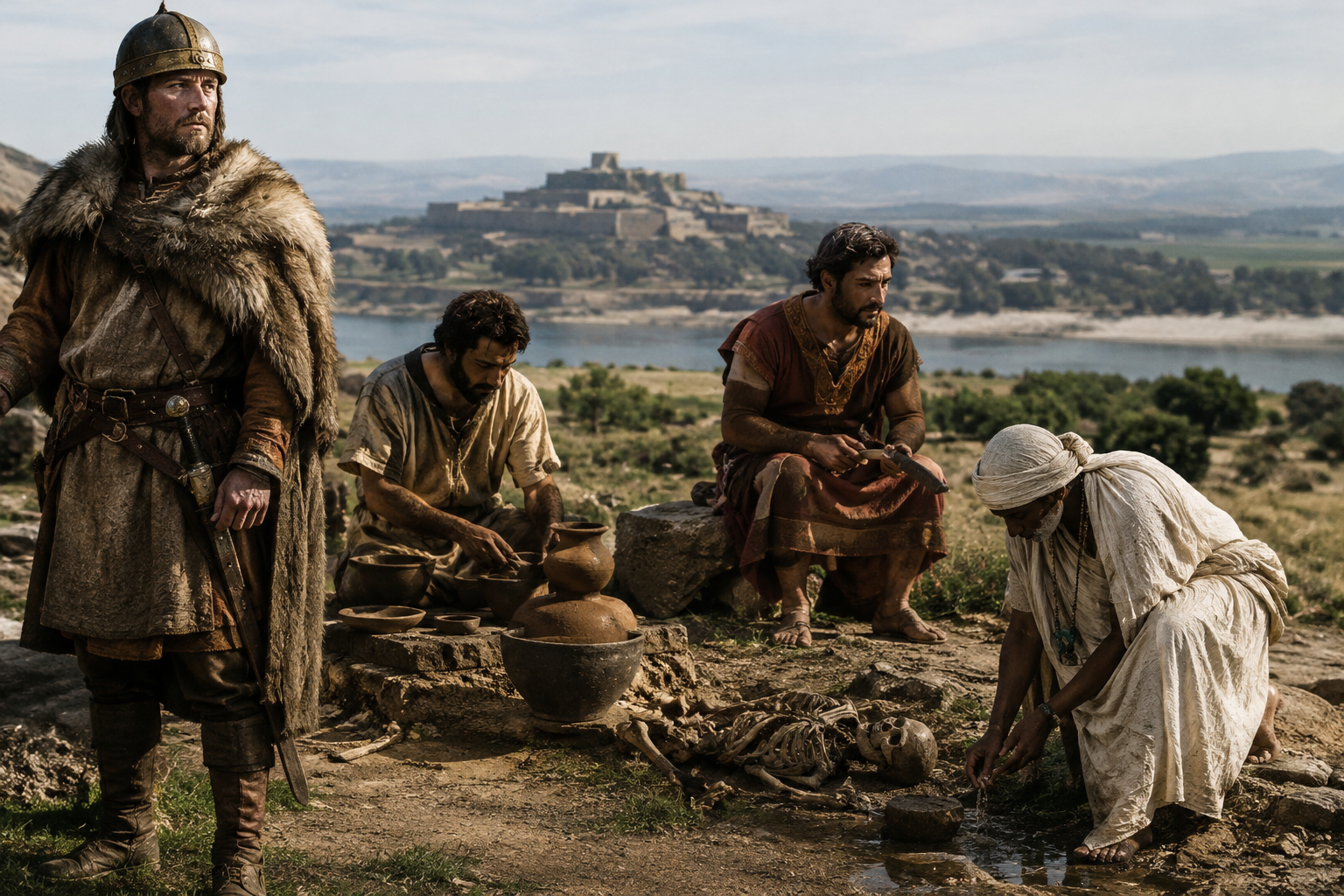
The oldest sample in this group is ETM010 from Middle Bronze Age Ebla, Tell Mardikh in Syria, dated here to around 2600 BC. Ebla is one of those archaeological names that still has the power to stop you in your tracks. This was an early city of the Near East, with palace archives, far-reaching exchange, and a political world already dense with diplomacy and competition.
To find a lineage associated with E1b1b1b2a1a1 in that setting is historically suggestive, because it places this paternal branch in an urban society of inland northern Syria long before the classical empires and long before medieval population movements. It reminds us that some lineages later found in Europe or Central Asia were already part of the demographic fabric of the ancient Near East.
Research on ancient Near Eastern populations, including work published in a major ancient DNA study of West Asia and surrounding regions, has made this broader point increasingly clear: Bronze Age societies were not genetically static islands. They were linked by marriage, trade, herding routes, warfare, and urban expansion. A Y-line like this one appearing at Ebla does not turn Ebla into the "origin" of the entire branch, but it does anchor the branch in one of the oldest and most consequential urban landscapes in the ancient world.
The sample R11675 from Beniamin in Armenia, dated to around 1420 BC, adds a different piece to the puzzle. Armenia and the wider South Caucasus are among the most interesting regions in archaeogenetics because they sit at the hinge of Anatolia, the Iranian plateau, the steppe, and Mesopotamia. People, goods, and ideas moved through these uplands for millennia, and the genetic evidence increasingly reflects that long entanglement.
For E1b1b1b2a1a1, Beniamin matters because it places the lineage, or a reported association with it, in the Bronze Age South Caucasus rather than only in later Mediterranean or Balkan contexts. That broadens the historical range of the branch and makes it harder to tell a one-direction story. A lineage present in Syria and Armenia in the Bronze Age could have moved through several kinds of societies: urban, pastoral, village-based, and frontier.
This is precisely the sort of regional complexity explored in work on the South Caucasus, including research on long-term genomic history in the region. The value of that scholarship is not that it hands us neat ethnic labels, but that it shows continuity and change operating together across thousands of years.
South Caucasus Genomic History
Then there is I3346, described here as "Skeleton Lake Sindhi Worshipper," from around AD 830. Roopkund, the high-altitude lake in the Indian Himalayas, is famous because its dead did not belong to a single obvious event or one tidy local population. The site has forced historians and geneticists alike to reckon with mobility into landscapes that once seemed marginal.
If the association with E1b1b1b2a1a1 is sound at the level reported, the significance lies less in surprise than in scale. By the early medieval period, lineages from the broader E1b1b1 world had plainly traveled through, or been incorporated into, South Asian populations. That does not mean direct descent from Ebla or Armenia in any traceable genealogical sense; over nearly three millennia, countless branches appear and disappear. But it does show how a paternal line can surface in unexpectedly distant ritual and pilgrimage contexts.
There is a useful historical discipline in this. We are often tempted to imagine ancient lineages as tribal badges. Roopkund argues against that habit. Whatever social identity I3346 held in life, it cannot be reduced to a haplogroup label, and yet the haplogroup still preserves a faint but real record of wider human contact.
With only a handful of ancient examples, caution is essential. The exact article haplogroup is a very specific terminal-style label, while ancient studies do not always resolve every sample to the same depth. In practice, that means some individuals may be securely placed only within a broader parent branch, even when later databases associate them with E1b1b1b2a1a1. The responsible point is not to overclaim resolution that the archaeology or published genetics may not fully support.
Even so, the pattern is meaningful. The four reported samples point to a paternal history that appears in early urban Syria, Bronze Age Caucasian highlands, the post-Roman middle Danube, and an early medieval South Asian context. That distribution makes best sense not as the footprint of a single ethnic group, but as the long afterlife of male lines moving through trade corridors, imperial zones, and mixed local communities.
There is an echo here of other MyTrueAncestry work on borderlands and blended populations, especially in regions shaped by Roman and post-Roman movement.
For someone researching E1b1b1b2a1a1 today, the most defensible takeaway is that this paternal branch belongs to a very old network of Near Eastern, Caucasian, and later Eurasian connections. The ancient men linked here did not live in one cultural sphere. They lived in a Bronze Age palace world, a South Caucasian landscape of exchange, a post-Roman frontier society, and an early medieval Himalayan setting. That is the real interest of the haplogroup: not prestige, not a single homeland myth, but a record of how one paternal line could be carried through remarkably different historical worlds.

Comments