Haplogroup E1b1b1b2
– 5 min read


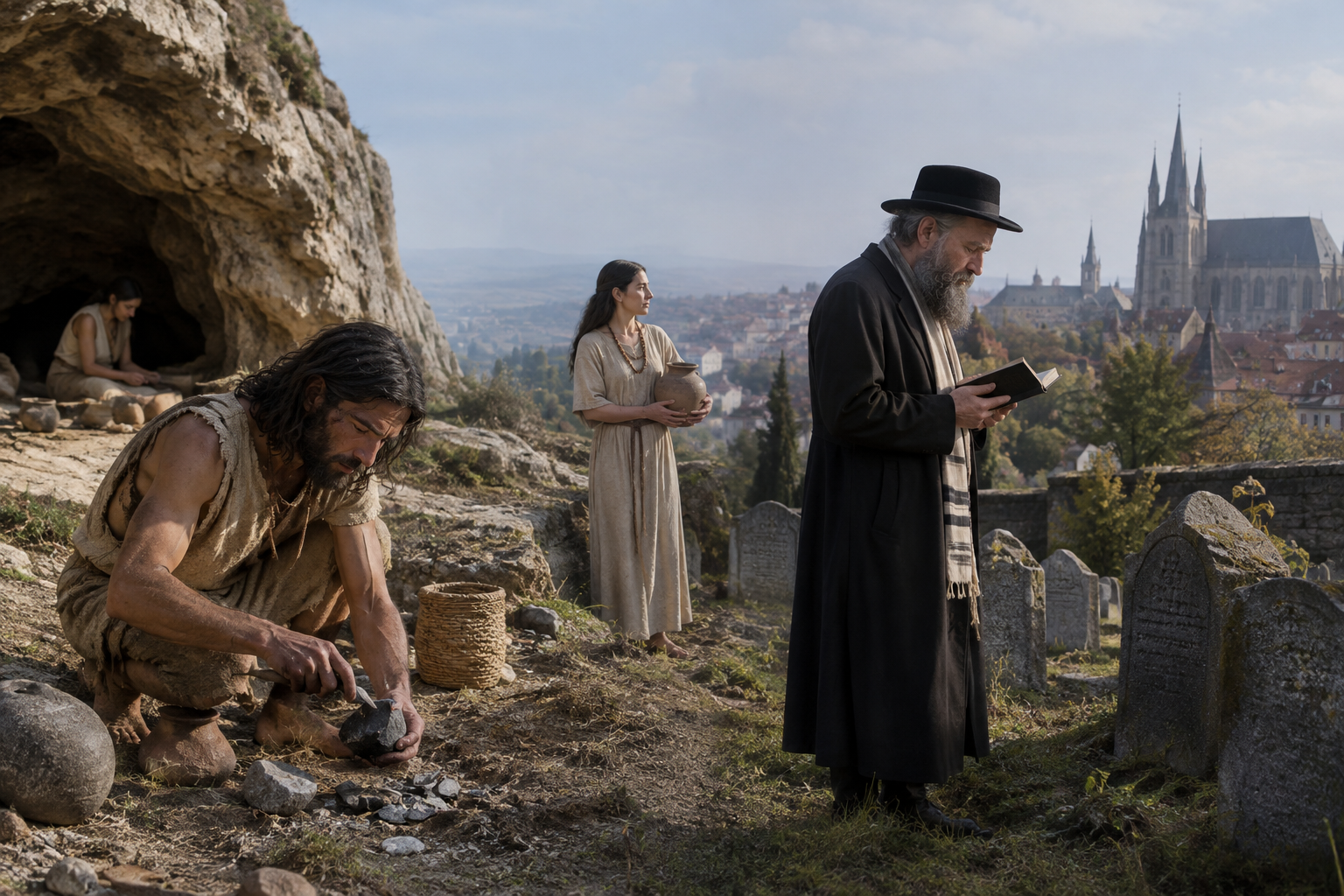
At Ain Ghazal in present-day Jordan, archaeologists uncovered one of the most important Neolithic settlements in the Levant: a place of early farming, plastered architecture, and famous human figures made from lime plaster. Among the ancient individuals studied from this site is sample I1414, dated to around 8100 BC and reported here in connection with the Y-DNA haplogroup E1b1b1b2. That matters because it places this paternal line, or at least a lineage associated with this branch, in the world of some of the earliest large settled communities of Southwest Asia.
For anyone tracing E1b1b1b2 today, this is a useful starting point. Y-DNA follows one direct paternal line only, not a whole ancestry, but ancient cases can still show where particular male lines appear in real archaeological settings. In this case, the evidence ties E1b1b1b2 to a remarkably long and varied record: early village life in the Neolithic Levant, later prehistoric cave use in the southern Levant, and a much later appearance in a medieval Jewish cemetery in Germany.
Ain Ghazal was not a minor hamlet. It was one of the major Pre-Pottery Neolithic B settlements, part of the great transformation in which hunting and gathering gave way to farming, herding, and permanent architecture across the Levant. When a paternal lineage linked to E1b1b1b2 turns up here in sample I1414, it anchors that lineage in a society that was helping to build a new way of life.
That does not mean one man "founded" anything, nor that one haplogroup explains the Neolithic. Ancient settlements were genetically mixed communities, and the Levant in this period was already a region of interaction. But I1414 shows that a branch within the broader E1b1b1b family was present among these early farmers, in a setting central to the spread of village-based life.
Research on early Near Eastern populations has repeatedly shown that the Neolithic was not a simple story of a single homogeneous people moving outward in lockstep. Sites like Ain Ghazal instead reveal local continuity, regional contacts, and social complexity. A genetic study of ancient Near Eastern populations can be found here: https://www.biorxiv.org/content/10.1101/059311v1.
The second major appearance comes from Peqi'in Cave in the Chalcolithic southern Levant, where sample I1171, dated to around 3900 BC, is also associated here with E1b1b1b2. This is a very different world from Ain Ghazal. By the Chalcolithic, communities in the region were using metals, producing increasingly elaborate material culture, and depositing their dead in striking cave contexts.
Peqi'in has become well known because it captured a snapshot of a distinctive burial population from the late 5th to 4th millennium BC. The site has been important not only for archaeology but also for ancient DNA, because it helps show that the southern Levant was not static between the early farming period and later Bronze Age societies. The people buried there belonged to communities with their own local traditions and wider connections.
For E1b1b1b2, I1171 is valuable because it shows continuity of presence in the broader Levantine zone across thousands of years, while also warning against oversimplification. The same broad paternal branch can appear in very different societies. An early Neolithic villager at Ain Ghazal and a Chalcolithic cave-burial individual at Peqi'in are not interchangeable evidence; together, though, they show that this paternal ancestry belonged to the long human history of the region.
Researchers investigating the Peqi'in Cave burials published one of the key studies here: https://www.nature.com/articles/s41467-018-05649-9. That work helped underline just how informative Chalcolithic Levantine burials can be for understanding population change and local diversity.
Neolithic Expansion in the Aegean
It is worth being careful with the label itself. E1b1b1b2 is a specific branch within the much larger E1b1b1b grouping, a major paternal cluster with a long history in parts of Africa, the Near East, and the Mediterranean. But the broad fame of E1b1b1b should not be casually projected onto every narrower branch. Without sample-by-sample resolution beyond the classification provided here, it is safest to say that these ancient men were reported in association with E1b1b1b2, not to build an overconfident migration tale from the label alone.
That caution is especially important because ancient Y-DNA resolution can vary. Some samples are assigned to a precise terminal subclade, others only to a broader parent branch. In popular ancestry discussions, people often rush from a haplogroup name to claims about ethnicity, language, or famous historical peoples. Archaeology is usually much messier, and more interesting, than that.
In the case of E1b1b1b2, the most defensible picture from these samples is a paternal line present in the Levant from very early farming times onward, and still visible much later in communities shaped by entirely different religious, cultural, and historical worlds.
The latest sample in this small group is I14847, from the Late Medieval Ashkenazi cemetery at Erfurt in Germany, dated to around 1350 AD. That setting immediately changes the frame. We are no longer dealing with prehistoric farmers or Chalcolithic cave burial, but with a documented medieval Jewish community in central Europe, living in one of the continent's urban worlds of trade, scholarship, pressure, and periodic violence.
Erfurt has become an important site in the genetics of Ashkenazi Jewish history because cemetery samples there provide a rare direct glimpse into a medieval population rather than relying only on modern DNA. A lineage associated here with E1b1b1b2 fits a broader historical reality: Ashkenazi communities were never genetically uniform. Their ancestry reflects deep eastern Mediterranean and Near Eastern roots alongside the demographic history of Jewish life in Europe.
What makes I14847 so useful is not that it proves an unbroken documented line from Neolithic Jordan to medieval Germany; it does not. Rather, it shows that this paternal branch, or a closely related one under the reported classification, appears within a historically recognizable Jewish population many millennia after its earlier appearances in the Levant. That is precisely the sort of long-range pattern ancient DNA is good at illuminating when used carefully.
Three samples are not a whole history of a haplogroup. Still, these three are unusually suggestive because they sit in such different archaeological and historical contexts. I1414 from Ain Ghazal places E1b1b1b2 in one of the earliest great settled communities of the Levant. I1171 from Peqi'in Cave shows the branch again in a later prehistoric society of the same wider region, but under very different cultural conditions. I14847 from Erfurt demonstrates that the lineage also appears in medieval Ashkenazi Europe.
That combination points less to a single dramatic migration than to durability. Some paternal lines persist through enormous changes in economy, religion, language, and political order. The men carrying them may live in plastered Neolithic villages, Chalcolithic burial landscapes, or medieval Jewish towns, while the Y-chromosome line itself continues quietly through the generations.
The most distinctive thing about E1b1b1b2 in this evidence is its appearance in the Levant at very early dates and its later presence in a medieval Ashkenazi burial ground far to the northwest. For someone researching this paternal line today, that does not promise a neat single-origin story, but it does place the lineage within a historically important arc linking early Southwest Asian farming worlds, later Levantine populations, and parts of the medieval Jewish diaspora.






Comments