Haplogroup E1b1b1a1b1a3

– 5 min read


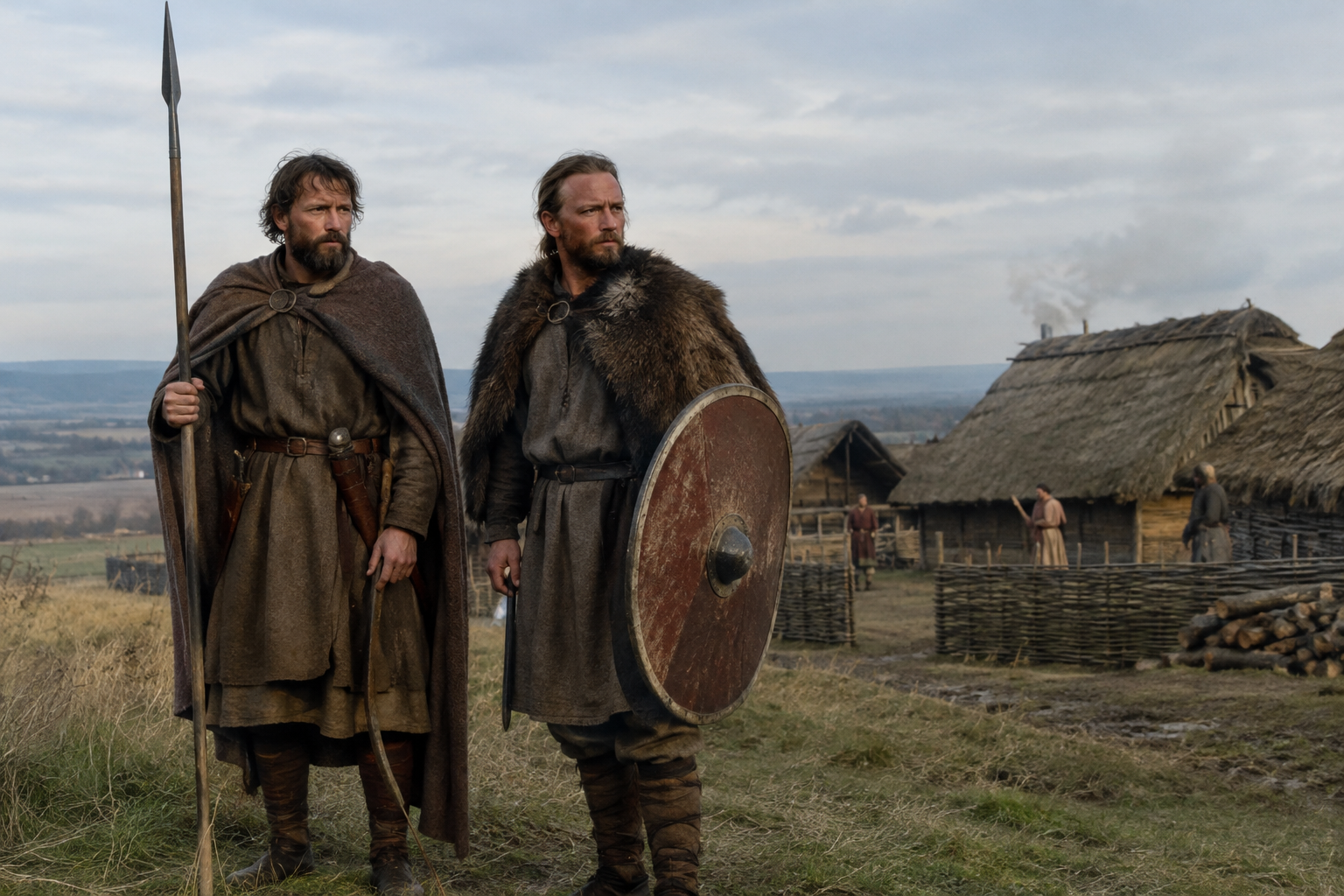
At Hegyko in western Hungary, in the old borderland once known as Scarbantia in Pannonia, two men dated to about AD 525 stand out for anyone tracing the Y-DNA haplogroup E1b1b1a1b1a3. They are recorded as HMU066 and HMU004, both from the post-Roman Barbaricum beyond the former imperial frontier. That is already an arresting setting: not the Roman Empire at its confident height, but a landscape after empire, where old provincial structures, mobile groups, and local communities were being reshaped together.
The interest of these samples is not that they let us pin a single ethnicity onto a grave. They do not. What they do offer is something more historically useful: a glimpse of a paternal line associated with E1b1b1a1b1a3 in a fifth- to sixth-century frontier zone where identities were mixed, political loyalties unstable, and ancestry could not be read neatly from labels such as Roman or barbarian. Y-DNA tracks one direct paternal line only, but even that narrow line can become illuminating when it appears in exactly the sort of place where worlds were colliding.
Hegyko lies in the Little Hungarian Plain, a region that had long been entangled with Roman power. Scarbantia, nearby, had been an important Roman town, but by the early sixth century this was no tidy imperial province. The western Hungarian borderlands had become a contact zone linking former Roman populations, newcomers from different directions, and communities adapting to the collapse of old political boundaries.
That is the real backdrop for HMU066 and HMU004. Both are associated with the post-Roman period in Barbaricum, around AD 525. The site matters because it belongs to the age when the old Roman frontier still shaped settlement and movement, even though imperial control had ebbed. In such a landscape, a Y-chromosome lineage like E1b1b1a1b1a3 is valuable less as a badge of identity than as evidence that paternal ancestry in this region was already highly varied.
An ancient DNA study examining this region has helped show just how diverse post-Roman communities in the Little Hungarian Plain could be, with local continuity and long-distance connections existing side by side. The broader research context can be seen in this genetic study of post-Roman populations in the Carpathian Basin.
The haplogroup name is precise, but precision in naming should not tempt us into false precision in storytelling. E1b1b1a1b1a3 is a downstream branch within the wider E1b1b1 family, a major paternal lineage with deep roots outside central Europe and a long history around the Mediterranean, the Balkans, and parts of Africa and western Asia. But the presence of one specific branch at Hegyko does not by itself tell us when that line first arrived in the region, nor through which exact migration episode.
That distinction matters. A narrow subclade is not automatically a marker of one people, one language, or one historical event. In late antique Pannonia and its neighboring zones, lineages could have arrived through Roman military service, trade, marriage, local survival from earlier periods, or more than one of these at once. The history is messier than the map legends of older textbooks, and ancient DNA is often most useful when it forces us to admit that messiness.
So HMU066 and HMU004 should be read as evidence for the presence of this paternal branch in a post-Roman frontier community, not as proof of a single ethnic identity. That is still important. It places E1b1b1a1b1a3 in a historically charged landscape where the end of Roman rule did not create empty space, but a new mosaic of people.
The fact that both HMU066 and HMU004 come from the same broad place and period is suggestive. It tells us that this was not an isolated one-off signal from a single burial. Even so, caution is needed: repeated occurrence at one cemetery or local cluster does not prove that the men were close paternal relatives, nor that the whole community was dominated by that lineage.
Still, repetition changes the historical weight of the evidence. One occurrence can be a curiosity; two begin to hint at a local pattern. At Hegyko, that pattern suggests that men carrying lineages assigned to this branch were present enough to appear more than once in the ancient record of a single frontier setting. In archaeogenetics, that is often how the most useful stories begin: not with a grand dynasty, but with the quiet recurrence of a lineage in a real burial landscape.
There is also a wider historical point. Cemeteries in post-Roman central Europe often reflect communities formed through blending rather than replacement. The old opposition between Roman and barbarian can be far too blunt for what the evidence now shows. People living near former frontiers were not always newcomers, not always locals, and often descendants of several different histories at once.
It is tempting to imagine the fifth and sixth centuries in the Carpathian Basin as a succession of named peoples marching through: Huns, Goths, Langobards, Gepids, and others. They certainly mattered politically. But burial grounds and genomes keep reminding us that political names and biological ancestry do not line up neatly. The men buried around Hegyko lived in a world where prestige, power, and allegiance could shift faster than family lines did.
That is where a haplogroup such as E1b1b1a1b1a3 becomes historically interesting. In a region often narrated mainly through steppe arrivals or Germanic-speaking groups, this paternal branch points to a more entangled background. The post-Roman Carpathian Basin was not only a corridor of invasions; it was also a holding zone of survivors, settlers, ex-soldiers, traders, and families whose roots ran in different directions.
This fits a broader pattern seen across late antique and early medieval Europe, where ancient DNA repeatedly reveals mixed communities rather than sealed ethnic blocks. A related MyTrueAncestry discussion of similarly varied origins in another early medieval cemetery can be found here:
Although the Hegyko samples are the fixed point of this article, the wider historical setting of E1b1b1 branches cannot be ignored. The broader E1b1b1 family has long been prominent in parts of the Balkans and the Mediterranean world, and that matters in former Pannonian territories. These lands were never isolated from southeastern Europe. Roman administration, military recruitment, colonization, and trade all linked the Danube frontier to the Adriatic, the Aegean, and beyond.
That does not mean HMU066 or HMU004 can be assigned a specific Balkan homeland. It does mean their paternal lineage sits comfortably within the sort of connected world late antiquity had created. Even after the western empire fractured, those older networks did not simply vanish. Families, memories, and lineages remained embedded in the landscape.
For readers interested in how deep Balkan population history shaped later European genetics, this related piece offers useful context:
If your paternal line falls under E1b1b1a1b1a3, the Hegyko evidence does not hand you a ready-made identity. What it does provide is something more solid than fantasy: a documented appearance of this lineage in a real post-Roman community on the former edge of empire, around AD 525. That places your branch, or a closely related one, within the kind of mixed frontier society that helped shape early medieval Europe.
HMU066 and HMU004 are valuable because they resist simple storytelling. They show that this haplogroup was present in a world where Roman institutions had weakened but human mobility had not, where ancestry was layered, and where paternal lines could persist across political collapse. For anyone tracing E1b1b1a1b1a3 today, that is the most responsible and most interesting conclusion of all: not a legend of single origin, but a place in one of Europe's great historical borderlands.






Comments