Haplogroup E1b1b1a1b1a10f1

– 5 min read


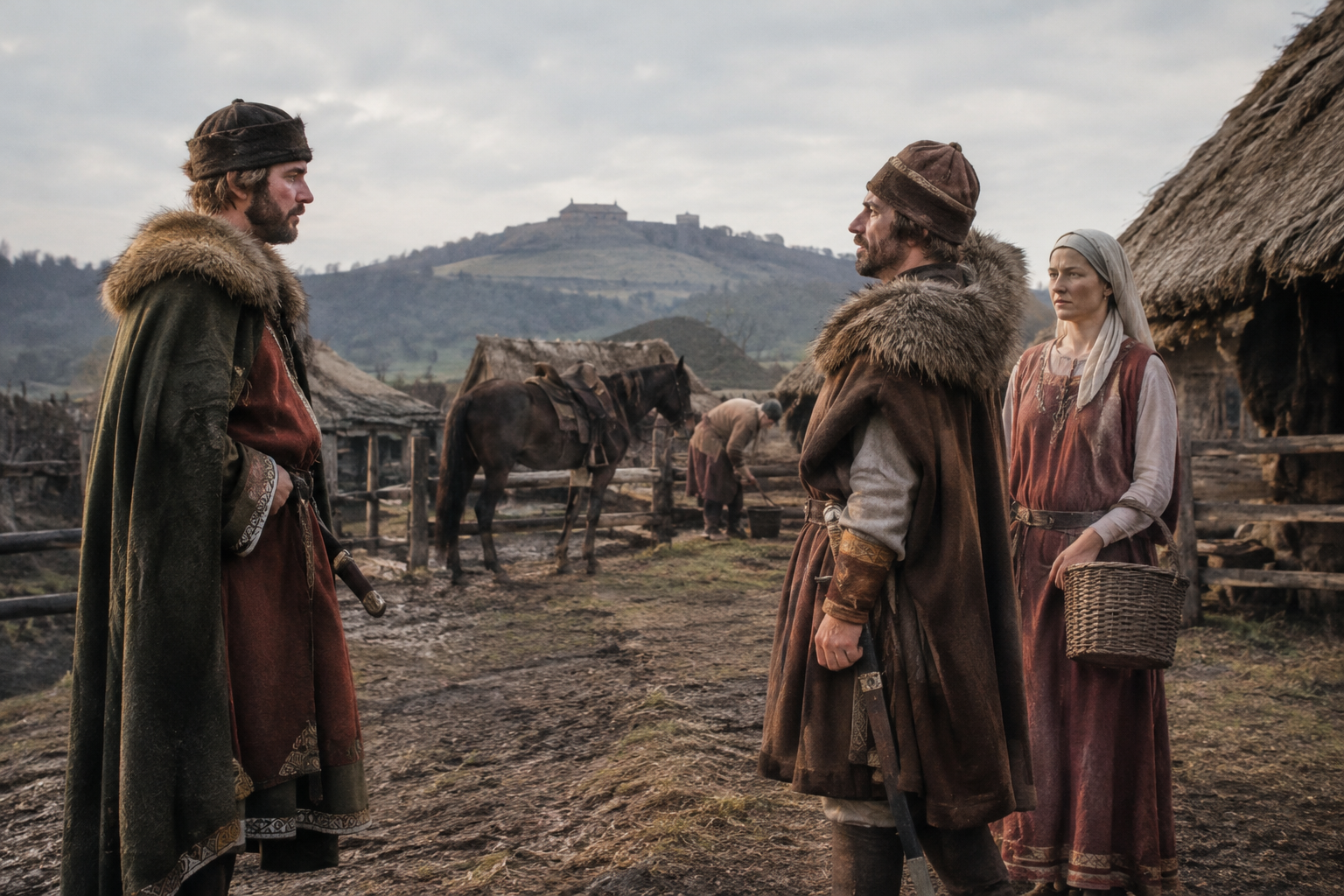
At Himod-Káposztás in western Hungary, one excavated man from around AD 850 carries an unexpectedly long Y-chromosome label in modern reporting: E1b1b1a1b1a10f1. The individual is recorded as sample KBS18, from the Carolingian frontier zone of the Carpathian Basin. That matters because frontier cemeteries are where grand historical categories begin to fray. On paper this was a borderland between powers; in the ground, it was a place where real communities buried their dead, carrying lineages that did not fit any simple idea of "Frankish," "Avar," or "early Hungarian."
KBS18 is a useful reminder of what Y-DNA can and cannot do. It traces one direct paternal line only, not the whole ancestry or identity of a person. But even that narrow line can be historically revealing when it turns up in a well-dated archaeological setting. In this case, E1b1b1a1b1a10f1 appears not in some abstract map of migrations, but in a documented early medieval burial from a politically sensitive landscape.
By the mid-9th century, the western part of the Carpathian Basin sat in a complicated world of post-Roman inheritances, Avar legacies, Slavic-speaking communities, and Carolingian political expansion. Himod lies in what is now Hungary, but in AD 850 it stood within a zone shaped by imperial pressure from the west and older regional populations already rooted in the basin. Archaeology in such places rarely yields tidy ethnic blocks. It yields mixed cemeteries, layered habits, and people whose ancestry could have several different geographical strands at once.
That is precisely why KBS18 is interesting. The haplogroup E1b1b1a1b1a10f1 belongs within the wider E1b1b1 framework, a major paternal lineage with a long history in parts of Africa, the Mediterranean, and southeastern Europe. Yet the exact sub-branch in this article is much narrower than that broad parent. We should be careful not to project the entire history of haplogroup E onto this specific twig. What the ancient evidence securely gives us is something more modest and more valuable: one man on the early medieval Hungarian frontier whose paternal ancestry connected him to a wider and older web of movement across Europe and the Mediterranean world.
An ancient DNA study of this region, published in Science Advances, has helped sharpen this picture of the western Carpathian Basin after Late Antiquity. The broader lesson is not that one lineage "belongs" to one people, but that border societies were assembled from multiple inherited threads.
To anyone raised on old textbook history, an E-lineage in medieval Hungary may sound exotic, as though it must signal one dramatic migration event. But the archaeology of Europe has been teaching the opposite lesson for years. Southeastern Europe, the Balkans, the Adriatic, Italy, and the Danube basin have all been zones of repeated movement since prehistory. Soldiers, traders, farmers, church networks, captives, and households moved through them long before modern borders existed.
In other words, KBS18 does not need a melodramatic backstory to make sense. The Carpathian Basin had been absorbing newcomers and reshaping local populations for millennia. Roman rule linked the region to the wider Mediterranean; Late Antique and early medieval upheavals then layered in new connections from the steppe, central Europe, and the Balkans. A paternal line from the wider E1b1b1 family could have reached this frontier by any number of historically ordinary routes long before AD 850.
That is one reason the precise subclade matters. The article haplogroup, E1b1b1a1b1a10f1, is a very fine-grained label in a modern phylogenetic tree. Ancient reports sometimes identify lineages to such depth, but the historical meaning still depends on context. A terminal branch tells us that modern testing can place a Y chromosome very specifically; it does not, by itself, tell us which language the man spoke, what clothes he wore, or which political authority he obeyed.
The phrase "Carolingian border" can sound military and remote, but cemeteries like Himod are above all local places. People were not buried as footnotes to empires. They were buried by families and communities living through a period when the old Avar world had collapsed, Carolingian influence pressed eastward, and new power arrangements were emerging across the basin.
That setting makes KBS18 historically richer than a bare haplogroup label. He represents the kind of person who often disappears in narrative history: neither emperor nor conqueror, but an inhabitant of a contact zone. His paternal lineage hints at deeper Mediterranean or southeast European connections within a community living on a western Hungarian frontier in the 9th century. That is exactly the sort of small-scale evidence that complicates simplistic stories of population replacement.
Recent work across Europe has repeatedly shown that early medieval burial grounds were often more diverse than older nationalist histories expected. Some communities look locally continuous, others include recent migrants, and many combine both. The result is less a parade of sealed-off tribes than a patchwork of neighborhoods and kin groups with different ancestral backgrounds.
Roman-Barbarian Frontier Mixing
If we step back from Himod, the wider parent haplogroup E1b1b1 has a substantial history in southeast Europe and the Mediterranean. That broader distribution helps explain why its appearance in the Carpathian Basin should not be treated as anomalous. The Balkans in particular have long been one of the regions where branches of E1b1b1 became established, and movements northward into Danubian territories are historically plausible across many periods, from prehistory to the medieval centuries.
But here caution is essential. It would be wrong to claim that KBS18's exact branch can be traced neatly to one named ancient migration or one specific people. The evidence we have does not justify that. What it does justify is a more grounded historical picture: medieval Hungary, especially along its western edges, was part of a connected world in which paternal lines associated with southeastern European and Mediterranean histories could already be fully integrated into local communities.
This fits neatly with other archaeogenetic work showing how messy frontier populations could be. The Danube was not merely a border to be defended; it was also a corridor of movement, exchange, recruitment, marriage, and resettlement. Once you remember that, a lineage like E1b1b1a1b1a10f1 at Himod stops looking improbable and starts looking exactly like what borderland archaeology often reveals.
One ancient sample does not define a population, but it can sharpen the questions we ask of it. KBS18 suggests that by around AD 850, the paternal makeup of communities in western Hungary already included lineages outside the stereotypes often imposed on the period. Instead of imagining a simple handover from one neatly bounded people to another, we should picture a social landscape made up of survivors, newcomers, descendants of earlier provincial populations, and families tied into more distant networks.
This matters especially in Hungarian history, where the 9th and 10th centuries are often told in terms of conquest and political transformation. Those events were real, but populations on the ground were not blank slates waiting for history to arrive. Cemeteries from the region show that local complexity predated the best-known political turning points. A man like KBS18 belonged to that complexity.
It also helps explain why genetic studies of medieval Hungary have been so revealing. They are not just testing royal burials or elite graves; they are exposing how varied ordinary and frontier communities could be. That is where haplogroups become historically useful: not as badges of identity, but as clues to the deep and uneven making of populations.
For someone exploring the haplogroup E1b1b1a1b1a10f1 today, the clearest lesson from KBS18 is not a claim to one famous tribe or dynasty. It is something subtler and more interesting. This paternal branch appears in a real early medieval man from the Carolingian borderlands of Hungary, showing that such lineages were already part of the human mix in a politically charged region where central Europe, the Balkans, and older Mediterranean connections overlapped. That is a modest conclusion, but a strong one - and in ancient DNA, strong and modest is usually where the best history lies.






Comments