Haplogroup E1b1b1a1a1b1a1
– 4 min read


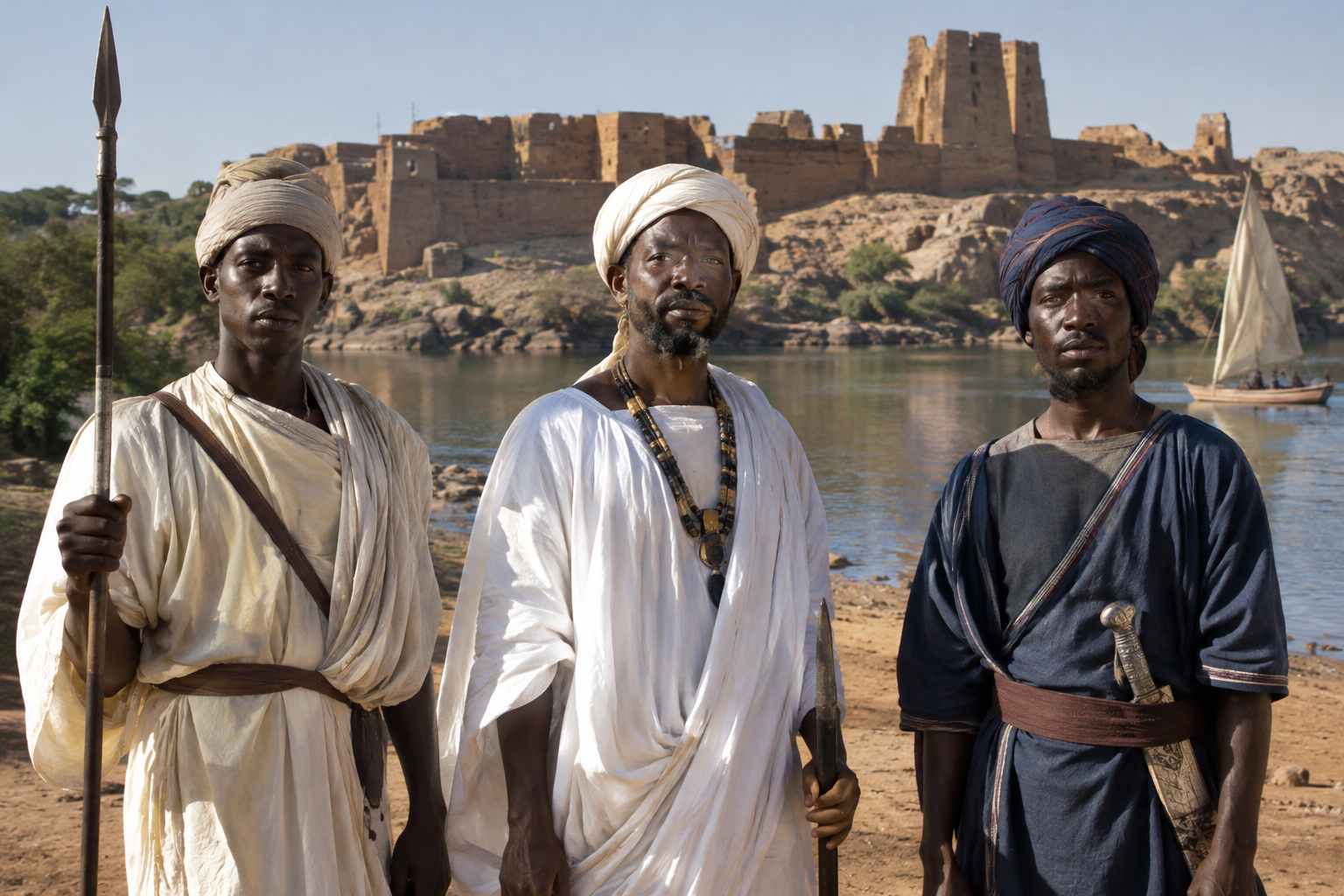
At Kulubnarti, on the Nile in medieval Nubia, ancient DNA has put a very specific paternal line into a very specific historical landscape. Three male individuals from this cemetery cluster - I6250, dated around AD 1220, I6327, dated around AD 1080, and I18508, from Early Makurian Nubia around AD 750 - have been associated here with Y-DNA haplogroup E1b1b1a1a1b1a1. That matters because Kulubnarti is not some vague backdrop in "ancient Africa". It belongs to the Christian kingdoms of medieval Nubia, a region with written history, distinctive burial traditions, and a long record of contact along the Nile corridor.
The striking thing is not a single glamorous tomb, but repetition across time at one place. If the same paternal branch appears in men buried at Kulubnarti from the Early Makurian into the Medieval Makurian period, we are looking at continuity within a local community rather than a one-off curiosity. Y-DNA traces one direct paternal line only, not a person's whole ancestry, but it can still show how male-line descent persisted within real historical societies.
Kulubnarti lies in what is now northern Sudan, in a part of the Nile Valley long shaped by movement, settlement, and political change. By the early medieval period this region formed part of Makuria, one of the major Christian Nubian kingdoms. Makuria was no isolated outpost: it was linked by river traffic, pilgrimage, diplomacy, and trade to other Nubian regions, to Egypt, and beyond.
The three individuals listed here come from that setting. I18508 belongs to the earlier horizon, around AD 750, while I6327 and I6250 belong to later medieval phases, around AD 1080 and AD 1220. Even with only these basic sample details, the pattern is informative: the same haplogroup branch appears in burials spanning several centuries of Nubian history.
An ancient DNA study examining populations from this region is linked here in research on medieval Nubian genomes. Without forcing more from the paper than the evidence provided, the broad value is clear enough: Kulubnarti has become one of the key sites for understanding how ancestry, health, and local community structure played out in medieval Sudan.
Kulubnarti and Life on the Edge
The haplogroup name is wonderfully technical, but it needs handling with care. E1b1b1a1a1b1a1 is a narrow branch within the wider E1b1b1 complex, a major paternal lineage with a deep history in Africa and adjoining regions. What we can say responsibly is not that every movement of the larger E lineage explains these men, but that this particular branch was present in medieval Nubia at Kulubnarti.
That distinction matters. Broad parent haplogroups often have huge geographic and chronological ranges, while a finer subclade may represent a much more local or historically recent pattern. So the real story here is not "where E came from" in some grand prehistoric sense, but how one paternal branch shows up repeatedly in a documented Nubian community across centuries.
For anyone researching this haplogroup today, the most defensible connection is therefore to the Nile Valley's long population history - especially northeastern Africa, where local continuity and outside contacts often overlapped rather than replacing one another outright.
I18508, from around AD 750, anchors this branch in the Early Makurian period. That was a formative era in Christian Nubia, after the conversion of the Nubian kingdoms and during the consolidation of local political and religious life. A paternal lineage present at this stage and still visible centuries later hints at stability inside the community, or at least within some of its male lines.
I6327, around AD 1080, belongs to a later medieval phase when Makuria was still a serious political force, though increasingly entangled in the shifting fortunes of the Nile Valley. Then comes I6250, around AD 1220, by which time Nubia was facing mounting pressures from the north and internal political strain. Yet this paternal branch still appears in the burial population.
It is tempting to turn that into a dynastic tale, but the evidence does not require that. What it does support is something quieter and more archaeologically useful: direct paternal continuity at one site over roughly five centuries. In ancient DNA, that is often more revealing than a dramatic claim.
African DNA Population History
One of the enduring misconceptions about medieval Nubia is that it sat outside the main current of Afro-Eurasian history. In fact, Nubian kingdoms negotiated with Muslim Egypt, maintained Christian institutions, and participated in long-distance exchange networks. Genetics fits that picture rather well: continuity in some lines can exist alongside mixture, mobility, and cultural change.
Kulubnarti is especially useful because it reminds us that the Nile Valley cannot be reduced to a simple north-south corridor with people endlessly flowing through it. Communities could be rooted, local, and persistent, even while living in a region famous for movement and imperial attention. A haplogroup like E1b1b1a1a1b1a1 appearing repeatedly at the same site helps make that point in human terms.
This is also why medieval Nubian evidence deserves to stand beside better-known studies from Europe or the Mediterranean. Ancient DNA is at its best when it illuminates historically documented societies that have too often been treated as peripheral. Kulubnarti is one of those places.
North Africa's Genetic History
Single ancient Y-DNA results are interesting, but clusters are better history. A lone man with a particular lineage may represent many things: local descent, recent migration, marriage patterns, or chance survival in the record. Three individuals from the same broader site and historical tradition, spread across centuries, carry more weight.
That still does not mean every man at Kulubnarti belonged to the same paternal line, or that this branch defined Makuria as a whole. But it does suggest that E1b1b1a1a1b1a1 was not an incidental arrival in this burial population. It had a place in the lived demographic fabric of medieval Nubia.
For readers who enjoy wider comparisons about how ancient DNA reveals mixed origins in historic communities, there is an instructive parallel in this post on diverse origins at a 7th-century Madrid burial site. The settings are very different, but the broader lesson is similar: cemeteries often show that past populations were both locally grounded and historically connected.
Mixed Origins in Medieval Burials
The most distinctive thing about E1b1b1a1a1b1a1 in this case is not a legendary founder or a royal pedigree, but a sequence of real men buried in medieval Nubia: I18508, I6327, and I6250. Together they place this paternal branch inside the Christian Nile world of Makuria across several centuries. For someone researching this haplogroup today, that does not promise descent from a named ruler or a single ancient tribe. It does, however, point toward a paternal history that fits convincingly within the long continuity of northeastern Africa and the medieval communities of the Nubian Nile.






Comments