Haplogroup E1b1a1a1a1c1b

– 5 min read


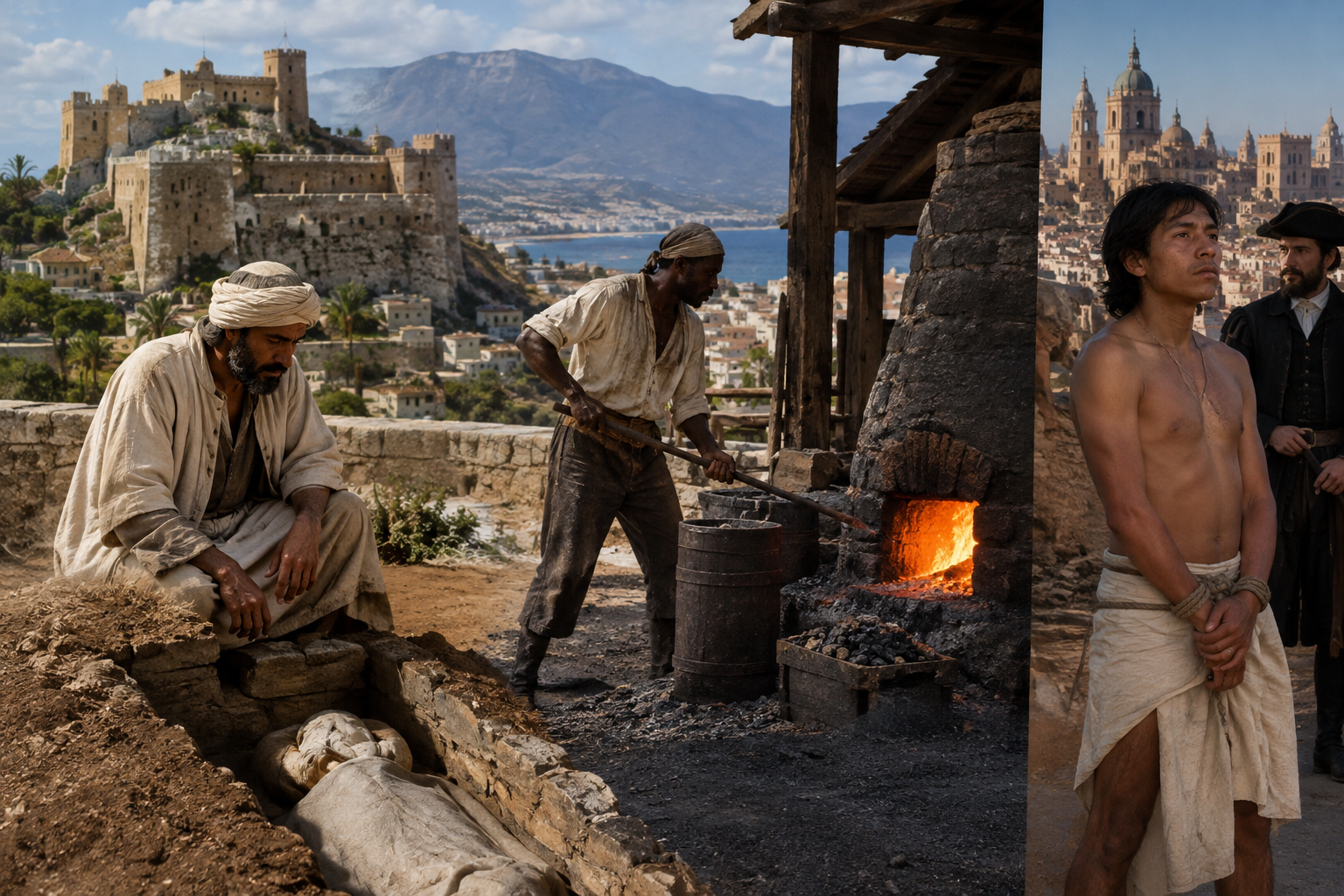
In Palermo, at Castello San Pietro, one medieval burial stands out for what it quietly says about the Islamic Mediterranean. The individual labelled CSPBN2a, dated to about AD 925, carried the Y-DNA haplogroup E1b1a1a1a1c1b. That is a very specific paternal branch within the wider E1b1a family, a lineage most strongly associated today with populations of West and West-Central African ancestry.
That does not mean this man can be reduced to a single origin story. Y-DNA follows only one direct paternal line, not a person's whole ancestry, language, faith, or social identity. But in an Islamic burial from medieval Sicily, this paternal signature is historically arresting because it places a clearly sub-Saharan-linked male line inside one of the most connected societies in the medieval Mediterranean.
By the 10th century, Palermo was no provincial backwater. It was one of the major cities of the central Mediterranean, shaped by Muslim rule, maritime trade, slavery, migration, and the movement of soldiers, scholars, craftspeople, and merchants. A lineage like E1b1a1a1a1c1b appearing there is not an oddity dropped from nowhere; it fits a world in which Sicily was tied to North Africa, al-Andalus, the Maghreb, and routes extending far beyond them.
The important point is not to overstate what one burial proves. CSPBN2a does not by himself demonstrate a mass migration from any single African region, nor does his Y chromosome tell us his mother-side ancestry or personal life history. What it does show is that medieval Palermo included men whose paternal roots ultimately lay south of the Sahara, and that such lineages had entered the island's human landscape by the early 10th century.
This matters because Sicily is so often written as a story of Greeks, Romans, Byzantines, Arabs, Normans, and Spaniards, with Africa mentioned only at the shoreline. Ancient DNA keeps forcing the issue back open. Medieval Sicilian society was not simply influenced by Africa from afar; Africans and people of African descent were part of it.
The branch name here is extremely narrow: E1b1a1a1a1c1b. It sits deep inside a much larger Y-chromosome tree. The broader E1b1a family has a long and complex history in Africa and is especially common in many present-day West and West-Central African populations. But one must be careful: the ancient meaning of a precise subclade cannot simply be copied from a modern distribution map.
That caution is especially important with medieval and early modern individuals found outside Africa. A paternal lineage can move through trade, enslavement, military service, household migration, or longer chains of family settlement. By the time we meet a man like CSPBN2a in Palermo, his paternal line may have travelled through several societies before reaching Sicily.
Still, the broad historical frame is sound. In the medieval Mediterranean, sub-Saharan ancestry did not arrive only in the modern era. Islamic polities connected North Africa and southern Europe to trans-Saharan systems as well as to older Red Sea and Indian Ocean networks. Sicily was one of the places where those far-reaching connections became human, local, and buried in the ground.
For a wider look at how island populations in Italy preserve evidence of movement and mixture across time, see this related discussion of ancient Italian islands.
A very different setting appears with SJN001, an individual from early colonial Mexico City dated around AD 1539 and described as a slave trade victim. Here the same haplogroup branch is no longer turning up in an Islamic Mediterranean context but in the earliest generations of the Spanish colonial Atlantic.
This is where the history becomes brutally clear. In medieval Sicily, an African-linked paternal line may reflect many kinds of incorporation into society. In 16th-century Mexico, the phrase "slave trade victim" tells us plainly that forced displacement is central to the story. A paternal branch such as E1b1a1a1a1c1b helps identify one strand of ancestry, but the burial context reminds us that these were not abstract population shifts. They were human lives caught in the machinery of empire.
Research on first-generation Africans in early colonial Mexico has helped reveal how rapidly New Spain became a meeting ground of Indigenous Americans, Europeans, and Africans brought across the Atlantic under coercion. In that sense, SJN001 is historically invaluable. He shows that this haplogroup cannot be discussed only as an "African origin" lineage; it is also part of the documentary and biological record of early Atlantic slavery in the Americas. One study associated with this context is available here: https://www.researchgate.net/publication/341056035_Origin_and_Health_Status_of_First-Generation_Africans_from_Early_Colonial_Mexico.
The third supplied case is I15330, an enslaved laborer from the Catoctin iron-working furnace in antebellum Maryland, dated about AD 1810. Now we are in the industrial world of the early United States, and the same paternal branch appears again in a context defined by coerced labour.
There is something sobering about this sequence. Palermo, Mexico City, Maryland: three different societies, three different political systems, and yet the same direct paternal line appears in contexts shaped by long-distance movement and unequal power. The Maryland burial does not tell us the exact African homeland of this man's paternal ancestors, nor how many generations earlier they had crossed the Atlantic. But it does show the persistence of African male lines through slavery into the industrial economy of North America.
That matters archaeologically because plantation and labour-site burials are often the only surviving witnesses for people poorly recorded in written archives. A haplogroup like E1b1a1a1a1c1b becomes, in such cases, a thin but precious line of continuity. It can connect an individual in an American furnace community to a much larger history of African descent, survival, and family transmission under conditions designed to erase both.
An ancient DNA study linked to this broader sample set can be found here: https://www.biorxiv.org/content/10.1101/2022.06.12.495320v1.
At first glance, the three individuals have little in common beyond their Y chromosome. One was buried in Islamic Palermo, one in early colonial Mexico City, and one in antebellum Maryland. Yet together they reveal something unusually useful about this haplogroup: it appears not as a local dynasty tied to one castle or one medieval clan, but as a paternal line carried through some of the major connective systems of the last thousand years.
The first system is the medieval Mediterranean, where Islamic Sicily linked Europe and Africa. The second is the early modern Atlantic, where Iberian empire and the slave trade moved African peoples into the Americas. The third is the labour regime of the United States, where descendants of those forced migrations lived and died in industrial as well as agricultural settings.
That is why the Palermo burial is such a good place to begin. It unsettles lazy assumptions that African-linked paternal lines in Europe must always be recent. And the Mexico and Maryland individuals then push the story onward, showing how the same branch enters the documentary horizon of colonial violence and endurance across the Atlantic world.
For someone researching E1b1a1a1a1c1b today, these ancient cases suggest a paternal history that may intersect with Africa's deep population history, but also with the very mobile and often violent worlds of medieval Mediterranean exchange and the Atlantic slave trade. The strongest lesson is not that one sample explains your family, but that this lineage can appear in remarkably different historical settings while preserving a direct male-line connection across centuries.
That is the peculiar power of Y-DNA. It does not tell the whole story, but sometimes it preserves exactly the strand of history that empires, conquest, and slavery tried hardest to break.






Comments