Haplogroup E1b1a1a1a1c1a1a3a1d1

– 4 min read


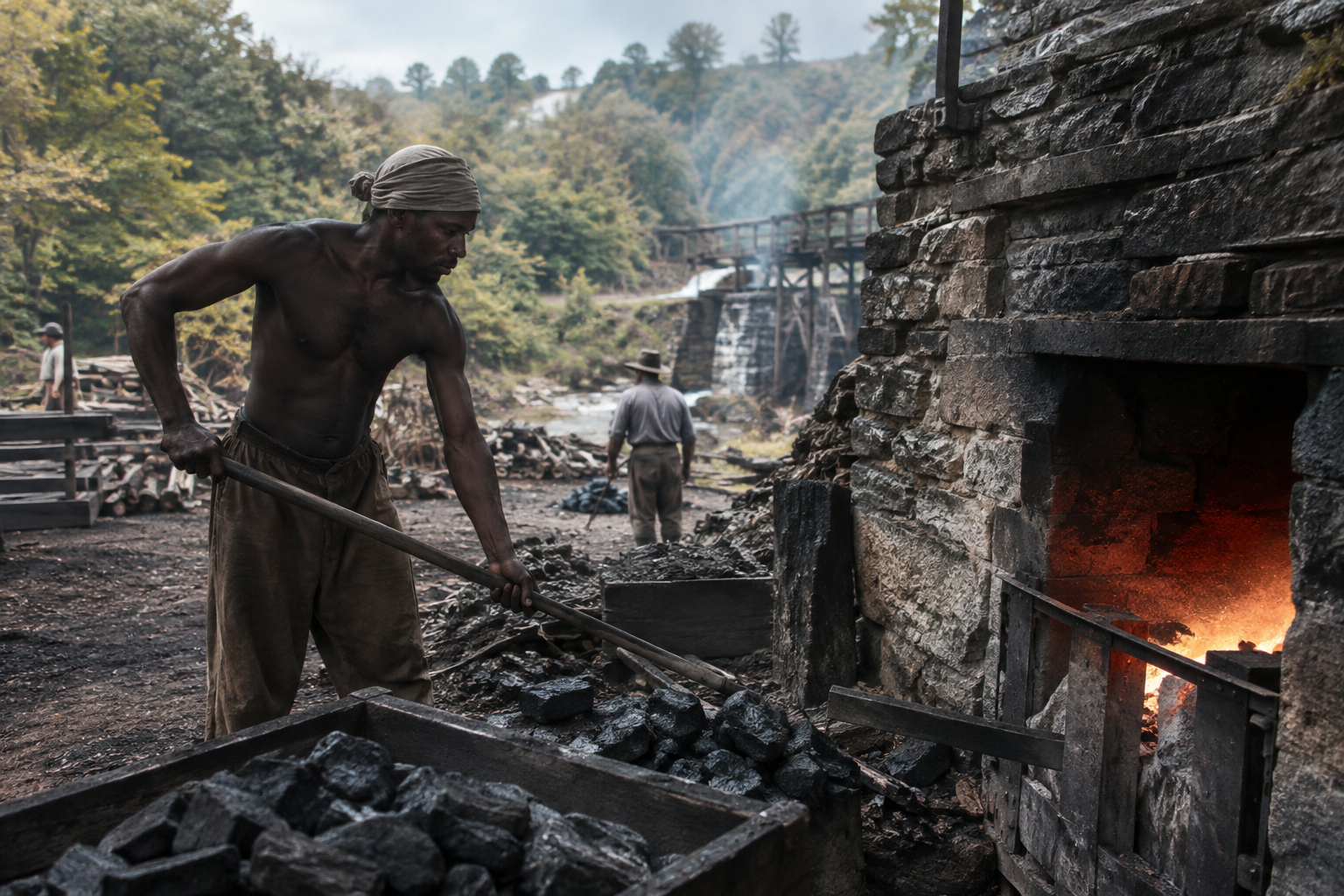
One of the more arresting discoveries linked to the Y-DNA haplogroup E1b1a1a1a1c1a1a3a1d1 is not from a royal tomb or an Iron Age cemetery, but from an industrial site in antebellum Maryland. Sample I8094, identified as an enslaved laborer from the Catoctin iron-working furnace and dated to around 1810 AD, belongs to a context that sits squarely inside the archaeology of slavery, work, and forced migration in the early United States.
That matters because this haplogroup is part of a much wider Y-chromosome family, E1b1a, that is strongly associated with paternal lineages in West and West-Central Africa. The exact branch named here, however, is much narrower than that broad parent group, and with the evidence presently at hand, the safest historical use of it is local and human: it helps anchor one paternal line within the lived world of an enslaved man in Maryland rather than serving as a license for sweeping claims about every earlier movement of the lineage.
The Catoctin Furnace site in Maryland is one of those places where industrial history and human history meet rather brutally. Founded in the colonial period and active into the nineteenth century, the furnace depended on laborers who made charcoal, mined ore, moved heavy materials, and kept a demanding iron industry running. Among them were enslaved African Americans whose presence was fundamental to the enterprise but long underdescribed in conventional local history.
Sample I8094 comes from that world. Even with sparse summary data, the sample is historically vivid because it belongs to a named labor system, a place of work, and a period when slavery in Maryland was woven into both Atlantic commerce and regional industry. Y-DNA traces one direct paternal line only, not the total ancestry or identity of a person, but in this case that paternal line contributes to a larger reconstruction of African-descended lives in early America.
A genetic study associated with these burials can be found here: https://www.biorxiv.org/content/10.1101/2022.06.12.495320v1. Without overstating what one paper or one marker can do, research on sites like this has helped move the conversation beyond anonymous categories and toward the biological and historical realities of specific communities.
The haplogroup label here is strikingly precise: E1b1a1a1a1c1a1a3a1d1. In practice, though, a long Y-DNA name should make us more careful, not less. Broad haplogroups can have deep time depth and wide geographic spread, while fine subclades may reflect much later branching histories that are still unevenly documented in ancient DNA.
So the solid point is this: sample I8094 is reported in connection with this branch, and that places a very specific paternal line inside the African diaspora of the early nineteenth-century Chesapeake. What it does not do, on its own, is identify an exact ethnic group, language community, or homeland in Africa for that individual. Archaeology, documentary history, and comparative genetics all have to work together, and even then the answers are often probabilistic rather than absolute.
Still, there is a bigger historical frame worth setting out. Branches under E1b1a are common in many parts of sub-Saharan Africa and frequently appear in studies of the Atlantic slave trade and African-descended populations in the Americas. That makes the presence of this paternal line at Catoctin Furnace historically unsurprising, but no less important.
Maryland in the late eighteenth and early nineteenth centuries was tied into a dense Atlantic system of plantation agriculture, shipping, credit, and labor extraction. Industrial sites such as iron furnaces are sometimes overshadowed by tobacco plantations in popular memory, yet they were deeply entangled with slavery. The remains of an enslaved worker from such a place remind us that coerced African-descended labor was not confined to fields; it also fed furnaces, workshops, roads, and the wider machinery of American expansion.
It is worth pausing over the date. Around 1810 AD is very recent by the standards of many archaeogenetic studies, which often focus on prehistory or the classical world. But there is nothing trivial about more recent burials. In fact, they can be among the most historically charged because the social setting is better documented and the ethical stakes are clearer.
Catoctin Furnace shows how ancient-DNA methods are increasingly being used not only to trace remote migrations but to recover biographies erased by slavery and class. This is archaeology in a properly historical sense: bones from a furnace cemetery, documentary traces of bondage, and genetic evidence together revealing a community whose labor helped build wealth for others.
That shift in scale matters for MyTrueAncestry readers. Many people come to haplogroups expecting grand migrations, and those certainly matter. But sometimes the most powerful insight is narrower and sharper: a lineage turns up in a burial ground attached to an ironworks, and suddenly paternal ancestry is no longer an abstract map but part of a real and unequal social order.
DNA, Slavery, and Early America
Although this article centers on one individual, the broader interpretive setting is the African diaspora in North America. Genetic evidence from historic-era burials has repeatedly shown that African-descended communities in the Americas were never biologically or culturally uniform. Enslaved people were drawn from multiple regions, reorganized under violence, and then formed new families and communities under extreme constraint.
That is why even a single paternal lineage can be meaningful without being overinterpreted. E1b1a1a1a1c1a1a3a1d1, in this context, is less a badge of fixed ethnic identity than a surviving thread from African paternal history carried through enslavement into the Chesapeake. The line endured, even as the social world around its bearer was structured to strip away autonomy, kinship, and remembered origin.
For this haplogroup, the most distinctive evidence currently in view is not a prehistoric migration trail but a documented African-descended paternal line in the burial ground of an enslaved laborer at Catoctin Furnace. That gives the branch a historically weighty anchor in the archaeology of slavery, industry, and the African diaspora in early America. If you carry this lineage today, the responsible takeaway is not a fantasy pedigree but a connection to one of the most consequential human stories recoverable through DNA: the survival of paternal ancestry through forced displacement, hard labor, and historical erasure.





Comments