Haplogroup D1a1b1a
– 5 min read


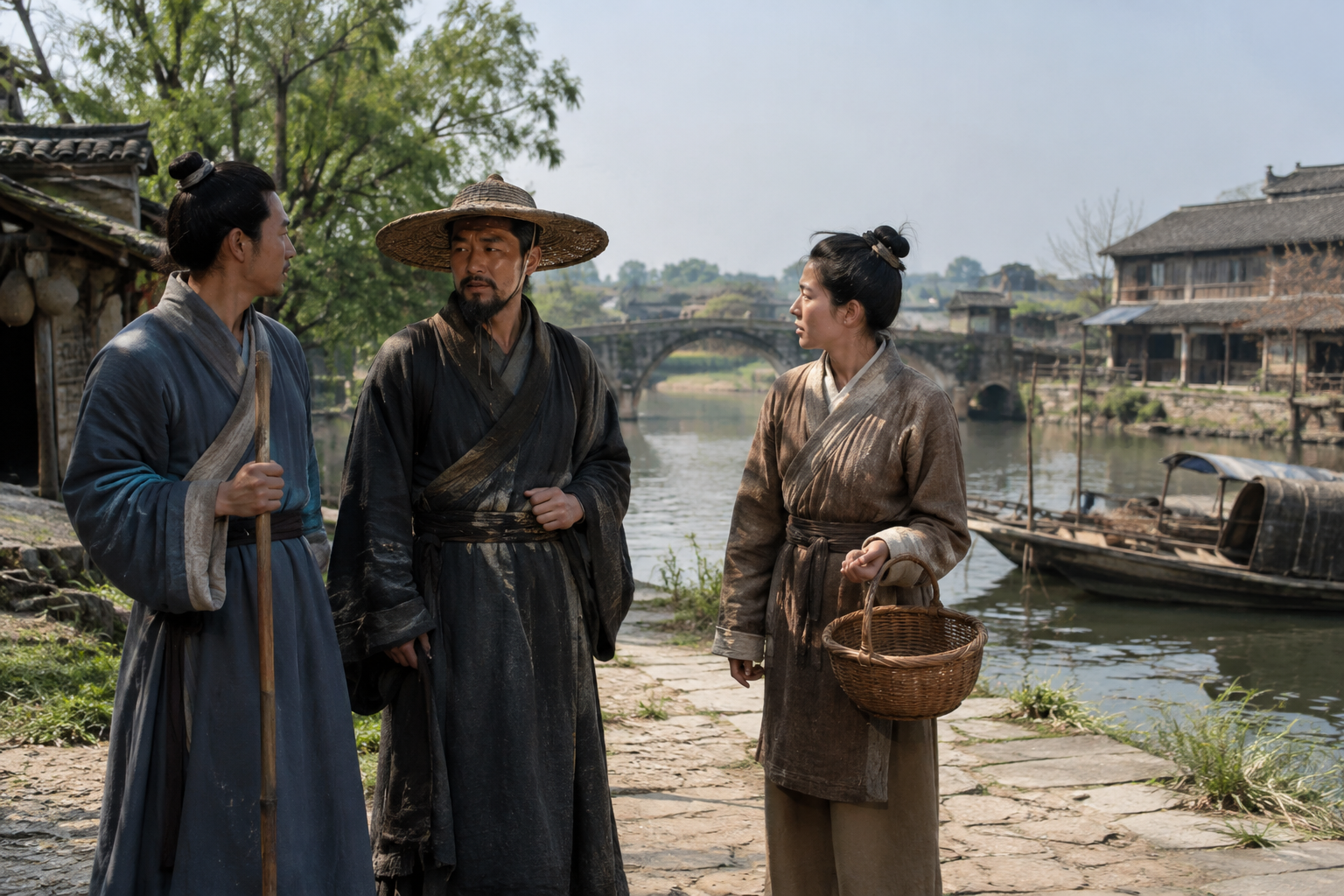
At Qianweigou in Sunhe, China, three men dated to around AD 1600 stand out not because they were buried with spectacular objects, but because they give us a very precise glimpse of one paternal line at the end of the Ming and into the Qing transition. The individuals identified as M11N, M9S, and M9N have all been associated here with Y-DNA haplogroup D1a1b1a, placing a usually deep-time discussion of East Asian paternal ancestry into a strikingly recent and historically legible setting.
That matters because D lineages are often discussed in very broad prehistoric terms. Yet these Qianweigou men remind us that a Y-chromosome branch is not only an ancient survival from some remote population history. It is also a living social fact in historical communities, carried by real people in a real landscape of villages, families, and dynastic change. A Y-DNA line traces one direct paternal line only, not a person's whole ancestry, but even that narrow thread can be historically revealing.
The most useful thing about the Qianweigou evidence is its repetition. We are not looking at a solitary outlier but at three individuals from the same broad site and period: M11N, M9S, and M9N, each dated around AD 1600 and described as Qing-Ming Dynasty China from Qianweigou, Sunhe. When the same paternal branch appears more than once in such a context, it suggests local continuity of a male line within the community, though not necessarily a close genealogical relationship that can be assumed without explicit kinship testing.
In archaeology, a cluster like this is often more informative than a single glamorous burial. One person can always be exceptional. Three men from the same time and place begin to show us a pattern. That pattern is especially interesting for D1a1b1a because the haplogroup sits within a larger Y-chromosome family whose roots in East Asia are very old, but whose later historical distributions are patchier and often regionally distinctive.
An ancient DNA study on these remains and their wider context appears to be linked to research published on the Qianweigou material. Even without over-claiming details not given here, the presence of three related branch assignments at one late imperial Chinese site is enough to make the paternal story worth pausing over.
Haplogroup D is one of the more unusual major Y-chromosome lineages in Eurasia because its distribution today is comparatively concentrated rather than evenly spread. It is best known from parts of East Asia, especially in populations connected with Tibet, Japan, and some other regions, while being much rarer across most of mainland Eurasia than the giant paternal branches O, C, N, or R. That alone makes any securely dated historical occurrence useful.
But one must be careful here. The article's haplogroup is not haplogroup D in general; it is the narrower branch D1a1b1a. A broad parent lineage can have a deep prehistoric history, yet a particular sub-branch may have its own much later regional story. The Qianweigou individuals therefore should not be turned into shorthand for all carriers of D across East Asia, still less into evidence for one simple migration route.
What they do show is that this branch, or a reported association with it, was present among men in north Chinese historical populations around AD 1600. That is a valuable corrective to the habit of talking about paternal lineages as though they belonged only to prehistory. Here the lineage sits squarely in the world of late imperial China, where communities were already shaped by centuries of state expansion, internal migration, frontier settlement, and local marriage networks.
Around AD 1600, north China was living through the last decades of the Ming and the approach of Qing rule. It was a period of political strain at the imperial level, but ordinary burial grounds often preserve something rather different from court history: continuity in local populations. The men from Qianweigou belong to that quieter but in many ways more durable historical register.
There is a temptation, whenever a haplogroup seems uncommon or distinctive, to attach it to dramatic ethnic labels or frontier identities. That would be rash. The Qianweigou sample labels place these individuals in a Ming-Qing context at Sunhe; they do not by themselves prove tribal affiliation, linguistic identity, or immigrant status. What the evidence supports is more modest and more interesting: by the early modern period, paternal lines linked with D1a1b1a were part of the human reality of communities in this region.
This is one of the broader lessons of archaeogenetics. Great empires may standardize administration, taxation, and law, but they do not erase the layered histories carried in village cemeteries. Male lines can persist through dynastic collapse, conquest, and cultural change, surviving not as abstract markers on a phylogenetic tree but through generations of fathers and sons living locally grounded lives.
For many MyTrueAncestry users, the instinct is to look for the oldest possible occurrence of a haplogroup. Age is important, of course, but it is not everything. A very ancient single sample can tell us that a lineage existed somewhere long ago. A small historical cluster, by contrast, can begin to show how that lineage functioned within an actual settled population.
M11N, M9S, and M9N do exactly that. They show recurrence at one site and in one time horizon. That recurrence raises sensible historical questions: was this paternal branch established locally for generations? Was it one among several male lines in the burial ground? Did it belong to a socially ordinary stratum of the community rather than an elite one? Those questions cannot all be answered from the sample labels alone, but the cluster gives us the right scale of inquiry.
It also highlights the importance of East Asian ancient Y-chromosome research more generally. As more studies refine paternal branches across time, lineages once treated as static become historical actors with changing regional footprints. Readers who want the wider East Asian background to paternal-line movements may find a useful companion piece in the post below.
East Asian Y-chromosome migrations
There is also a pleasingly practical side to this evidence. A haplogroup article can easily drift into grand narratives of origins and dispersals, but most people encounter Y-DNA because they want to understand family history. The Qianweigou men bring the scale back down. They were not mythic founders. They were historical individuals in a named place, in a period close enough to written history that many readers can imagine the texture of the world around them.
That is why a late imperial Chinese context matters for D1a1b1a. It suggests that if your own paternal line falls within this branch, your story may not be best approached only through very ancient population prehistory. It may also have chapters in the more recent demographic history of East Asia: settlement, local continuity, regional branching, and the ordinary persistence of lineages through turbulent centuries.
Another relevant comparison comes from work on elite and kinship structures in historical China. That does not make the Qianweigou men elites, but it does show how ancient DNA is increasingly able to illuminate family organization and paternal continuity in Chinese archaeological contexts.
The clearest supported insight from these samples is simple: D1a1b1a is not just a branch with deep East Asian roots in the abstract. It is a lineage documented here in multiple men from Qianweigou, Sunhe, around AD 1600, showing that this paternal thread formed part of the population history of historical China. For someone researching this haplogroup today, that is a useful anchor point: not a royal claim, not a complete ethnic identity, but a real archaeological foothold in a named community and period.






Comments