Haplogroup B2b1a1

– 4 min read


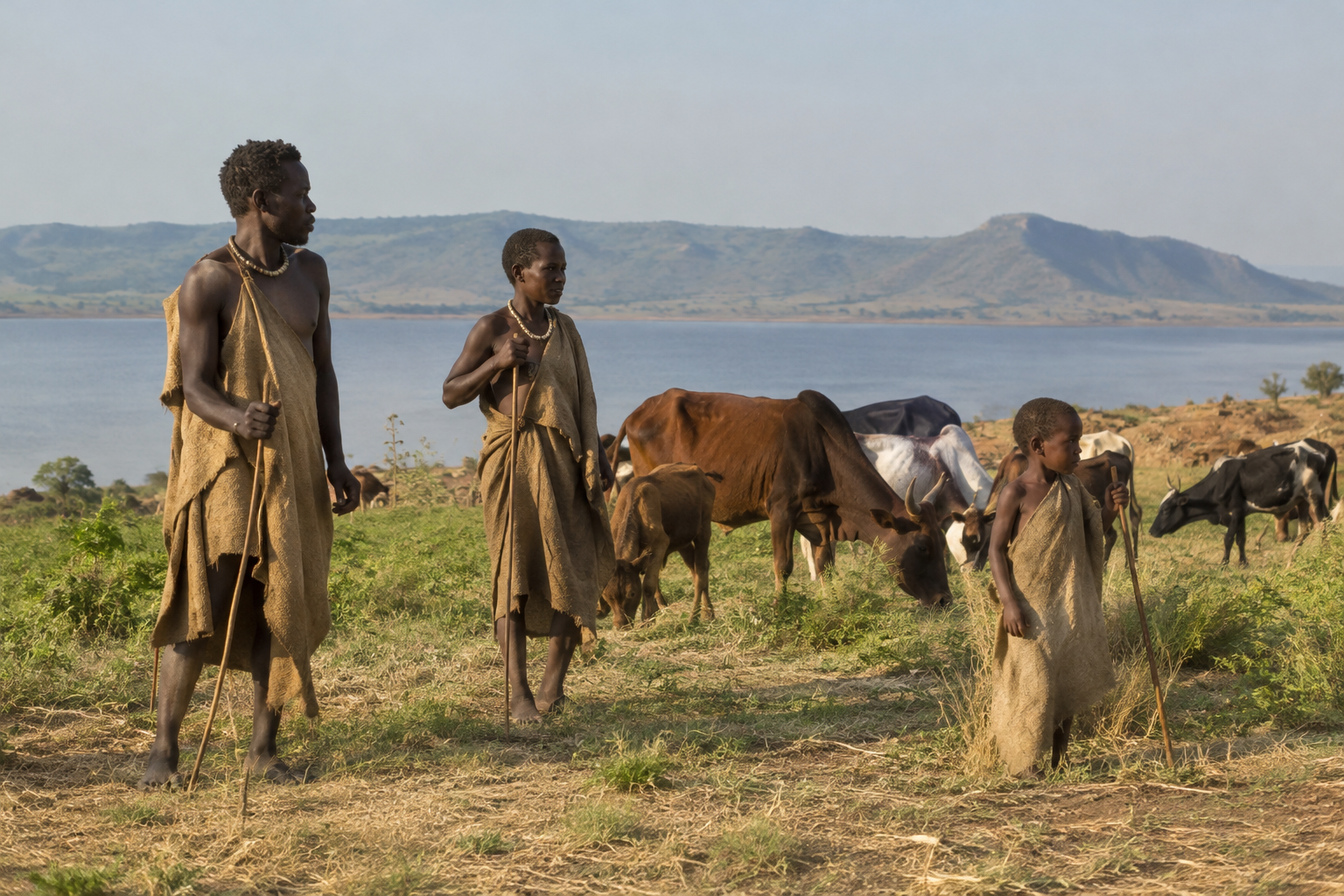
One of the clearest ancient signposts for haplogroup B2b1a1 comes from eastern Africa rather than from a king's tomb or a famous monument. The sample I4427, identified as an Ancient Malawi Pastoralist and dated to around 4000 BC, anchors this branch in a very early archaeological landscape shaped by herding, mobility, and local adaptation. That matters because B2b1a1 sits within a deeply African Y-chromosome tradition, and ancient finds of this sort are far more informative than later mythmaking.
For anyone researching this lineage today, the important point is simple: Y-DNA follows one direct paternal line only. It does not describe all of a person's ancestry. But when a lineage like B2b1a1 turns up in an early pastoral context in Malawi, it gives us something unusually valuable - a real human case, in a real place, at a very early date.
Sample I4427 belongs to a prehistoric setting long before the better-known states and trading systems of later African history. Around 4000 BC, communities in parts of eastern and south-central Africa were negotiating major changes in subsistence and movement. The label "pastoralist" is already telling: this was not simply a foraging world frozen in time, but one in which livestock and new social practices were beginning to matter.
That makes I4427 especially interesting for B2b1a1. Instead of encountering this paternal branch only in present-day testing, we see it associated with an ancient person living in a period when herding lifeways were part of a wider reorganisation of society. An ancient DNA study of this broader regional history, published in Scientific Reports, helped bring such early African individuals into focus and showed how genetics can illuminate population history well beyond the usual Eurasian heartlands of archaeogenetic storytelling.
It is tempting to treat every haplogroup as if it had a neat migration arrow attached to it. Real evidence is messier, and therefore more interesting. B2 is an African Y-chromosome macro-lineage with considerable antiquity, but the narrower branch B2b1a1 should not automatically be credited with every pattern known for the larger parent group. What I4427 gives us is firmer and more modest: proof that a paternal line associated with this branch was present in ancient Malawi in a very early pastoral setting.
That kind of evidence changes the scale of the story. Instead of asking only where the branch is found today, we can ask what sort of communities carried it in prehistory. In this case, the answer points toward people living through an important economic transition, when livestock, seasonal movement, and contact between neighbouring groups were likely central features of life.
In African archaeology, those transitions are often more revealing than later ethnic labels. Ancient DNA does not turn a prehistoric burial into a named tribe known from far later texts. What it can do is place a paternal line inside a documented archaeological horizon. For B2b1a1, that horizon currently looks early, African, and tied at least once to pastoral lifeways in the Malawi region.
The wider significance of I4427 lies in geography as much as in chronology. Malawi sits in a region connected to broader eastern African networks of movement, exchange, and ecological adaptation. Early herding did not spread into all landscapes in the same way, nor did it involve a single homogeneous people marching neatly southward. Archaeology increasingly shows mosaics: local communities adopting new animals and practices at different tempos, sometimes alongside older subsistence strategies.
So when a Y-lineage such as B2b1a1 appears in this context, it suggests continuity of African paternal diversity within those changing worlds, not the replacement of everything that came before. That is a crucial corrective to older grand narratives that treated pastoralism as if it always arrived with a single biological package. Ancient genetics now lets us see that population history and cultural change were related, but not identical.
Africa, Settlement, and Disease
This is also why African ancient DNA is so important for the public understanding of the past. For decades, the global story of archaeogenetics was heavily weighted toward Europe and western Asia. Finds like I4427 remind us that eastern and south-central Africa have equally deep population histories, and that their paternal lineages deserve to be discussed on their own terms rather than only as background to other continents.
There is another useful historical lesson here. Haplogroup B2b1a1 is older than the named polities, clans, and language communities that dominate written history. That means no responsible article should leap from an ancient Malawi pastoralist directly to a modern ethnic identity, still less to a royal genealogy. The evidence does not work like that.
What it does show is that one direct paternal line now carried by some modern testers has roots in an African prehistoric setting of considerable antiquity. That alone is significant. In practical terms, it places B2b1a1 among lineages participating in a very old human story in eastern Africa, one that predates ironworking states, medieval trade networks, and colonial frontiers by millennia.
Seen in that light, I4427 is not a thin data point but a historical anchor. The sample helps rescue B2b1a1 from the abstractness of a haplotree and returns it to a human scale: an actual man, in ancient Malawi, living in a community shaped by livestock and landscape around 4000 BC.
How Ancient DNA Rewrites History
At present, the strongest ancient clue for B2b1a1 is not a dynasty but a prehistoric pastoralist from Malawi. That is a rather splendid thing in itself. It suggests that this paternal branch belongs to a deep African heritage and that at least one early carrier lived in a community participating in the spread or maintenance of herding in eastern Africa.
For a modern tester, that does not provide a ready-made ethnic label or a heroic family saga. It provides something better: a credible connection to the very old population history of Africa, grounded in archaeology and strengthened by ancient DNA. B2b1a1 is, in other words, a lineage with roots in one of the continent's early pastoral worlds - and that is already a remarkable inheritance.






Comments