Haplogroup A1b1b

– 6 min read


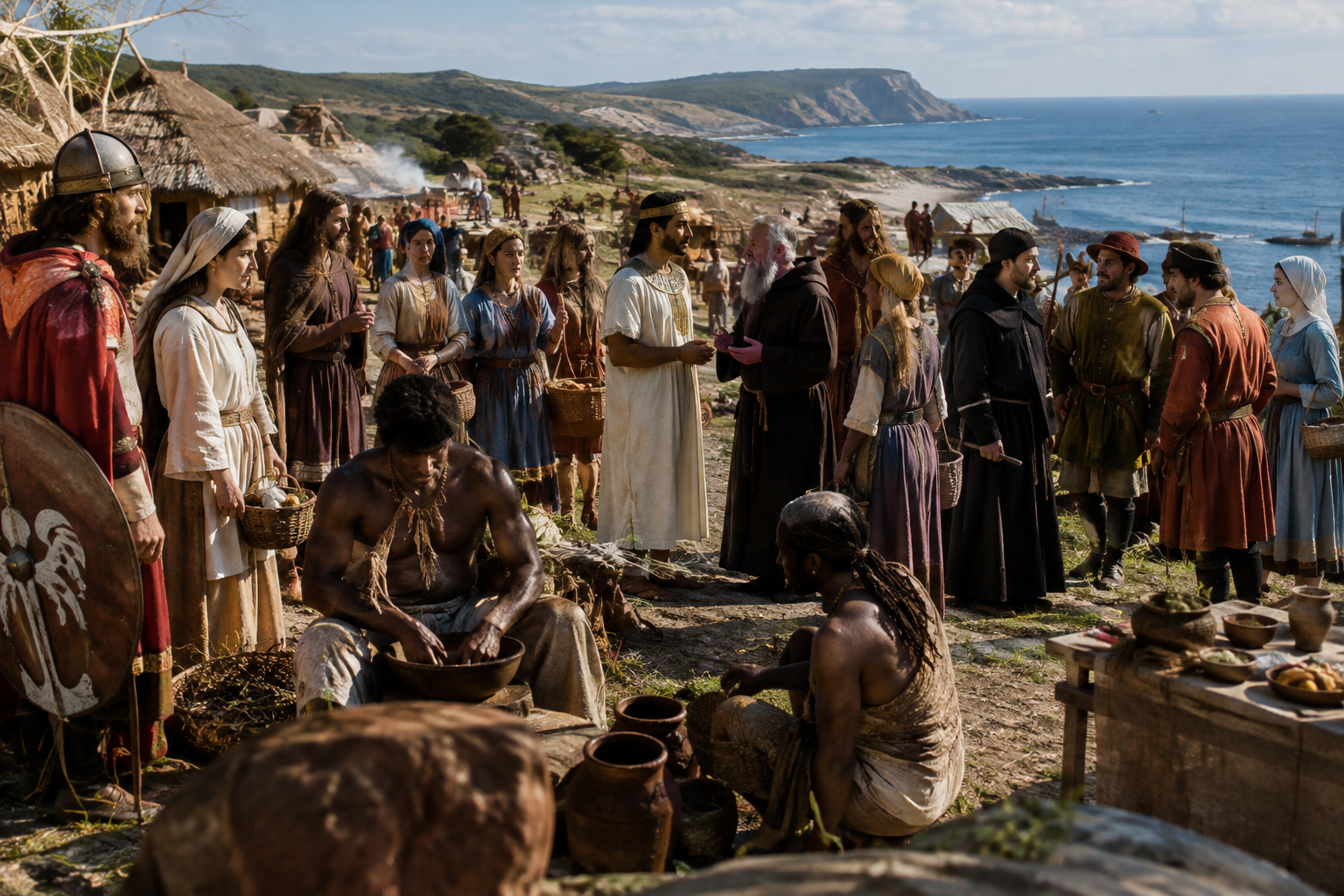
Haplogroup A1b1b is the sort of Y-chromosome lineage that reminds us, rather sharply, that paternal ancestry does not obey the neat borders of later kingdoms, languages, or modern identities. It is a lineage of deep human antiquity, one that appears in ancient DNA from Africa but also turns up, in the supplied evidence, in burials scattered across Europe and the Mediterranean. That alone makes it historically interesting: not because it lets us slap a single label on the men who carried it, but because it shows how long, how tangled, and how surprising paternal history can be.
A Y-DNA haplogroup traces one direct paternal line only: father to son, back through time. It is not a summary of a person's whole ancestry, culture, or ethnicity. In the case of A1b1b, that warning matters especially. This is a very ancient branch within the wider Y-chromosome tree, and the ancient samples associated with it stretch across very different places and periods. Rather than a tidy tale of one people marching from one homeland to another, what emerges is something more interesting: fragments of a long-lived paternal lineage moving through hunter-gatherer worlds, early farming societies, Iron Age communities, Roman-era ports, and medieval towns.
Broadly speaking, haplogroup A belongs among the deepest branches of the human Y-chromosome tree, with especially ancient associations in Africa. That much is well established in the wider study of human paternal diversity. But one must be careful here: the history of the broad parent haplogroup is not automatically the history of every narrow sub-branch in every region. For a specific designation like A1b1b, the responsible approach is to follow the evidence where the ancient samples actually take us.
And the evidence supplied here is striking. Some of the earliest anchors come from southern Africa, including several men from Ancient Oakhurst, Western Cape, South Africa: OAK003_B0101 and OAK003_B0103 dated to 4400 BC, OAK003_C0103 dated to 4200 BC, OAK012_A0101 dated to 3700 BC, and OAK014_A0101 plus OAK014_A0103 dated to 3400 BC. Alongside them stand other African finds such as baa001 from Ballito Bay, South Africa dated to 110 AD, I9133 from Iron Age South Africa Nuwehoop dated to 75 AD, and I9028 from Hunter Gatherer South Africa dated to 150 BC.
These are not footnotes. They place this paternal lineage in some of the deepest recoverable layers of African population history and remind us that any later appearance of related paternal branches beyond Africa has to be read against that much older background.
The real fascination begins when the map broadens. One of the supplied European anchor points is I7010 from Mesolithic Belgium, Grotte de la Faille du Burin, dated to 6750 BC. Then come Neolithic and later prehistoric samples from central and western Europe: TR94 and TR113 from Neolithic Germany Trebur Grossgartach dated to 4800 BC, AD172, AD188, and AD197 from Neolithic Germany Baden Wuerttemberg Altendorf dated to 3050 BC, and WB13a1, WB13b2, and WB17c1 from Late Neolithic Germany Nordrhein Westfalen Warburg dated to 3000 BC. There is also I13627 from Neolithic Belgium Trou Al-Wesse dated to 3203 BC and SCH004 from Le Cres Neolithic France dated to 4300 BC.
What do these tell us? Not that Europe was somehow "an A1b1b continent" - nothing so crude. Rather, they show that paternal lineages assigned at this level were present in multiple prehistoric settings, including early farming contexts. Ancient DNA has made it increasingly clear that Neolithic Europe was not a monoculture in genetic terms. Communities could be locally rooted, mobile, and surprisingly varied all at once.
The Iron Age and classical Mediterranean world add another layer. PSD4, from Piceni Italic Sirolo Numana, Iron Age Ancona, Italy, dated to 650 BC, places this lineage in an Adriatic Italic context. THE006, from Ancient Egypt Luxor, III Intermediate Period, dated to 690 BC, opens a Nile-side chapter. I28503, from an Ancient Carthage Outlier, Tunisia, dated to 387 BC, and I22114 from Roman Era Sardinia Tharros dated to 297 BC, show how this paternal branch appears again in the wider Mediterranean, in places connected by trade, war, migration, and empire.
There is even f1R, a Roman Pompeii Vesuvius Victim, Casa del Fabbro, dated to 79 AD. Pompeii, frozen by catastrophe, often tempts us into imagining a single Roman "type." Ancient DNA keeps spoiling that fantasy. Roman towns were busy, mixed, and open to movement. A paternal lineage like A1b1b appearing there fits that wider picture of Mediterranean complexity.
Explore Ancient Italian Islands
If prehistoric and classical samples show breadth, the early medieval material shows persistence. In the migration-period zone of central and eastern Europe we find RKF119 and RKF252 from Migration Period Hungary Rakoczifalva dated to 650 AD, and HNJ001 from Pannonian Hungary Hajdunanas, also dated to 650 AD. Nearby in the wider post-Roman world are I41200 from Gothic Grave Aul of Kan Omurtag Bulgaria Han Krum Village dated to 400 AD, OBM016 from a Sarmatian Outlier Germany Obermoellern dated to 500 AD, and several 5th-century burials from Saxony-Anhalt, including BRC064x, BRC038x, DRH047, DRH049, OBM050, OBM003, BRC018x, and DRH028.
That is not the pattern of a single tribe jealously guarding one paternal signature. It is, instead, the pattern of lineages appearing across frontier societies where Roman institutions, mobile war bands, local communities, and immigrant groups overlapped. The same can be said for PC1004 and PC1005 from the Late Roman Period Poland Carpathian Foothills Boczne, dated to 350 AD, and for Skoki_S51 from the Kingdom of Poland Skoki Wielkopolska Vovoidship dated to 1400 AD.
Northwestern Europe offers another cluster. Medieval England is represented by ATP_PSN_935 from Cherry Hinton dated to 1055 AD, ATP_PSN_497 from Cambridge Benet Street dated to 1250 AD, ATP_PSN_504 and ATP_PSN_524 from Augustinian Friars dated to 1290 AD and 1340 AD, and ATP_PSN_1203 from Late Medieval England Clopton, Cambridgeshire dated to 1561 AD. In Belgium, the Sint-Truiden series - ST0146, ST1054, ST2023, ST2076, ST2104, ST2263, and ST0067 - tracks the lineage through medieval urban life.
For readers interested in how such mixed post-Roman communities worked, the Gothic and frontier world makes an illuminating comparison.
What, then, has all this to do with Sicily and the House of Branciforte? The answer is geographical and historical context, not a certificate of direct descent. The supplied family material places us at Castello di Mazzarino in central Sicily, a castle that grew out of the medieval world of Norman and later feudal rule and became closely tied to the Branciforti family. Built on a commanding height, it watched routes and countryside alike, and over time it shifted from a hard military stronghold into a residence shaped by changing politics and taste.
That description captures Sicily beautifully because Sicily has never been just one thing. Greek, Arab, Norman, Spanish, and Italian layers all meet there, sometimes uneasily, sometimes fruitfully. A lineage like A1b1b fits that wider historical lesson rather well. The island's noble houses emerged in a landscape already ancient, already peopled by communities connected to the wider Mediterranean for millennia.
We do have Mediterranean comparanda in the supplied ancient DNA: I22114 from Sardinia, I28503 from Carthage, THE006 from Luxor, f1R from Pompeii, and PSD4 from Iron Age Italy. None of them proves that the Branciforti paternal line was A1b1b. None of them can bridge the gap between an ancient burial and a documented noble pedigree on its own. But together they do place Sicily's later aristocratic world inside a far older web of Mediterranean movement.
That is where castles help. Not genetically, of course. A castle cannot yield a pedigree merely by standing on a hill. But strongholds like Castello di Mazzarino preserve the memory of where power settled, how lordship worked, and how families rooted themselves in landscapes shaped by much earlier peoples. In that sense, the ruins of Mazzarino are companions to ancient DNA: both are fragments, both are incomplete, and both force us to think in long stretches of time.
Read About the House of Branciforte
The supplied evidence for A1b1b suggests a paternal lineage with deep African roots and an unexpectedly broad archaeological footprint. It appears in ancient southern African hunter-gatherer contexts, in Neolithic Europe, in Iron Age Italy, in Egypt and Carthage, in Roman Pompeii, and across medieval Europe. That does not make all these men one people. It makes them evidence that paternal history is often older, wider, and less obedient to later identities than written history might lead us to expect.
For family historians, that is both humbling and thrilling. A Y-DNA haplogroup can connect your direct paternal line to large historical processes - migrations, local continuities, frontier mixing, urban growth, and the long afterlife of ancient populations. But it cannot, by itself, prove descent from a noble house, a named tribe, or a castle-owning dynasty. What it can do is place your paternal line in a much bigger human story.
Readers interested in Sicily's especially complex population history may want to continue with medieval and island-focused evidence.
If you carry haplogroup A1b1b, or a related paternal branch, MyTrueAncestry can help you explore how your DNA compares with ancient individuals such as PSD4 from Iron Age Italy, THE006 from Luxor, or the Oakhurst men of ancient South Africa. Those matches do not automatically prove direct genealogical descent or membership in any noble family, but they can offer a remarkable window into the deep history of your paternal line.






Comments