Genetic Diversity and Early Admixture in Gothic-Associated Communities of Late Antique Bulgaria
– 6 min read


Gothic Communities in Late Roman Bulgaria: A Genetic and Archaeological Study
This comprehensive study examines two late Roman cemeteries in modern Bulgaria through the lens of ancient DNA analysis, revealing that "Goths" in the Balkans were not a single biological people migrating south from Scandinavia. Instead, Gothic identity emerges as a broad, flexible cultural label shared by men and women of strikingly different origins who were buried with similar ornaments, following the same religious practices, and identified under the same Gothic name in historical texts. The analysis of 38 individuals from these cemeteries demonstrates how Gothic affiliation functioned as a political and religious framework rather than an ethnic bloodline.
The rise and fall of ancient peoples left marks not only on the landscape but also in our genes. If you’ve ever wondered how your ancestry fits into that larger historical mosaic, MyTrueAncestry.com offers a fascinating perspective.
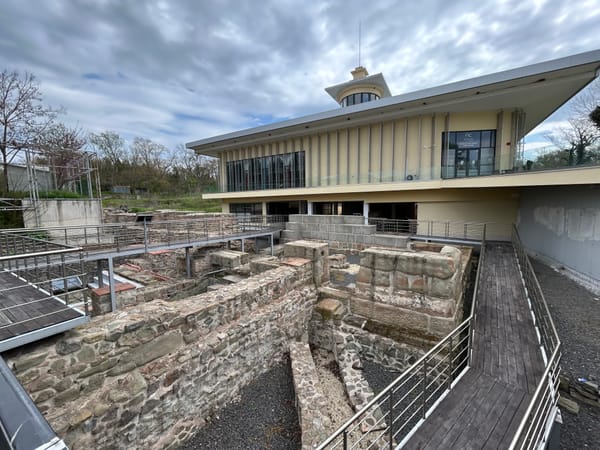
The research focuses on two sites closely tied to Gothic history in Bulgaria. Aquae Calidae, located beside ancient Roman thermal baths in Thrace, contains graves that cut through earlier Roman structures, suggesting a new community establishing itself in an older landscape. The cemetery is mentioned by late antique authors as a haunt of "barbarian villagers" and shows characteristic Gothic material culture including fibulae, belt sets, beads, and Arian Christian burial orientations.
The second site, the Aul of Khan Omurtag in Moesia Secunda, represents an extensive Arian Christian complex with four basilicas and successive cemeteries spanning over a century. This episcopal center, possibly connected to the Gothic bishop Ulfilas, contains burial phases from the pre-Hunnic period through the era of Hunnic domination to the years following the battle of Nedao in 454 CE.
Both locations display unmistakably Gothic archaeological signatures: characteristic brooches, specific grave goods, east-west burial alignments associated with Arian Christianity, and in some cases, artificially deformed skulls indicating status and identity markers common among Late Antique groups. Yet genetic analysis reveals two completely different population clusters, demonstrating that Gothic material culture did not correspond to a single shared ancestry.
The genetic analysis reveals remarkable diversity within these supposedly homogeneous Gothic communities. At Aquae Calidae, individuals fall into distinct genetic groups: one strongly connected to central Anatolia and the eastern Mediterranean, carrying Y-chromosome lineages common in Anatolia and the Near East, while another shows connections to the Wielbark and Chernyakhov cultures north of the Danube. The cemetery's overwhelmingly male composition, with approximately six men for every woman, suggests a military or garrison community.
Particularly striking individual cases illustrate this diversity. One man shows approximately half his ancestry related to Levantine and Egyptian populations with a Near Eastern Y-chromosome lineage, yet lies in a standard Gothic-style grave with Christian orientation. Another individual combines a Near Eastern paternal line with a maternal lineage tracing to sub-Saharan Africa. These examples demonstrate that Gothic identity could encompass people of widely varying geographic and ethnic origins.
At the Aul of Khan Omurtag, the genetic picture changes dramatically over time. Early burial phases show strong connections to northern Gothic populations, with Y-chromosomes typical of Baltic and Scandinavian regions. However, successive cemetery phases reveal a gradual shift: northern ancestry components diminish while Balkan and Anatolian ancestry increases. By the final phase, Y-lineages are entirely Anatolian or Near Eastern in character, though mitochondrial DNA remains consistently Balkan, suggesting male newcomers integrating with local female populations.
The chronological analysis provides crucial insights into when these populations first mixed. By examining DNA patterns as a molecular clock, researchers estimate that major admixture between northern Wielbark-like groups and southern Balkan-Anatolian populations occurred approximately 11-13 generations before the burials, centering around 50 CE with a range from late 1st century BCE to early 2nd century CE.
This timing predates the first historically documented Gothic-Roman agreements south of the Danube in the later 2nd century, suggesting that genetic mixing creating these composite frontier communities was already underway long before formal Gothic settlements in the Balkans. The research connects this early mixing to the Roman conquest of Dacia after 106 CE, where colonists from Anatolia and the Balkans established mixed populations that later encountered Wielbark-associated groups expanding southward.
When Rome abandoned Dacia in the 270s, these mixed frontier populations, bound by marriage, service, and religion to Gothic political structures, likely moved into the Balkans. This migration pattern explains why Gothic communities in Bulgaria already displayed such genetic diversity by the 4th and 5th centuries.
Detailed kinship analysis reveals interesting patterns in these Gothic communities. The study identifies nine pairs of close relatives through shared DNA segments, almost all found within the Aul of Khan Omurtag complex across multiple cemetery phases. Significantly, no close kinship links exist between the two sites despite their similar burial customs and religious practices, indicating that Gothic cultural practices spread independently of family networks.
At Aquae Calidae, mitochondrial DNA analysis shows that among 20 individuals, each carries a different maternal lineage—no two people share the same maternal line. This pattern suggests a community assembled from diverse maternal origins rather than a tight-knit migrant clan, fitting expectations for a military or frontier population drawing recruits, followers, spouses, and perhaps slaves from across the Roman and post-Roman world.
The contrast between changing paternal lineages and stable maternal lineages runs throughout both sites. Y-chromosomes show large compositional shifts over time, particularly at the Aul of Khan Omurtag, where northern-associated lineages gradually give way to Anatolian and Near Eastern types. Meanwhile, mitochondrial DNA remains stable and rooted in local Balkan lineages, suggesting male-biased migration and integration patterns.
The evidence strongly supports an ethnogenesis model of Gothic identity formation. Rather than representing a single ethnic group with shared ancestry, Gothic communities in Late Antique Bulgaria functioned as cultural and political frameworks that incorporated diverse populations through shared language, law, alliances, and particularly through Arian Christianity, which provided their distinctive religious identity within the empire.
Individual biographies recovered from graves illustrate this process dramatically. One man from the Aul of Khan Omurtag carries a Y-chromosome type most closely related to modern Buryats and Mongols, with approximately 6-7% East Asian ancestry overall, yet was buried in a Gothic Arian Christian cemetery with standard funerary rites. Another individual carries the classic Scandinavian-associated I1 Y-chromosome but shows heavily mixed ancestry with large portions of Roman-Byzantine and Anatolian genetic components.
These cases demonstrate that Gothic burial practices could encompass warriors whose paternal lines reached back to Scandinavia, the Mongolian steppe, or the Near East, while their overall genetic makeup reflected the complex demographic history of the late Roman frontier. A shared Gothic identity in death, as in life, transcended biological ancestry.
This research fundamentally challenges traditional models of barbarian migration and ethnicity in Late Antiquity. The Gothic communities examined here were not homogeneous tribal groups maintaining distinct biological identities, but rather cosmopolitan frontier societies united by political allegiance, religious practice, and cultural expression rather than shared descent.
The findings reveal a late Roman Balkans characterized by remarkable mobility and integration. At Aquae Calidae, Gothic-identified individuals included people with ancestry tracing to the eastern Mediterranean, Africa, and beyond. At the Aul of Khan Omurtag, generations of intermarriage transformed a initially northern-dominated community into one genetically indistinguishable from local Anatolian and Balkan populations, while maintaining Gothic Christian identity throughout.
The study demonstrates that ethnic labels like "Goth" in Late Antiquity functioned as powerful integrative mechanisms, allowing diverse populations to unite under shared political, religious, and cultural frameworks. These communities represent successful examples of ethnogenesis—the historical process by which new ethnic identities emerge from the integration of previously distinct groups.
The genetic and archaeological evidence from these Bulgarian cemeteries reveals that Gothic identity in the late Roman period was fundamentally cultural rather than biological. The individuals buried at Aquae Calidae and the Aul of Khan Omurtag shared Gothic material culture, Arian Christian beliefs, and political allegiances, but came from remarkably diverse ancestral backgrounds spanning northern Europe, the Balkans, Anatolia, the Near East, Africa, and Central Asia.
This diversity was not accidental but reflects the nature of frontier societies in Late Antiquity, where military service, political alliance, religious conversion, intermarriage, and social mobility created new forms of identity that transcended traditional ethnic boundaries. The Gothic communities studied here represent successful examples of integration and adaptation in the complex political landscape of the late Roman Empire.
Rather than viewing the Goths as a single people maintaining distinct ethnic identity through migration, this research suggests we should understand them as participants in a broader process of cultural and political reorganization that characterized the transformation of the Roman world. Gothic identity provided a framework for unity and belonging that could accommodate remarkable diversity, offering insights into how ethnic identities form and persist in complex historical circumstances.
The implications extend beyond Gothic studies to broader questions about ethnicity, migration, and identity in the ancient world, demonstrating how genetic evidence can illuminate historical processes that remain invisible in traditional textual and archaeological sources alone.
Original source article: https://www.biorxiv.org/content/10.64898/2026.03.03.709317v2.full
Discover how your DNA connects to ancient civilizations at www.mytrueancestry.com.

Comments